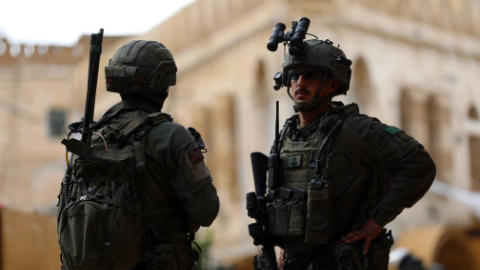

Israeli Forces Secure Key Streets in Hebron for Settlers Amid Persistent West Bank Tensions
Hebron, West Bank – Israeli security forces have taken control of several streets in the divided city of Hebron to facilitate safe passage for Israeli settlers, a move highlighting the fragile security dynamics in one of the most contentious areas of the Israeli-Palestinian conflict. The operation, reported on January 11, 2026, underscores ongoing frictions between settlers, Palestinian residents, and military personnel in the West Bank.
According to reports from Xinhua, Israeli forces secured streets specifically for Israeli settlers in Hebron, a city long marked by ideological and territorial disputes. The action reflects routine yet intensified security measures in the area, where settler movements often require military escort due to the risk of clashes. This incident was logged as a medium-severity civil unrest event, signaling elevated but not critical tensions as of early Sunday local time.
Hebron, known to Muslims as Al-Khalil, is the largest city in the West Bank and home to approximately 200,000 Palestinians alongside a few thousand Jewish settlers. The city has been split since the 1997 Hebron Protocol under the Oslo Accords, dividing it into H1 (under Palestinian Authority civil and security control) and H2 (under Israeli military control, encompassing settler enclaves and surrounding Palestinian neighborhoods). Streets secured by Israeli forces typically include routes like Shuhada Street, which has been a flashpoint for decades. Palestinians have long complained that such closures restrict their movement, while Israeli authorities cite them as necessary protections against potential attacks.
This recent securing of streets comes amid a broader context of unrest in the West Bank. Since the escalation of violence following the October 7, 2023, Hamas attacks on Israel and the subsequent Gaza war, the West Bank has seen a surge in settler violence, Palestinian attacks, and Israeli military raids. According to United Nations data up to late 2025, over 700 Palestinians and more than 30 Israelis were killed in the territory that year alone, with settlements at the epicenter. International observers, including the UN Office for the Coordination of Humanitarian Affairs (OCHA), have documented hundreds of incidents involving settler attacks on Palestinian property and vice versa.
Israeli officials maintain that such security deployments are defensive responses to threats. The Israel Defense Forces (IDF) regularly patrols H2 to protect settlers living in four main enclaves: Kiryat Arba, adjacent to Hebron; and intra-city settlements like Avraham Avinu, Tel Rumeida, and the Jewish neighborhood near the Cave of the Patriarchs (also called the Ibrahimi Mosque). The Cave of the Patriarchs, revered by Jews as the burial site of Abraham and other biblical figures and by Muslims as a mosque, remains a symbolic and physical divide, with separate access points enforced since the 1994 massacre of 29 Muslim worshippers by settler Baruch Goldstein.
Palestinian authorities and residents view these military actions as exacerbating daily hardships. The Hebron Rehabilitation Committee, a local NGO, has repeatedly highlighted how street closures and checkpoints impede access to markets, schools, and hospitals for Palestinians in H2. In recent years, settler expansions and home demolitions have fueled protests, sometimes met with Israeli crowd-control measures including tear gas and live fire.
The timing of this event aligns with seasonal sensitivities. January often sees increased settler marches and religious commemorations in Hebron, drawing larger crowds and necessitating bolstered security. While no immediate clashes were reported in connection with the street securing on January 11, the medium-severity classification by monitoring platforms indicates a potential for escalation if not managed carefully.
Background on Hebron Tensions
Hebron's status traces back to the 1967 Six-Day War, when Israel captured the West Bank from Jordan. The first Jewish settlers returned post-1967, establishing footholds amid international condemnation. The international community, including the UN Security Council via Resolution 2334 in 2016, deems Israeli settlements in occupied territories illegal under international law, though Israel disputes this, citing historical and security claims.
Efforts at de-escalation, such as the Temporary International Presence in Hebron (TIPH) observer mission established in 1997, ended in 2019 when Israel declined to renew its mandate. Since then, bilateral security coordination between Israel and the Palestinian Authority has continued, but trust remains low amid political stalemates.
Data from the Palestinian Ministry of Health and Israeli sources show a pattern: In 2024-2025, West Bank violence reached levels not seen since the Second Intifada (2000-2005), with settler population growth—now over 500,000 across the West Bank—adding pressure.
Outlook
As Israeli forces maintain their positions in Hebron, both sides brace for potential spillover. Palestinian leaders have called for international intervention to curb settler activities, while Israeli Prime Minister Benjamin Netanyahu's government has prioritized settlement security. With stalled peace talks and regional conflicts simmering, incidents like this street securing serve as microcosms of the unresolved Israeli-Palestinian divide. Monitoring groups urge restraint to prevent broader unrest, but history suggests persistent volatility in Hebron.
(Word count: 712)






