Israel War Continues With Near-Daily Gaza Attacks Eight Months After Ceasefire
Eight months after a ceasefire between Israel and Hamas, the Israel war features Israeli forces conducting near-daily attacks on Gaza, where they now occupy over 60 percent of the territory, while Norway’s foreign minister warns that Israel is losing international friends due to its military actions in Gaza, Lebanon, Syria and Iran.
Current Situation in Gaza
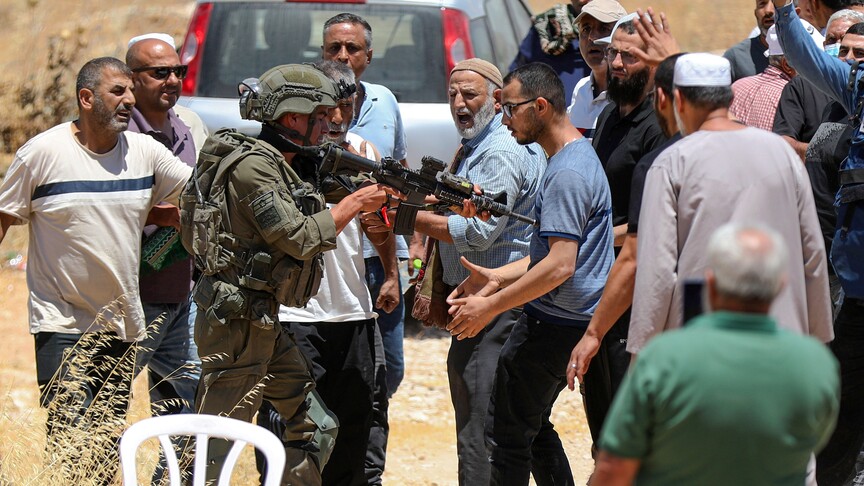
Eight months have passed since Israel and Hamas reached a ceasefire agreement on the Gaza Strip, yet the enclave continues to face near-daily attacks. Nearly 1,000 people have been killed and 3,000 wounded since the ceasefire took effect. Israeli forces occupy more than 60 percent of Gaza, confining 2.2 million Palestinians to an ever-shrinking area. Nearly 73,000 Palestinians have been killed in Israeli attacks on Gaza since October 2023. No reconstruction is underway despite the passage of time. The members of the Palestinian committee tasked with overseeing reconstruction under a proposed plan have not even entered the Gaza Strip and remain in Egypt awaiting access, while Hamas maintains full control on the ground. [1]
Conditions remain dire for the population, with residents confined amid ongoing military presence and no visible progress on rebuilding efforts. The absence of reconstruction leaves basic infrastructure unrepaired, compounding the challenges faced by those living in the territory. Israeli occupation of more than 60 percent of the area continues to restrict movement and access for the 2.2 million Palestinians. [1]
Norwegian Foreign Minister’s Assessment
Norwegian Foreign Minister Espen Barth Eide describes conditions in Gaza as a crisis, noting that residents live in tents amid rats, with extreme cold in winter and intense heat in summer. He states that people are no longer being killed on a daily basis and are not starving to death, yet the overall situation qualifies as a full crisis. Eide points out that President Donald Trump’s so-called Board of Peace and promised reconstruction have not materialized. [1]
Eide observes that Israel does not comply with UN resolutions and that the international community appears unable to address the country’s ongoing violations of international law. He warns that Israel is losing friends through its warfare against the Palestinians and its attacks in Lebanon, Syria and Iran, describing this development as dangerous for the country in the long term. [1]

Israeli attacks continue in Gaza eight months after ceasefire with over 60 percent of territory occupied. — Source: thenewarab
International Reactions and Shifting Opinion
Actions by several countries reflect growing criticism of Israeli policies. Italy’s Prime Minister Giorgia Meloni has adopted increasingly tough language toward Israel. France has denied entry to key members of Prime Minister Benjamin Netanyahu’s government. The EU has imposed sanctions on a number of violent settlers and organizations supporting them. Norway, along with the United Kingdom and France, added further settlers to its sanctions list this week. [1]
A Gallup poll earlier this year showed for the first time that more Americans sympathize with the Palestinians than with Israel. Eide notes that dissatisfaction with Israel’s warfare and U.S. military support is increasing even among those on the far right, though he stresses the importance of preventing any rise in antisemitism. He clarifies that criticism of the state of Israel is not the same as antisemitism. [1]
Developments Involving Iran
Israel’s Defense Minister Israel Katz states that the war against Iran is far from over. The military remains prepared to strike Iran with great force, according to Katz. [2] [3]
These statements come amid continued regional tensions, with Katz emphasizing that operations against Iran have not concluded. The defense minister’s remarks underscore Israel’s readiness for further military action in that theater. [2] [3]
{IMAGE_3}
Impact of the War on Lebanon
One hundred days into Israel’s war on Lebanon since 2 March, the toll has surpassed 14,000 killed or wounded. More than 1,300 people have been killed and over 3,700 wounded after the November 2024 ceasefire. Between 2 March and 9 June, 3,666 people were killed, including 247 children and 56 elderly, while 11,321 were wounded. Among those killed and wounded were 516 Syrians, 219 Palestinians and 153 people of other nationalities. [4]
Israeli attacks during this period heavily targeted the health sector, killing 131 healthcare workers and wounding 392. Seventeen hospitals were damaged, three were closed, 170 ambulances were damaged, 37 centres were targeted and 168 attacks on ambulance teams were recorded. Military personnel also faced targeting, with 29 members of the Lebanese Army, three members of the Internal Security Forces, one General Security officer, 13 State Security personnel and one member of the Parliament police killed since 2 March. [4]
Four journalists were killed while carrying out their work, including Amal Khalil, who was left bleeding for hours before dying on 22 April after Israeli forces prevented paramedics and the Lebanese army from reaching her. Ahmed Hariri was killed in an airstrike on 22 May while working as both a paramedic and journalist. Al-Manar TV journalist Mohammed Sherri was killed on 18 March. At least one million people have been displaced, most from southern areas where Israel occupies and controls around 68 villages by fire. [4]
More than 5,400 housing units have been destroyed and more than 5,300 others damaged since 2 March, with the total number of housing units destroyed or damaged exceeding 61,000. More than 10 villages have been destroyed. Preliminary estimates indicate economic losses exceeding $20 billion. [4]
Norway’s Recognition of Palestine
Norwegian Foreign Minister Espen Barth Eide maintains that Norway and Spain’s recognition of Palestine two years ago was the correct decision. He notes that 157 of the UN’s 193 member states have now recognized Palestine as an independent state. Eide argues that such recognition acknowledges the limits of peace diplomacy when one party refuses to negotiate, yet he believes these steps will ultimately benefit Israel by encouraging it to exit its wars. [1]
What to watch next: Further statements from Espen Barth Eide on whether additional European countries adopt similar positions on recognition and sanctions, alongside updates on reconstruction committee access to Gaza and any new military actions reported by Israel’s defense minister.