Israel and Hezbollah Agree to Ceasefire as US-Iran Deal Faces Strain
Israel and Hezbollah agreed to a ceasefire effective at 4 p.m. local time on Friday, following deadly exchanges in Lebanon that strained a US-Iran memorandum of understanding signed days earlier to end the wider Middle East conflict amid the Iran war. [1] [2]
Ceasefire Agreement Between Israel and Hezbollah
Israel and Hezbollah agreed to a ceasefire on Friday after deadly exchanges between the two sides in Lebanon put a deal to end the Middle East war under strain less than two days after it was signed. [1] The ceasefire is scheduled to take effect at 4 p.m. local time on Friday. [2] Mediation efforts led to the breakthrough, with two regional officials and a US official informing about the ceasefire which was brokered through mediation by Qatar, the United States and Iran. [2] A senior Israeli official confirmed that Israel and Hezbollah were in a ceasefire as long as Hezbollah does not attack Israel. [2] The official also said that Israel would keep its forces in southern Lebanon where it has occupied an area along Israel's northern border. [2] A senior Israeli official and two Hezbollah sources confirmed the ceasefire to Reuters. [3] “If Hezbollah does not attack us, then for us it is not a time of war,” the Israeli official said. [3] Israeli forces would remain in southern Lebanon, the official added. [3] The senior U.S. official told Reuters that the ceasefire was worked out by negotiators for the U.S. and Qataris with help from Iran. [3] “Hezbollah and Israel have agreed to a ceasefire,” the U.S. official said. [3] “We understand that after the exchange of fire earlier today, Israel and Hezbollah are now in a ceasefire.” [3]
Impact of Recent Violence on the Truce
Nearly an hour after the truce was meant to take effect, a Reuters journalist in northern Israel said Israeli strikes could still be seen taking place across the border in Lebanon. [3] A plume of smoke rose from behind a Lebanese village near the frontier. [3] Israeli airstrikes had killed at least 47 people in Lebanon since midnight, the Lebanese health ministry reported. [3] Israel reported four of its soldiers killed in south Lebanon in one of the deadliest Hezbollah attacks of the war. [3] Israel said it carried out strikes targeting Hezbollah operatives and infrastructure across several areas in response to repeated Hezbollah ceasefire violations. [3] Hezbollah denied it had violated the ceasefire and accused Israel of repeatedly violating truce terms, including the terms of the U.S.-Iran agreement. [3] A statement from the group accused Israeli forces of carrying out attacks that killed civilians, destroying homes and infrastructure, and continuing its ground incursions. [3] Heavy fighting overnight was concentrated in an area north of the Litani River known as Ali al-Taher hill – high ground strategically important to Hezbollah where Israeli forces had sought to advance, a senior Lebanese security source said. [3] Hezbollah said its fighters ambushed an Israeli force advancing near the hill, destroying three Merkava tanks with guided missiles and targeting troops with rocket and artillery fire. [3] Hezbollah said it later attacked Israeli forces that had sought to enter the area to retrieve casualties. [3] Israel has seized a self-declared security zone in the south, saying it aims to shield northern Israel from Hezbollah attack. [3] Its forces have been razing villages in the south where they say Hezbollah has embedded itself. [3] Hezbollah has continued to launch attacks on Israeli positions in the south this week, including with explosive drones that have killed and injured troops. [3] Lebanon’s health ministry has recorded 3,912 people killed in Lebanon as a result of Israeli attacks since March 2, including 746 medics, women and children. [3] Israel’s death toll from this round of hostilities with Hezbollah includes at least 32 soldiers and four Israeli civilians. [3]
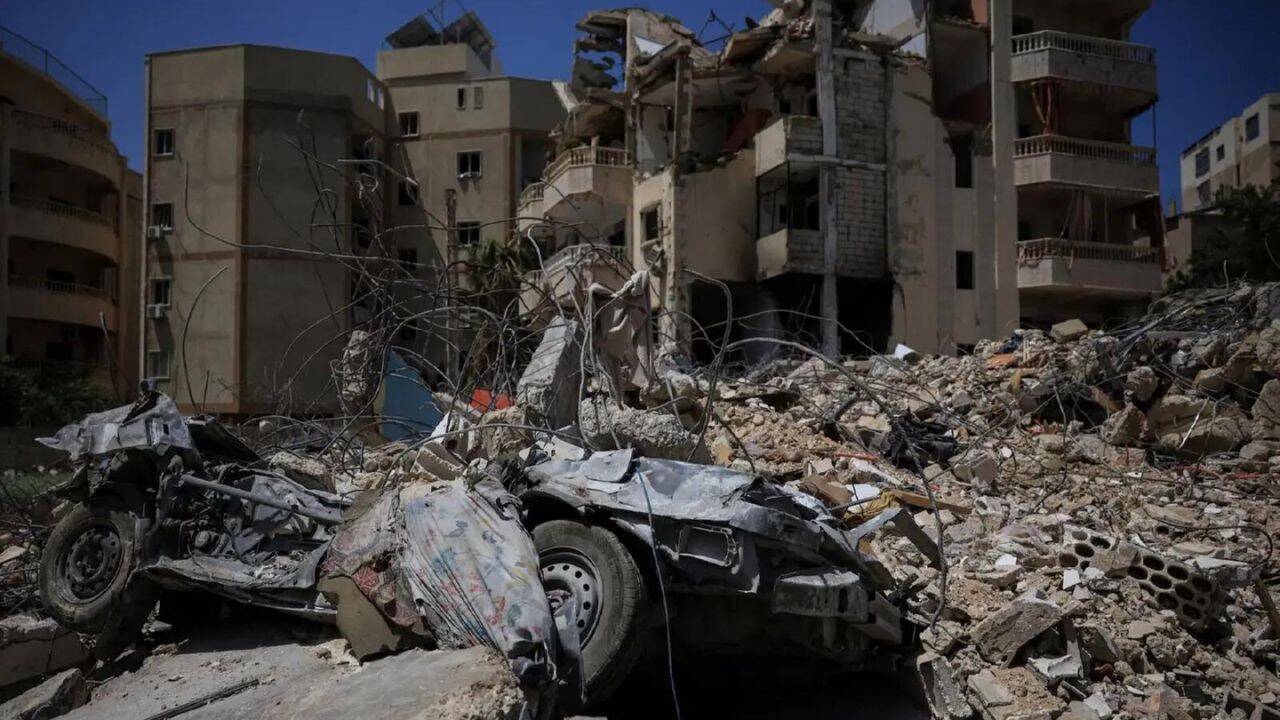
Israel and Hezbollah ceasefire takes effect after deadly exchanges in Lebanon. — Source: timesofindia
US-Iran Memorandum of Understanding
The Iran deal requires the United States, Iran, and their allies to declare an immediate and permanent termination of military operations on all fronts, including Lebanon. [3] The Memorandum of Understanding, which ostensibly ends the four-month war between the US and Iran, illuminated the profound US defeat. [4] The MOU’s commitments include immediate termination of military operations including in Lebanon. [4] The US and Iran “refrain from the threat or use of force against each other.” [4] Mutual respect of US and Iranian sovereignty. [4] The US and Iran commit to negotiating a final agreement within 60 days, although this timetable can be extended by mutual consent. [4] The US and regional partners will develop a $300 billion plan for reconstruction and economic development in Iran. [4] The mechanism for implementation is to be finalized within 60 days. [4] The US commits to “terminate all types of sanctions against the Islamic Republic” including United Nations sanctions. [4] The US will fully remove its naval blockade within 30 days and will remove its forces “from the proximity of the Islamic Republic within 30 days after the final deal.” [4] Iran will engage in dialog with the Sultanate of Oman “to define the future administration of maritime services in the Strait of Hormuz in discussion with other Persian Gulf littoral states in line with the applicable international law” and rights of coastal states. [4] Iran “reaffirms that it shall not procure or develop nuclear weapons” as was its stated policy before the war. [4] Additionally, under International Atomic Energy Agency supervision, its current stocks of highly enriched uranium will be blended down, and enrichment for “Iran’s nuclear needs” will be agreed in the final deal. [4] Pending the final deal, Iran will maintain the status quo of its nuclear program, and the US will not impose any new sanctions or deploy additional forces to the region. [4] US lifts naval blockade of Iran: The US military said it had ended its naval blockade of Iranian ports as part of the agreement with Tehran to suspend military operations during negotiations. [5] US Central Command (CENTCOM) said all blockade enforcement efforts have ceased and US forces are no longer restricting maritime traffic to or from Iran. [5]
Reactions from Iranian and US Officials
Senior Iranian official says Iran humbled its enemies: Mohsen Rezaei, an adviser to Iran’s supreme leader, hailed what he called Iran’s “victory” in the war, saying the country had “shattered” its enemies’ dominance. [5] In a post on X, he described the conflict as an “epic” that would endure in history, while also mourning senior leaders killed in the war and saying “vengeance” was the only remedy for their deaths. [5] Ghalibaf warns against US violations of MoU: Iran’s chief negotiator and parliament speaker, Mohammad Bagher Ghalibaf, said Tehran would not tolerate any breach of the memorandum of understanding by Washington. [5] In a post on X, he warned that any “bad faith, breach of contract, and excessive demands” would be met with a “crushing response”, adding that Iran’s adversaries had already been “slapped” during the war and would face an even harsher response if they repeated their actions. [5] Vance backs US-Iran deal as Washington ends blockade and Iran hails wartime gains. [5] United States Vice President JD Vance has delayed his planned trip to Switzerland to start a new round of peace talks with Iran following the signing of a memorandum of understanding (MoU) to end the war, the White House has said. [5] Vance earlier defended the agreement between Washington and Tehran amid criticism from US officials and Israel, saying the signing of an MoU has launched a 60-day negotiating period towards a final deal. [5] Schumer attacks Trump over deal: Democratic Senate Minority Leader Chuck Schumer said the US is “worse off because of Trump’s incompetence, his ego, and his inability to listen to facts”. [5] Schumer rejected claims that Democrats would support any funding for Iran, saying, “Democrats will not be helping Trump send $300bn to Iran.” [5] Critics of the memorandum have alleged it includes $300bn for Iran’s reconstruction, but Trump and senior US officials deny any US funds will be provided, saying any investment would come from Iran’s neighbours and other participating countries. [5] Trump administration defends Iran deal: Reporting from Washington, DC, Mike Hanna says Republican hawks have also criticised the MoU, arguing that Tehran has received too many concessions, particularly the immediate waiver of sanctions on Iranian oil exports. [5] The Trump administration rejected that criticism, saying it is acting in US interests. [5]

Israel and Hezbollah ceasefire takes effect in Lebanon after deadly exchanges. — Source: cyprusmail
Strain on US-Israel Relations
Israel, which was not consulted in the negotiations that led to this week’s U.S. memorandum of understanding with Iran, has bristled at the apparent requirement that it halt its campaign in Lebanon, which it invaded after Hezbollah fired across the border in solidarity with Tehran on March 2. [3] The Israeli official said Israel had the freedom to act against emerging threats and threats to its forces and territory. [3] Earlier, Israeli Prime Minister Benjamin Netanyahu had vowed to “extract a very heavy price” from Hezbollah for the killing of the four soldiers. [3] Israeli officials have voiced anger at the U.S.-Iran pact, saying it does not go far enough to address Israeli concerns over Iran’s nuclear programme. [3] US warns Israel to comply with Lebanon terms: US Vice President JD Vance delivered what Al Jazeera’s Mike Hanna described as “very strong” messages to Israel, amid criticism from Israeli officials and pro-Israel groups over the Iran deal. [5] Hanna said the memorandum makes clear that Lebanon is part of the agreement and that Israel must halt military operations there, a provision that has drawn pushback from some pro-Israel lawmakers. [5] The Trump administration, however, is defending the inclusion of Lebanon in the deal. [5] US-Israel relationship faces strain over Iran deal: Political analyst Harlan Ullman says there is a “great split” between US President Trump and Israeli Prime Minister Benjamin Netanyahu over the deal. [5] “Netanyahu is furious. He’s out to break this deal,” Ullman told Al Jazeera, describing the relationship as increasingly “volatile” and “dangerous”. [5] While Netanyahu has avoided publicly attacking the agreement, Ullman said the Israeli leader sees it as a threat to his political future before the October elections. [5] “By Trump calling out Netanyahu, by saying that he, Trump, controls all the shots, it’s giving rise to support an opposition candidate to Netanyahu when the elections come this fall,” Ullman said. [5]
Broader Regional and Global Implications
On the subject of the relative decline of US power and influence, the impacts of the war on world energy supplies—especially in Asia—will reinforce political and economic pressures for alternative—non-fossil—energy sources. [4] China is already light years ahead of the US in clean energy production technologies, while President Donald Trump thinks only in the very short term as he maximizes oil and gas production and exports while attempting to revitalize filthy coal mining. [4] Bottom line: The US loss in this totally avoidable imperial war of choice was severe. [4] Perhaps like the “decent interval” with which the Nixon administration sought to minimize the domestic political costs of the US defeat in Vietnam, by dragging out negotiations and agreeing to a remarkably vague framework, President Trump hopes to minimize the impacts of his lost war on the November midterm elections. [4] The escape clause that allows for the extension of negotiations beyond the 60-day timeline should prepare us for a long, difficult, and drawn-out process. [4] And in true Trumpian form, despite the commitment to “refrain from the threat or use of force against each other,” within hours of the MOU’s release, our president threatened to resume bombing if he was not satisfied with the outcome of negotiations. [4] With 1,000 Gazans having been killed since the declaration of that ceasefire, and with Israeli Prime Minister Benjamin Netanyahu more concerned with winning his nation’s October election and staying out of jail, the US ability to enforce the termination of Israeli military operations in or its occupation of its northern neighbor is in doubt. [4] Iran’s confirmation that it will it not procure or develop nuclear weapons is nothing new. [4] That was the case before President Trump withdrew from the Joint Comprehensive Plan of Action nuclear agreement negotiated by President Barack Obama and was reiterated numerous times by Iranian leaders before the Trump-Netanyahu regime change attempt, which resulted in a harder-line government. [4] Like Japan, South Korea, Sweden and Poland, Iran will remain a threshold nuclear state, and the MOU allows for enrichment for medical and power generation use, as Iran has insisted for years. [4] But Trump’s defeat will reverberate globally. [4] Elites in many nations will be taking a North Korean lesson from this and the Ukrainian wars: If you have nuclear weapons, nuclear weapons states won’t attack you. [4] Diplomatically, between this globally disastrous war, Trump’s total disregard of allies in launching and fighting the war, the US cessation of military aid to Ukraine and its inability to facilitate either a ceasefire or peace negotiations in that war, the Euro-Atlantic alliance is on life support and solidarity among US people and Europeans is but a memory. [4] And as we look to possible future crises, Europeans are overestimating Russia’s military power and are racing to create a European Union superpower—either within or independent of NATO. [4] Then there is the lesson from the Iran war for the US-Chinese competition for Asia-Pacific regional hegemony. [4] The failure of Trump’s Iran war illuminated US-Chinese dynamics and realities at play over the last decade or more. [4] As enumerated in the Quincy Institute’s webinar with military analysts Brandon Carr, Jennifer Kavanagh, and Kelly Grieco, the war demonstrates that the US is not in a position to militarily defend Taiwan, nor will it be able to credibly threaten to defeat China in a non-nuclear war. [4]
What to watch next: The escape clause that allows for the extension of negotiations beyond the 60-day timeline should prepare observers for a long, difficult, and drawn-out process, with Iran’s drones and missiles establishing area deniability that China could similarly apply.