
Iran Strikes on Bahrain and Kuwait Prompt Sharp UN Reprimand From US
Iran strikes on Bahrain and Kuwait on Sunday prompted an emergency UN Security Council meeting where US Ambassador Mike Waltz confronted an Iranian diplomat and displayed images of the attacks' aftermath. [1]
UN Security Council Confrontation
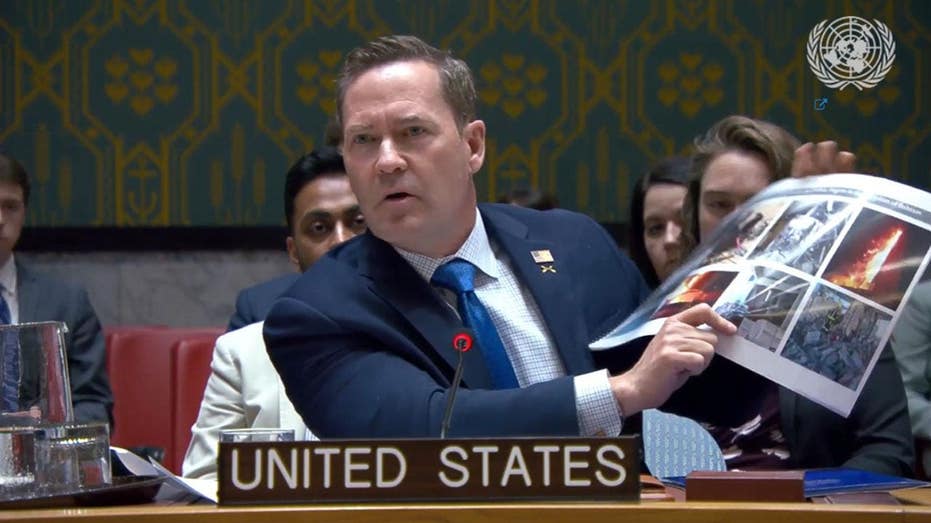
U.S. Ambassador to the United Nations Mike Waltz scolded Iran during this week's UN Security Council meeting, saying Tehran "will not silence" the body following claims by the Islamic Republic's representative that council members were spreading falsehoods about its recent attack targeting neighboring Gulf states. [1] "Let me remind you where you are," Waltz told Iranian diplomat Amir Saeid Iravani. "This is the United States of America. This is the United Nations Security Council. You will not silence this body." [1] Waltz's remarks came during an emergency meeting of the council in response to drone and missile attacks targeting Bahrain and Kuwait on Sunday following new U.S. airstrikes against Iran. [1] During the exchange, Waltz held up what he said were images of the aftermath of the Iranian attacks, including a family whose home in Bahrain was destroyed by a Shahed drone, a hotel full of tourists that was also hit, and a building used by first responders that Waltz said was deliberately targeted. [1] "Are they lying?" Waltz said of the victims of the attack. "Is this hypocrisy? Is this what this council is here to denounce today? I ask the representative, are these lies? … I'd say not." [1]
Iranian Response and Denials
During his remarks, Iravani argued that the council should not have met, while accusing the U.S., Bahrain and other members of lying. [1] "Once again, the representative of the United States has resorted to lies and disinformation against Iran in a desperate attempt to justify the US's unlawful acts of aggression," Iravani said. [1] He also rejected the "unfounded accusations made by certain Western members of the Council and the representative of Bahrain." [1] "Instead of addressing the root cause of the current crisis, they have ignored the unlawful aggression committed against Iran and sought to shift blame onto the victim," he added. [1] "Their double standards and hypocritical behavior have deprived them of any credibility to lecture others," Iravani stressed. [1] In a post on X, Waltz reiterated his position. "Iran will not silence us on our own soil," he wrote. "That might work in Tehran, but not in the UN Security Council. We will tell the truth." [1]

Iran begins week of funeral ceremonies for slain Supreme Leader Khamenei. — Source: aljazeera
Bahrain's Account of Attacks
Abdullatif bin Rashid Al Zayani, Bahrain's minister of foreign affairs, said that since Feb. 28, the island nation has been subjected to a total of 808 attacks, comprising 203 ballistic missiles and 605 armed drones. [1] "These attacks deliberately targeted civilian facilities, critical infrastructure and residential areas, resulting in the deaths of three innocent civilians and injuries to 465 others," he said, disputing Tehran's claim that its aggression is directed solely against military objectives. [1] Gulf countries strongly condemned Iran's drone attack on Bahrain as rising tensions threaten the MOU. [1] Firefighters work to extinguish fire in the aftermath of Iranian drone attacks, according to Bahrain's Interior Ministry, at a location given as Bahrain, in this handout image released on June 11, 2026. [1]
Escalation Timeline and US Actions
Washington and Tehran have repeatedly accused each other of violating a fragile ceasefire agreement. [1] On June 27, President Donald Trump said U.S. forces struck Iranian missile and drone storage locations, and coastal radar sites, after Iran violated the deal. [1] The exchanges of fire began when an Iranian drone struck a merchant vessel off Oman last week and the U.S. military retaliated, officials said. [1] "It is very possible that they will never learn! There may come a point when we are no longer able to be reasonable, and will be forced to militarily complete the job that we very successfully started," Trump wrote on Truth Social. [1] "If that happens, the Islamic Republic of Iran will no longer exist!" [1]
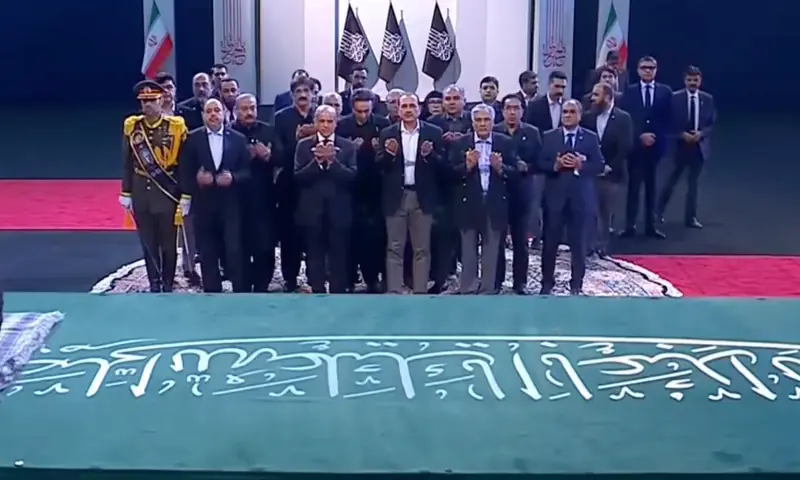
PM Shehbaz and CDF Munir pay respects to Iran's assassinated supreme leader Khamenei. — Source: dawn
Khamenei Funeral Proceedings
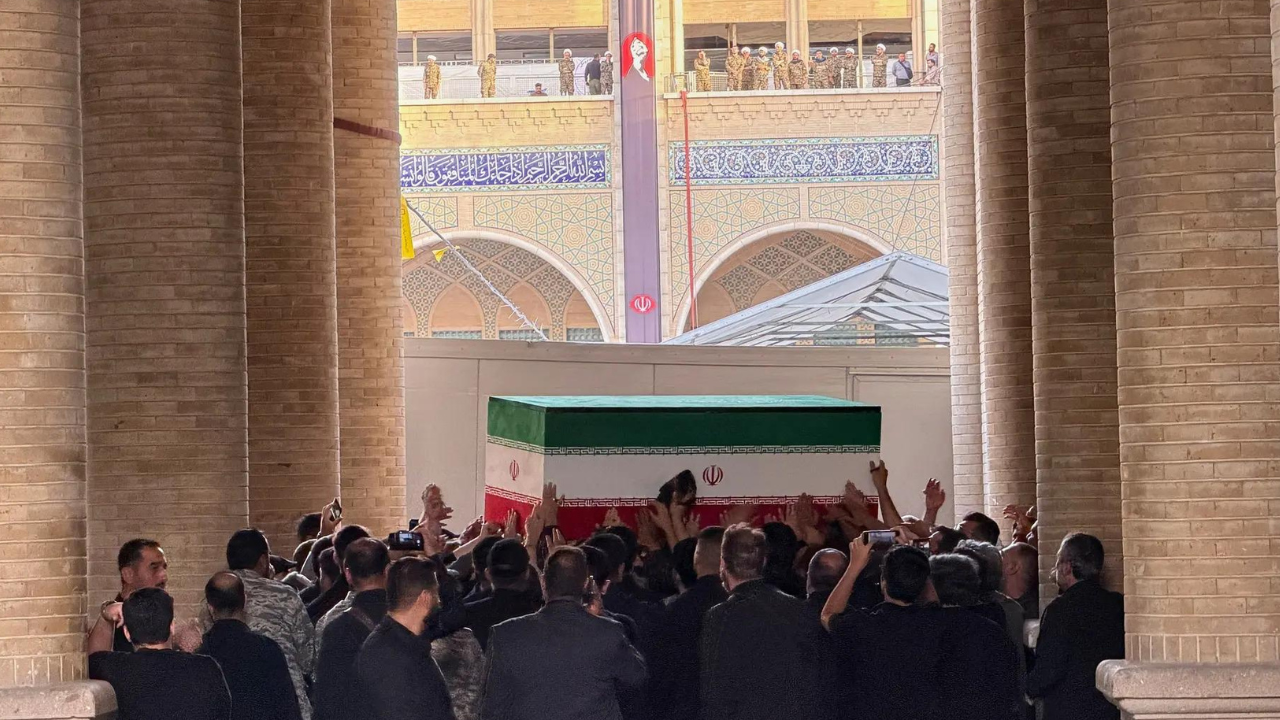
The body of Iran’s late Supreme Leader Ayatollah Ali Khamenei lies in state in a vast hall in Tehran as top Iranian officials and foreign dignitaries pay their respects, marking the beginning of a week of funeral ceremonies. [2] Black-clad mourners carried Khamenei’s coffin aloft at the vast Grand Mosalla religious complex in the capital, Tehran, on Friday, with the casket draped with the national flag of the Islamic Republic that he led for more than three decades. [2] Authorities expect public mourning and grand processions to attract millions before Khamenei’s burial next week, four months after the 86-year-old leader was killed at his compound on February 28, the first day of a joint United States-Israeli war on Iran. [2] Alongside Khamenei’s casket lay those of his three-year-old granddaughter, eldest daughter, son-in-law and daughter-in-law – all killed in the strike on February 28. [2] State TV broadcast footage of Iranian President Masoud Pezeshkian paying his respects at Khamenei’s coffin, alongside the parliament speaker and chief negotiator, Mohammad Bagher Ghalibaf. [2] Ahmad Vahidi, head of the Islamic Revolutionary Guard Corps (IRGC), the ideological arm of the Iranian military, also made his first appearance since the start of the war. [2] Many world leaders are also attending the six days of commemoration, with a public ceremony scheduled on Saturday in Tehran, followed by a procession through holy cities in both Iran and neighbouring Iraq. [2] Al Jazeera’s Resul Serdar Atas, reporting from Tehran, said the government has not invited several European countries to the funeral, and the “attendees were mostly from either neutral or friendly states”. [2] “According to the Foreign Ministry spokesperson, so far more than 50 delegations have already paid their respects to Iran’s late supreme leader,” he said, naming the presidents of Iraq, Tajikistan, Turkmenistan, Georgia, as well as Pakistan’s Prime Minister Shehbaz Sharif. [2] Prime Minister Shehbaz Sharif and Chief of Defence Forces and Chief of the Army Staff Field Marshal Asim Munir on Friday paid their respects to Iranian supreme leader Ayatollah Ali Khamenei, who was assassinated in a US-Israeli strike on February 28. [3] In a statement, PMO said that PM Shehbaz attended the funeral, where he paid “rich tribute” to the assassinated supreme leader. [3] He also expressed solidarity with Ayatollah Mojtaba Khamenei, President Dr Masoud Pezeshkian and the people of Iran in their moment of “national grief”. [3] Iranian authorities expect millions of people to flood the streets of Tehran starting Saturday, in scenes reminiscent of the 1989 funeral of Khamenei’s predecessor, Supreme Leader Ayatollah Ruhollah Khomeini, attended by an estimated 10 million people. [2]
Diplomatic and Security Context
US officials became increasingly concerned that Israel could target Iranian Foreign Minister Abbas Araghchi and Parliament Speaker Mohammad Bagher Ghalibaf on their return to Iran after peace negotiations between Washington and Tehran in Pakistan in April, the report published on Wednesday said. [4] According to the New York Times, Washington was concerned that an Israeli assassination attempt could derail the talks and it asked regional countries to warn Iran about the potential threat. [4] "Any attempt to kill the Iranian leaders would end the talks and reignite the fighting," American officials told the newspaper. [4] While Washington was increasingly focused on securing a ceasefire and a diplomatic framework, Israel remained sceptical of negotiations that fall short of its broader war aims. [4] The New York Times reported that concerns peaked during negotiations that began in earnest in April, when Araghchi and Ghalibaf emerged as key interlocutors in talks aimed at securing a ceasefire and laying the groundwork for a longer-term agreement. [4] On the return journey, Iranian security services informed the aircraft carrying Ghalibaf that intelligence indicated Israel was preparing an attack and that two Israeli fighter jets had entered Iranian airspace from the western border near Iraq, the newspaper reported, citing Iranian officials. [4] The aircraft subsequently made an emergency landing in Mashhad, and members of the delegation completed the journey to Tehran by land, travelling for approximately eight hours, the newspaper said. [4] His funeral, initially delayed at the height of the Middle East war, is taking place as Iran and the US uphold a fragile ceasefire after signing the Islamabad Memorandum of Understanding to halt the conflict. [3]
What to watch next: The remaining days of the funeral ceremonies are expected to draw millions across multiple cities including Qom, Najaf, Karbala and Mashhad, while the fragile ceasefire agreement between the US and Iran continues to hold.