
Earthquake Japan: Powerful Quake Triggers Tsunami Off Coast
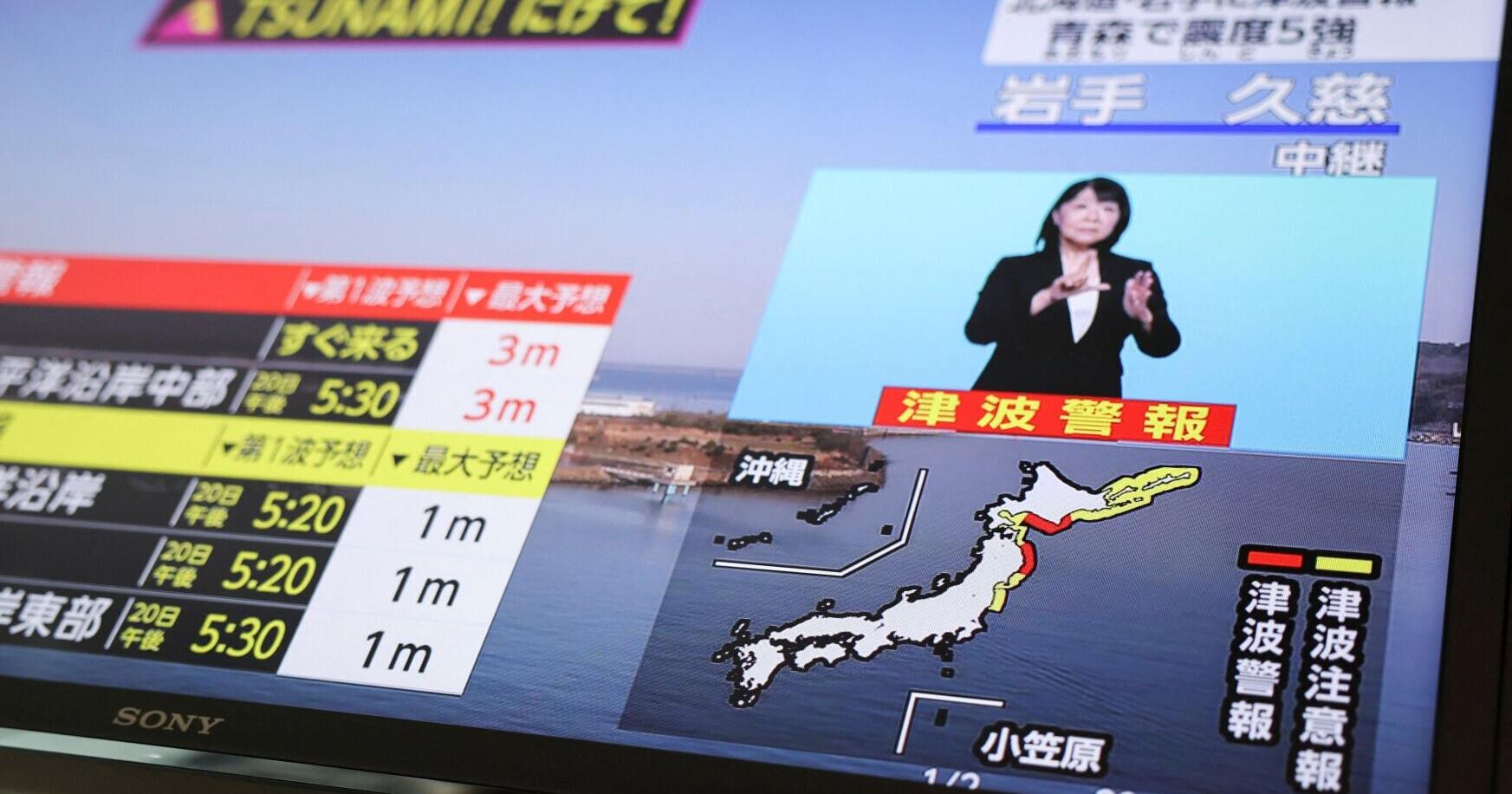
A powerful earthquake off the coast of Japan has triggered a tsunami, marking a significant seismic event in the region.[1] This earthquake Japan development, reported through national news channels, underscores the ongoing vulnerability of Japan's coastal areas to such natural phenomena.[1] The primary quake's impact extends to generating tsunami waves, prompting immediate attention from monitoring agencies.[1] Accompanying this main event are detailed reports of specific tremors, including a 4.8 magnitude earthquake and a 4.0 magnitude event, both detected by authoritative seismic data providers.[2][3] These occurrences highlight the dynamic nature of tectonic activity near Japan, with precise locations and depths providing critical insights into the events' characteristics.[1][2][3]
Overview of the Main Event
The core of this seismic episode centers on a powerful earthquake that has triggered a tsunami off the Japan coast, as captured in national news reporting.[1] This event, disseminated via platforms like GDELT monitoring national news, emphasizes the quake's potency and its direct link to tsunami generation.[1] Published on 20260421T021500Z, the report frames the earthquake as a major incident off the coast, where the energy release was sufficient to displace ocean waters and initiate wave propagation.[1]
In the context of earthquake Japan patterns, such offshore events carry heightened risks due to their proximity to populated coastal zones, though specifics on immediate impacts remain tied to the reported trigger mechanism.[1] The tsunami alert stems explicitly from this powerful quake, positioning it as the primary driver of the broader hazard.[1] National news outlets have spotlighted this connection, ensuring that the public and authorities are informed of the cascading effects from the initial rupture.[1] This overview aligns the main event with the documented seismic disturbances, setting the stage for examining the individual quakes that contribute to the regional picture.[1][2][3]
The significance of the tsunami trigger cannot be overstated within the reported framework; it represents a classic outcome of submarine tectonic shifts, where vertical seafloor displacement imparts energy to the water column above.[1] As per the national news summary, the earthquake's power was key to this process, occurring in a tectonically active zone off Japan.[1] Monitoring such events involves correlating surface observations with subsurface data, and this instance provides a clear example of how a single powerful quake can escalate into a multi-hazard scenario.[1] The publication timestamp indicates real-time awareness, allowing for rapid dissemination to stakeholders.[1]
Details of the 4.8 Magnitude Earthquake
A 4.8 magnitude earthquake struck 107 km ENE of Miyako, Japan, at a depth of 35.4 km, according to USGS data.[2] This tremor, precisely located in the oceanic region northeast of Miyako—a coastal area on Japan's Honshu island—places it firmly offshore, aligning with the broader context of coastal seismic risks.[2] The magnitude of 4.8 denotes a moderate-level event capable of being felt widely, particularly given its relatively shallow depth, which amplifies ground shaking potential compared to deeper quakes.[2]
The location, 107 km ENE of Miyako, situates the epicenter in the Pacific Ocean waters adjacent to Japan, a zone prone to subduction-related activity.[2] Depth measurement at 35.4 km indicates an intermediate crustal penetration, where the rupture likely occurred along a fault interface not too distant from the surface.[2] USGS reporting on this M4.8 earthquake provides these coordinates as essential for modeling wave propagation and potential aftereffects.[2] In relation to the main event, this quake's offshore positioning contributes to the tsunami-triggering narrative, as shallower depths facilitate greater seafloor upheaval.[1][2]
Further analysis of the 4.8 magnitude event reveals its role in the sequence: the precise ENE direction from Miyako underscores a vector pointing into the open sea, minimizing direct land impact but maximizing tsunami generation risks.[2] The 35.4 km depth is noteworthy, as it falls within the range where seismic energy transmits efficiently to the surface, potentially correlating with the reported powerful quake characteristics.[2] This detail from USGS enhances the authoritative tracking of earthquake Japan occurrences, offering data points for seismologists to assess stress accumulation in the region.[2]
Details of the 4.0 Magnitude Earthquake
Complementing the sequence, a 4.0 magnitude earthquake occurred 114 km SE of Shima, Japan, at a remarkably deep level of 327.3 km.[3] Shima, located on the southern tip of Japan's Chubu region along the coast, sees this event positioned southeast in the oceanic expanse, again offshore.[3] The lower magnitude of 4.0 suggests a less intense surface expression, largely attributable to the profound depth, which dissipates much of the energy before reaching the surface.[3]
USGS documentation specifies the 114 km SE offset from Shima, placing the hypocenter well into the mantle transition zone, far beneath the ocean floor.[3] A depth of 327.3 km classifies this as a deep-focus earthquake, typically associated with subduction slabs descending into the Earth's interior, a hallmark of Japan's tectonic setting.[3] Unlike shallower events, this one's deep origin reduces the likelihood of significant ground shaking or direct tsunami causation, but it still registers on global seismic networks.[3]
Examining the 4.0 magnitude details, the southeastern location from Shima aligns with plate boundary dynamics, where the Philippine Sea Plate interacts with the Eurasian Plate.[3] The 327.3 km depth implies a rupture high in the downgoing slab, contributing to the ambient stress field that may influence shallower quakes.[3] This USGS-reported event provides a counterpoint to the 4.8 magnitude tremor, illustrating the vertical extent of seismic activity off Japan.[2][3] Such depth contrasts are crucial for understanding energy distribution in earthquake Japan clusters.[3]
Contextual Seismic Activity
These earthquakes form a interconnected tapestry of seismic activity off Japan, with the powerful main event triggering a tsunami and the specified 4.8 and 4.0 magnitude quakes providing granular data.[1][2][3] National news ties the tsunami to the primary offshore quake, while USGS details flesh out the magnitudes, locations, and depths: 4.8 at 107 km ENE of Miyako (35.4 km deep) and 4.0 at 114 km SE of Shima (327.3 km deep).[1][2][3] This combination reflects a snapshot of heightened activity in coastal-offshore zones.[1][2][3]
The 4.8 magnitude quake's shallower profile complements the tsunami reports, as moderate shallow events offshore can displace water effectively.[1][2] Conversely, the deep 4.0 event at 327.3 km adds to the regional stress profile without direct surface hazards.[3] Both locations—Miyako ENE and Shima SE—straddle key subduction segments, contextualizing the powerful quake's impact.[2][3] GDELT's national news aggregation on 20260421T021500Z captures the urgency, linking these to broader earthquake Japan monitoring.[1]
In this framework, the events underscore layered seismic threats: tsunami from shallow power, subtle deep adjustments.[1][2][3] Cross-referencing sources reveals a cohesive picture, with USGS precision enhancing news overviews.[1][2][3] Such activity patterns inform preparedness, highlighting offshore Japan's perpetual vigilance needs.[1][2][3]
What to watch next: Continued monitoring for tsunami developments from the powerful offshore earthquake, alongside potential aftershocks near Miyako and Shima as per USGS-tracked events.[1][2][3]