
Denmark Issues Stark Warning to U.S. Over Trump's Renewed Push for Greenland Control
Copenhagen, Denmark – Danish Prime Minister Mette Frederiksen issued a forceful rebuke on Monday against U.S. President Donald Trump's repeated calls for American control over Greenland, cautioning that any attempt to seize the territory by force would shatter eight decades of transatlantic security cooperation.
The comments came hours after Trump, speaking on Sunday, emphasized the strategic necessity of U.S. oversight of Greenland, tying the proposal to national security imperatives in the wake of a recent American military operation in Venezuela. Greenland, an autonomous territory within the Kingdom of Denmark, has long been eyed for its vast mineral resources and critical Arctic position, which includes hosting the U.S.-operated Thule Air Base.
Frederiksen's warning underscores the deepening tensions between the NATO allies, with the Danish leader stating that such a move "would destroy 80 years of transatlantic security links." Her remarks were reported widely across European media, highlighting the potential rupture in longstanding defense partnerships forged after World War II.
Europe's Muted Response Amid Heightened Stakes
European reactions to Trump's latest statements have remained notably restrained, according to reports from France 24. While Denmark has taken a firm public stance, broader continental leaders have largely avoided direct confrontation, possibly wary of escalating friction with the United States at a time of global instability.
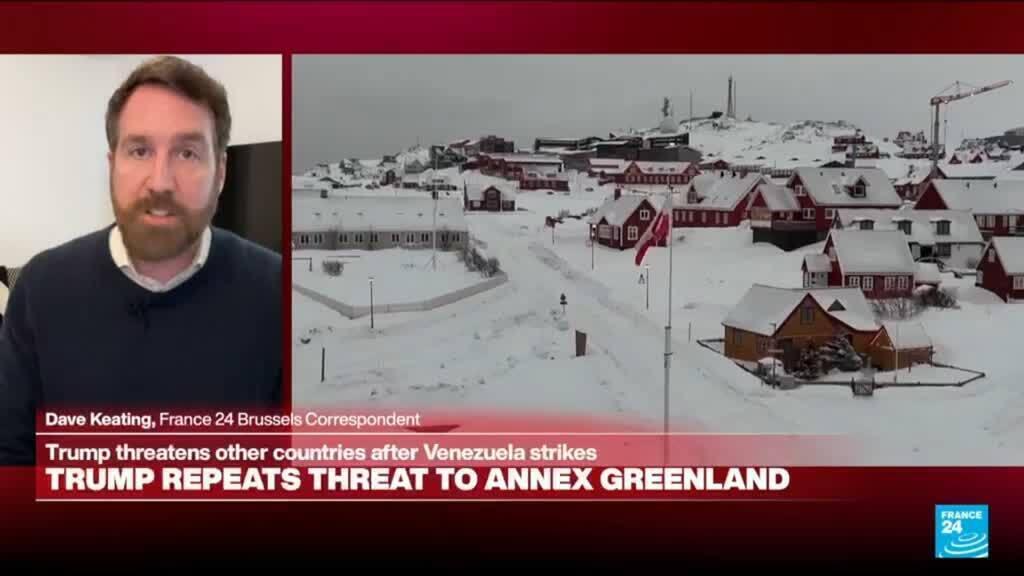
France 24 correspondent Dave Keating noted in his report that the Danish response carries significant weight given Greenland's status. "Denmark's prime minister warned Monday that any US move to take Greenland by force would destroy 80 years of transatlantic security links, after President Donald Trump repeated his desire to annex the mineral-rich Arctic territory," Keating said.
Newsmax echoed this, framing the issue within the context of NATO dynamics: "Denmark's prime minister warned Monday that any U.S. move to take Greenland by force would destroy 80 years of transatlantic security links." The outlet also referenced Washington's recent military intervention in Venezuela, suggesting Trump's Greenland advocacy is part of a broader recalibration of U.S. security priorities in the Western Hemisphere and beyond.
Trump's invocation of the Venezuelan operation – a U.S. military action that began in late 2025 – positions Greenland as a linchpin in countering perceived threats from Russia and China in the Arctic. The region's melting ice has opened new shipping routes and access to rare earth minerals essential for technology and defense industries.
Historical Context of U.S. Interest in Greenland
Trump's renewed interest revives a saga that dates back to his first term. In 2019, he publicly floated the idea of purchasing Greenland from Denmark, prompting Frederiksen to famously declare it "absurd." The overture was shelved amid backlash, but strategic imperatives have persisted.
Greenland, with a population of around 56,000 mostly Indigenous Inuit, operates with significant self-governance under Danish sovereignty since 1953. The island hosts Thule Air Base, a key U.S. missile warning and space surveillance facility established during the Cold War. Under a 1951 defense agreement, the U.S. maintains operational control of the base, but Denmark retains ultimate authority over Greenlandic territory.
The Arctic's geopolitical value has surged in recent years. Russia has militarized its northern frontier, while China invests heavily in infrastructure and mining. NATO's 2022 Strategic Concept identified the High North as a vulnerability, prompting increased allied focus. Denmark, as a NATO founder, contributes through its Arctic Command in Nuuk, Greenland.
Frederiksen's government has invested in Greenland's autonomy, including a 2021 election where pro-independence parties gained ground. Any U.S. action could inflame local sentiments and complicate Denmark's balancing act between Western alliances and Arctic stewardship.
Implications for NATO and Transatlantic Ties
The exchange highlights frictions within NATO, where Denmark contributes 2% of GDP to defense spending and participates in missions from the Baltic to Afghanistan. A forceful U.S. bid for Greenland could strain Article 5 collective defense commitments, especially as Europe grapples with the ongoing war in Ukraine and energy dependencies.
U.S. officials have not yet responded to Frederiksen's comments, but Trump's Sunday remarks – dated January 4, 2026 – frame the issue as non-negotiable for American security. "We need control over Greenland," he reportedly stressed, linking it directly to post-Venezuela contingencies.
As the Arctic Council meets later this year, the episode risks polarizing discussions on resource sharing and environmental protections. Denmark has called for diplomatic channels to remain open, emphasizing Greenland's right to self-determination.
While no immediate military movements have been reported, the rhetoric signals a potential flashpoint in U.S.-European relations. Observers will watch for signals from NATO Secretary General Jens Stoltenberg, who has previously urged unity in the face of great-power competition.
This developing story reflects broader shifts in global power dynamics, where resource-rich frontiers like Greenland increasingly intersect with alliance loyalties.
(Word count: 712)






