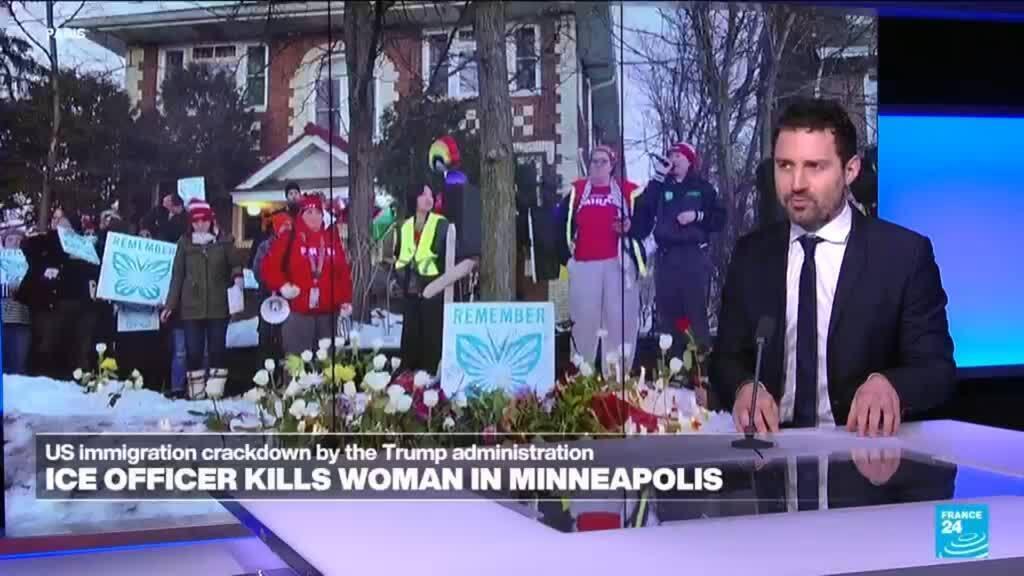

Deadly ICE Shooting in Minneapolis Sparks Nationwide Protests Amid Rising Political Violence Warnings
Minneapolis, Minnesota – A U.S. Immigration and Customs Enforcement (ICE) officer fatally shot Renee Nicole Good, a 38-year-old mother of three and award-winning poet, during a routine traffic stop on January 7, 2026, igniting protests across the city and beyond. The incident, described by authorities as an act of self-defense, has drawn sharp condemnation from local leaders and comparisons to the 2020 killing of George Floyd, exacerbating fears of escalating political violence in the United States as 2026 unfolds.
The shooting occurred amid heightened immigration enforcement under the Trump administration's renewed crackdown on undocumented immigrants. According to reports, Good was pulled over for a minor traffic violation when the confrontation escalated, leading the ICE officer to open fire. ICE has not released body camera footage or detailed the sequence of events, but the agency maintains the officer acted in self-defense. The death has triggered immediate backlash, with protests erupting in Minneapolis and spreading to other U.S. cities, where demonstrators have decried federal immigration policies as "reckless and destabilizing."
City and state leaders in Minnesota were quick to respond. Minneapolis officials condemned the federal action, highlighting tensions between local jurisdictions and ICE operations. France24 International Affairs editor Andrew Hilliar noted in coverage that the incident underscores broader friction over the administration's aggressive deportation efforts, which have intensified since President Trump's inauguration for a second term in January 2025. "This is not just a local tragedy; it's a flashpoint in the national debate over immigration enforcement," Hilliar explained.
Good's background has amplified public outrage. Described by the BBC as a "mother of three and award-winning poet," she was known in literary circles for her work exploring themes of family, resilience, and immigrant experiences. Friends and family portrayed her as a community pillar, making her death a poignant symbol for activists. Protests have included marches demanding justice, defunding ICE, and an end to what demonstrators call overly militarized federal policing.
Media coverage has evoked stark parallels to 2020, when George Floyd's death at the hands of Minneapolis police sparked global Black Lives Matter protests. A France24 press review on January 8 described the event as feeling "like 2020 again," with headlines questioning whether the U.S. is on the cusp of renewed civil unrest. The review highlighted anti-ICE demonstrations blocking streets in Minneapolis and calls for federal accountability.
This incident comes against a backdrop of warnings about surging political violence. On January 2, 2026, a former FBI agent publicly cautioned that incidents of political violence have escalated into the new year, citing recent events including an alleged assassination attempt—widely reported in conservative media as targeting high-profile political figures—and direct attacks on ICE facilities. These developments follow a turbulent 2024 election cycle marked by deep partisan divides, January 6-style insurrections, and sporadic clashes between far-right and far-left groups. The FBI's own assessments, as referenced in prior years, have tracked a rise in domestic extremism, with immigration policy emerging as a key trigger.
Background on U.S. Immigration Enforcement and Unrest
The Trump administration's immigration agenda, reinstated upon taking office in 2025, prioritizes mass deportations, expanded ICE authority, and border wall expansions. This mirrors policies from Trump's first term (2017-2021), which faced legal challenges and street protests but were curtailed under President Biden. Recent executive orders have empowered ICE to conduct traffic stops and workplace raids in sanctuary cities like Minneapolis, straining relations with Democratic-led localities.
Historically, such enforcement has correlated with spikes in civil unrest. The 2018 family separations at the border drew widespread condemnation, while 2020's protests blended police brutality concerns with immigration debates. Current tensions are compounded by economic pressures, including inflation and job market shifts affecting immigrant communities, alongside polarized media narratives.
Law enforcement data indicates a medium-severity uptick in related incidents: the Minneapolis shooting is classified as medium severity civil unrest, while the broader political violence trend shares the same rating. No arrests have been reported from the initial protests, but tensions remain high, with National Guard preparedness discussed in state capitols.
Outlook: A Volatile Start to 2026
As investigations into Good's death proceed—led jointly by ICE's Office of Professional Responsibility and Minneapolis police—calls for transparency grow louder. Community leaders urge de-escalation, while federal officials defend the officer's actions as necessary amid rising threats to ICE personnel, including recent attacks on facilities.
The convergence of this shooting with warnings of political escalation signals a precarious moment for the U.S. With midterm elections looming in 2026, immigration and public safety could dominate discourse. Analysts, drawing from France24 and BBC reporting, warn that unresolved grievances risk further mobilization, echoing cycles of unrest seen in recent American history. For now, Minneapolis streets serve as a microcosm of national divides, where policy clashes meet personal tragedy.
(Word count: 712)






