Conflict in Ukraine: UN Urges Security Council Action as Attacks Escalate
In the escalating conflict in Ukraine, the UN Deputy Relief Chief has called on the Security Council to act decisively to safeguard civilians as Russian attacks intensify across multiple fronts.[1] Russian forces are pushing to entrench positions in key areas like Hryshyne in Donetsk Oblast, where Ukrainian defenses are actively countering these moves by striking troop concentrations.[2] Meanwhile, Ukraine is ramping up production of advanced weaponry, including drones, long-range missiles, and robotic systems, enabling strikes deep into enemy territory.[3] A notable milestone occurred when robots seized a Russian position for the first time in the war.[5] In Sumy Oblast, Russian troops have taken several border settlements, though no immediate encirclement threatens the city of Sumy.[4] These developments highlight a dynamic battlefield where humanitarian concerns intersect with intense military maneuvering.
Overview of Humanitarian Situation
The humanitarian crisis in Ukraine has reached a critical juncture, prompting a direct appeal from senior UN officials to the Security Council. Joyce Msuya, the UN Deputy Relief Chief and Assistant Secretary-General for Humanitarian Affairs, delivered a statement emphasizing the urgent need for protective measures as attacks intensify.[1] Her address underscores the worsening conditions for civilians caught in the crossfire, with repeated references to the imperative for the Security Council to intervene and shield Ukraine's population.[1] This call comes amid a backdrop of heightened violence, where the scale and frequency of assaults are placing unprecedented strain on humanitarian operations.
Msuya's statement, delivered on April 20, 2026, highlights the OCHA's ongoing efforts, such as aid delivery in regions like Kherson, but stresses that without Security Council action, the protection of civilians remains at grave risk.[1] The repetition in her messaging—"UN Deputy Relief Chief urges Security Council to act to protect Ukraine's people as attacks intensify"—signals the gravity of the situation, reflecting a pattern of escalating threats that demand international response.[1] This humanitarian overview is not isolated; it ties directly into military escalations that exacerbate civilian vulnerabilities, as intensified attacks disrupt aid flows and endanger non-combatants.[1]
Expanding on the implications, Msuya's plea positions the Security Council as a pivotal body capable of enforcing safeguards, drawing attention to the humanitarian situation's deterioration.[1] The focus on protection measures aligns with OCHA's mandate, yet the intensifying attacks illustrate a cycle where military actions amplify relief challenges.[1] Reports from the field, including images of aid efforts in Kherson, provide visual testament to the UN's commitment, but Msuya's words convey that current efforts fall short without broader political backing.[1] This section of the conflict in Ukraine reveals how humanitarian needs are surging precisely as protective mechanisms lag, urging a reevaluation of international priorities.[1]
In depth, the UN's position reflects a strategic communication aimed at mobilizing global attention. By naming the Security Council explicitly, Msuya leverages its authority to push for resolutions that could mitigate the attacks' impact.[1] The humanitarian situation, characterized by intensified hostilities, demands not just aid but systemic protections, a point reiterated throughout her prepared remarks.[1] As attacks continue to mount, the UN's call serves as a barometer for the conflict's human cost, compelling member states to consider enforcement mechanisms.[1]
Military Developments in Donetsk Oblast
Russian forces have intensified their operations in the Pokrovsk agglomeration, specifically targeting Hryshyne in Donetsk Oblast, where they are attempting to establish entrenched positions in the settlement's center and northern areas.[2] These efforts represent a concerted push to solidify gains amid ongoing assaults, but Ukrainian defense forces are effectively thwarting these advances.[2] By striking clusters of Russian troops, Ukraine's military is disrupting enemy consolidation, preventing the Russians from digging in successfully.[2]
The dynamics in Hryshyne exemplify the grinding nature of frontline engagements in Donetsk Oblast. Russian pressure has increased, with troops seeking to hold key points in the settlement, yet Ukrainian responses—through targeted strikes on troop concentrations—have consistently repelled these attempts.[2] This back-and-forth underscores a Ukrainian strategy of denial, where defensive actions neutralize offensive momentum before it can build.[2] Ukrainska Pravda's reporting details how these thwarting operations maintain the line, countering Russian entrenchment at every step.[2]
Further analysis of the developments reveals a tactical stalemate favoring Ukrainian resilience. The focus on Hryshyne's center and north indicates Russian intent to create a foothold for broader advances in the Pokrovsk area, but repeated strikes on troop clusters have inflicted losses and stalled progress.[2] Ukrainian forces' ability to identify and target these clusters demonstrates effective reconnaissance and firepower integration, turning potential Russian gains into vulnerabilities.[2] As the conflict in Donetsk persists, these military developments highlight the high cost of entrenchment for the aggressor.[2]
In greater detail, the increased pressure on Hryshyne signals a broader Russian operational tempo in Donetsk Oblast, yet the consistent thwarting by Ukraine preserves territorial integrity.[2] Each failed entrenchment attempt weakens Russian logistics, as strikes on clusters deplete manpower and resources.[2] This pattern, reported directly from the front, positions Ukrainian defenses as a bulwark against incremental advances.[2]
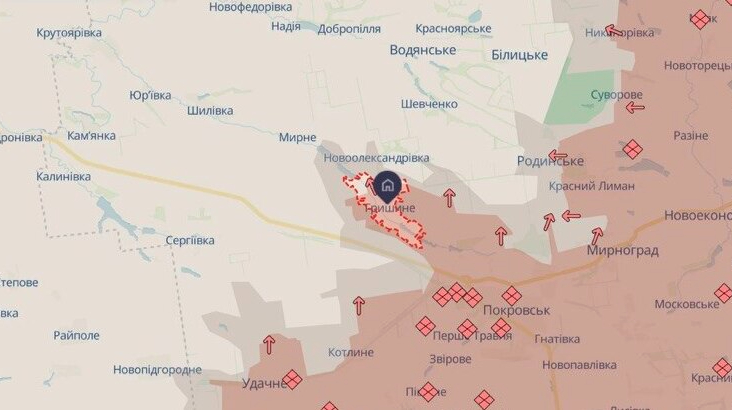
Russian forces attempt to entrench in Hryshyne, Donetsk Oblast, as Ukrainian troops counter assaults. — Source: ukrainskapravda
Ukraine's Use of Advanced Technology in Defense
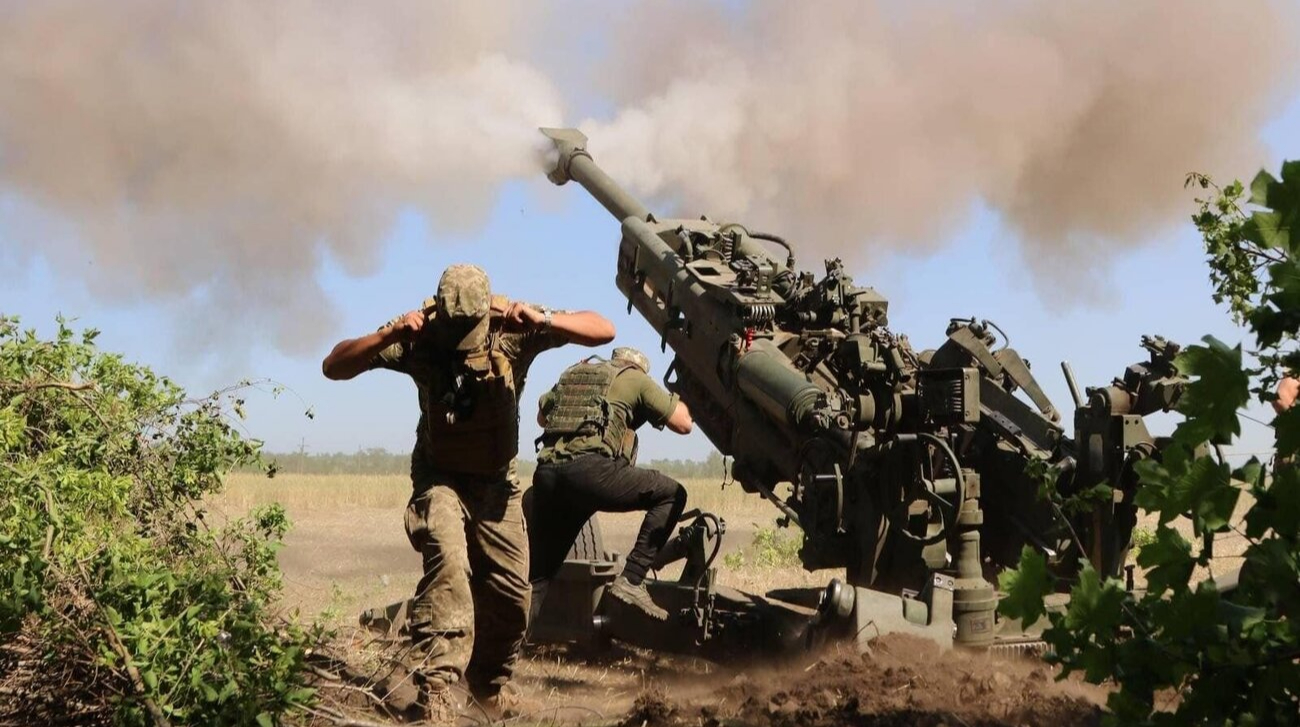
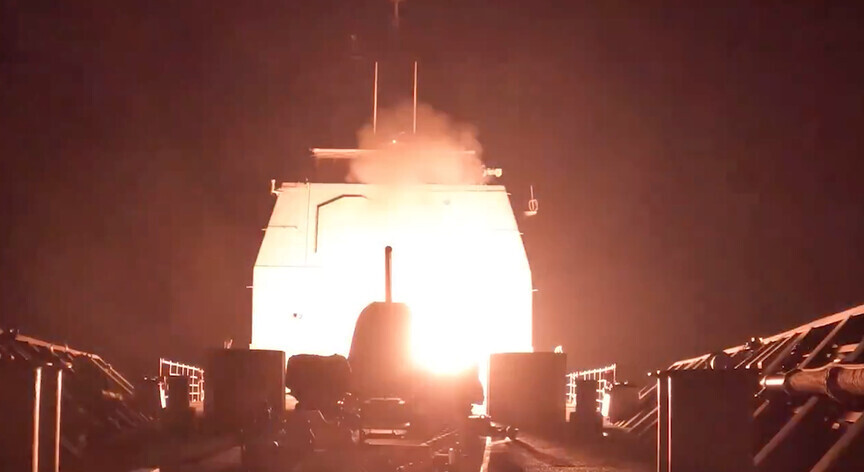
Ukraine's defense industry is demonstrating remarkable innovation, producing millions of drones, long-range missiles, and robotic systems to counter the Russian juggernaut.[3] These weapons enable strikes deep behind enemy lines, preserving Ukrainian soldiers while inflicting damage on adversary infrastructure and forces.[3] This technological shift represents a new model of national resistance, allowing a smaller force to challenge a larger opponent effectively.[3]
The scale of production—millions of drones alone—illustrates Ukraine's industrial mobilization, transforming domestic capabilities into battlefield advantages.[3] Long-range missiles extend reach into Russian rear areas, disrupting supply chains and command structures.[3] Robotic systems complement this arsenal, reducing human exposure while maintaining offensive pressure.[3] As reported by the Times of India, this prowess defies expectations, showcasing resilience through precision fire and unmanned operations.[3]
Contextually, these advancements interlock with traditional defenses, creating a multi-layered counter-strategy. Drones provide persistent surveillance and strikes, missiles deliver standoff precision, and robots handle high-risk maneuvers.[3] By striking deep, Ukraine compensates for numerical disparities, a tactic that has proven vital in sustaining prolonged resistance.[3] The preservation of soldiers through such tech underscores a doctrinal evolution, prioritizing technological leverage over manpower attrition.[3]
Delving deeper, the deployment of these systems marks a paradigm shift in the conflict. Millions of drones imply mass production lines scaled for sustained use, while long-range missiles target strategic assets far from the front.[3] Robotic integration further enhances this, enabling operations that minimize casualties.[3] This innovative defense not only counters Russian advances but redefines modern warfare asymmetry.[3]
First Robotic Seizure of a Russian Position
A groundbreaking moment in the conflict occurred when Ukraine's ground robots, or unmanned ground vehicles, seized a Russian position exclusively for the first time.[5] President Volodymyr Zelensky announced this achievement, highlighting it as a milestone in the war.[5] This operation demonstrates the maturing role of robotics in Ukrainian tactics, building on extensive drone usage.[5]
Zelensky's statement emphasizes the exclusivity of the robotic capture—no human troops involved—signifying a leap in autonomous warfare capabilities.[5] Asia Times reports this as akin to a "Terminator" scenario, where robots directly assault and hold enemy ground.[5] The event follows increased robotic deployments, complementing aerial drones in a comprehensive unmanned strategy.[5]
Analyzing the significance, this first-time feat validates Ukraine's investment in robotics, proving their efficacy in capturing positions without risking lives.[5] It expands tactical options, particularly in contested areas where human advances are costly.[5] Zelensky's public reveal serves to boost morale and signal technological parity.[5]
In detail, the seizure involved ground robots maneuvering to overrun the position, a development tied to broader unmanned trends.[5] This success foreshadows expanded robotic roles, integrating with drones for hybrid operations.[5]
Russian Advances in Sumy Oblast
Russian troops have captured several border settlements in Sumy Oblast, marking incremental gains along the frontier.[4] However, Ukraine's Joint Forces Command assesses no immediate threat of encirclement to the city of Sumy itself.[4] This evaluation comes amid Russian pushes, but Ukrainian statements affirm the city's security.[4]
The captures represent localized advances, yet the absence of encirclement risk indicates contained Russian momentum.[4] Ukrainska Pravda notes the Joint Forces' commentary, clarifying that border losses do not translate to broader threats.[4] This dynamic maintains Ukrainian operational freedom in the region.[4]
Further, the assessment reflects confident monitoring, where captured settlements are isolated from Sumy proper.[4] Russian efforts, while achieving footholds, face Ukrainian countermeasures preventing escalation.[4]
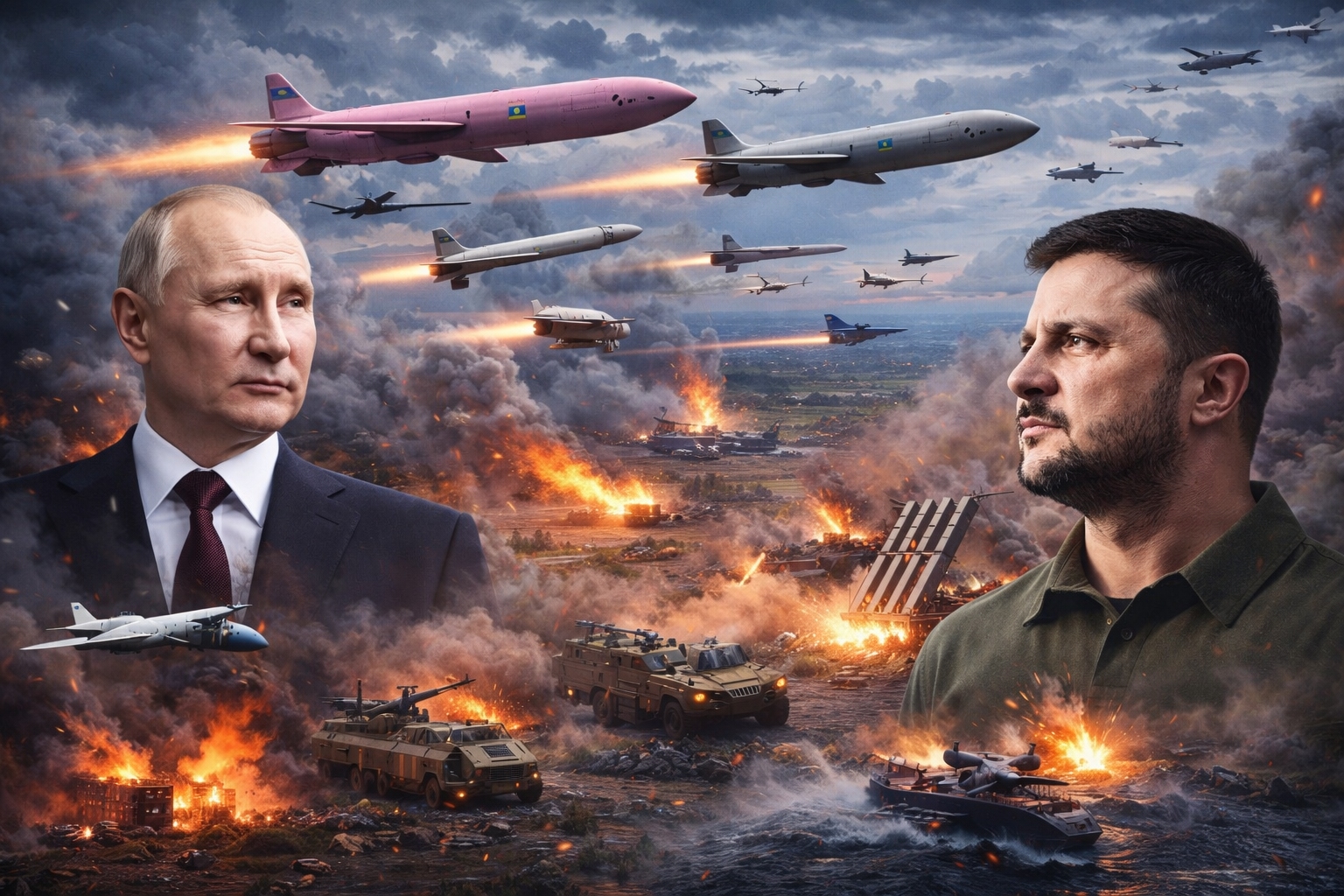
Ukrainian forces use drones, robots, and precision fire to counter Russian advances. — Source: timesofindia
Overall Conflict Dynamics
The interplay of humanitarian appeals, regional military actions, and technological innovations defines the current conflict dynamics.[1][2][3][4][5] UN calls for Security Council action frame the humanitarian toll of intensifying attacks, directly linked to Russian entrenchment attempts in Donetsk and border gains in Sumy.[1][2][4] Ukrainian responses—thwarting assaults via strikes and deploying drones, missiles, and robots—counter these pressures effectively.[2][3][5]
In Donetsk, failed entrenchments in Hryshyne dovetail with Sumy's contained advances, showing Russian multi-front strain against Ukrainian tech.[2][4][3] The robotic seizure milestone amplifies this, preserving forces while enabling deep strikes.[5][3] Msuya's urging contextualizes these as drivers of civilian peril.[1]
Holistically, Ukraine's production surge creates asymmetry, blunting Russian juggernauts across oblasts.[3][2][4] No Sumy encirclement sustains northern stability, allowing focus on Donetsk.[4] UN pleas urge global response to this volatile balance.[1]
These elements interrelate: tech counters advances, mitigating humanitarian fallout.[1][3][5][2][4] The conflict's trajectory hinges on these factors.
What to watch next: Monitor UN Security Council responses to intensifying attacks,[1] Russian entrenchment outcomes in Hryshyne,[2] and further Ukrainian robotic and drone deployments following the first position seizure.[3][5] Assessments of Sumy border dynamics will clarify encirclement risks.[4]