
Conflict in Mali: Russian Fighters Confirm Withdrawal from Northern City
Coordinated attacks by rival armed groups, including separatists and Islamists, have led to withdrawals by Russian fighters and the Malian army in northern Mali.[1] Ethnic Tuareg fighters are now in control of Kidal following these assaults, while an Al Qaeda-linked group reported the Mali army's withdrawal from a town in the north.[1][3] This escalation in the conflict in Mali marks a significant shift, with relative calm returning to areas like Bamako and Kati after the weekend's intense fighting.[4]
Overview of Recent Attacks
The recent violence in Mali stemmed from a series of coordinated attacks launched by various armed groups over the weekend, targeting multiple locations across the country.[1][2][5] These assaults involved ethnic Tuareg separatists alongside Islamist factions, striking simultaneously in a manner that overwhelmed government-aligned forces.[1] According to reports, the attacks were nationwide, affecting northern regions prominently but extending influence to other parts of the country.[1] Political analyst Josiasse Assemon described these operations as involving coordinated strikes on major cities, coupled with covert infiltration tactics, which together intensified the pressure on Mali's military government.[5]
This wave of violence represented a departure from previous patterns of isolated skirmishes, as the groups executed their plans in unison, leading to immediate territorial gains.[2] In Kidal, a key northern city, the separatist push was particularly effective, with Tuareg fighters claiming control after the assaults.[1] The involvement of Islamists alongside separatists highlighted the breadth of the offensive, which plunged the country into a period of heightened uncertainty.[4] These events unfolded over two days of fierce fighting, disrupting stability and forcing responses from both the Malian army and its foreign allies.[4][5]
The scale of the coordination was evident in how the attacks synchronized across different regions, suggesting advanced planning among the perpetrators.[2][5] This approach not only caught defenders off guard but also amplified the psychological impact on the military government, which has been grappling with ongoing insurgencies.[5] Reports from the scene indicated that the clashes were intense, particularly where jihadists allied with Tuareg separatists confronted army positions.[4] By Monday, the immediate fury had subsided in some areas, but the strategic repercussions lingered.[1][4]
Withdrawals by Forces
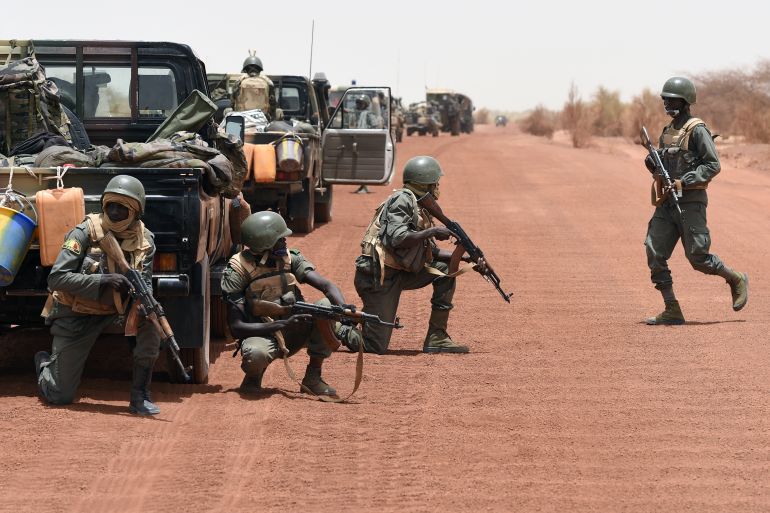
Confirmed withdrawals by Russian fighters and the Malian army from northern areas followed the separatist and Islamist attacks, marking a tactical retreat in the face of overwhelming pressure.[1][3] Russian fighters explicitly acknowledged pulling back from a northern Mali city, a development directly tied to the separatist offensives.[1] This admission came amid claims by ethnic Tuareg fighters that they had seized control of Kidal, solidifying their hold on the strategic location.[1]
Separately, an Al Qaeda-linked group announced that the Mali army had withdrawn from a town in the north, further evidencing the retreats prompted by the coordinated strikes.[3] These pullbacks were not isolated; they reflected the broader impact of the weekend's nationwide attacks, where government forces found themselves outmaneuvered.[1] The Russian presence, often associated with Wagner-linked mercenaries supporting the Malian military, had been a fixture in counter-insurgency efforts, but the recent events forced a reconfiguration of positions.[1]
The withdrawals underscore vulnerabilities in the defense of northern Mali, a region long contested by separatists.[1] Tuareg fighters' assertion of control in Kidal points to a significant loss of ground for the army and its allies.[1] While specific details on the extent of the retreats remain tied to these reports, the pattern indicates a concerted enemy advance that compelled these forces to fall back, potentially to regroup or reinforce other fronts.[3] This development has raised questions about the sustainability of foreign-backed operations in the area.[1]
Alliance of Rival Groups
Rival armed groups, despite their differing ideologies, have joined forces against the Malian state in these coordinated attacks.[2] Typically at odds, separatists like the ethnic Tuareg fighters and Islamist factions, including those linked to Al Qaeda, set aside divisions to launch joint operations across Mali.[2] This unusual alliance was key to the success of the weekend assaults, enabling them to challenge state control more effectively.[2]
The partnership allowed for a broader operational reach, with groups that might otherwise clash pooling resources for simultaneous strikes.[2] Reports highlight how these entities, often ideologically opposed, aligned temporarily against a common adversary—the Malian military government.[2] The question now lingers on whether this unity can endure beyond the immediate gains, as historical tensions could resurface.[2]
This convergence represents a tactical evolution in the insurgency, where pragmatic cooperation overrides long-standing rivalries.[2] By uniting, they amplified their impact, contributing to the withdrawals observed in the north.[2] The attacks' coordination across the country exemplifies this rare solidarity, which has caught observers off guard.[2]
Current Situation in Mali
Relative calm has returned to many parts of Mali, including the capital Bamako and the ruling junta's stronghold of Kati, following the weekend's attacks.[4] A fragile peace prevailed on Monday in these key areas after two days of fierce fighting between the army and jihadists allied with Tuareg separatists.[4] This lull has brought a temporary respite, though the nation remains plunged into uncertainty over the military government's future.[4]
The fighting had been particularly intense, involving direct confrontations that tested the junta's defenses in its own backyard.[4] Bamako, as the political heart, and Kati, a military hub, saw the clashes subside, allowing normalcy to creep back cautiously.[4] However, the alliance of jihadists and separatists has cast a shadow, heightening concerns about broader instability.[4]
While northern areas like Kidal remain under separatist control, the south's relative calm offers a contrast, though experts caution that the underlying tensions persist.[4] The events have deepened the precariousness of the junta's position, with the nationwide scope of the attacks amplifying fears of further erosion.[4]
Implications of the Conflict
The simultaneous attacks signal a new phase of conflict in Mali, according to political analyst Josiasse Assemon.[5] Mali faces growing pressure as these coordinated operations target major cities, employ covert infiltration, and unite rival armed groups.[5] This shift indicates a more sophisticated insurgency, capable of multi-front assaults that strain the government's resources.[5]
Assemon's assessment points to the attacks as a turning point, where the convergence of separatists and Islamists heralds intensified challenges ahead.[5] The use of infiltration tactics alongside overt strikes on urban centers demonstrates enhanced capabilities among the attackers.[5] This new dynamic could prolong the conflict, complicating efforts to restore order.[5]
The analyst's view aligns with the observed outcomes, such as territorial losses in the north and the fragile calm elsewhere.[5] As rival groups sustain their cooperation, the military government must navigate this evolved threat landscape.[5]
What to watch next: Observers will monitor whether the alliance of rival armed groups holds amid their gains against the Malian state, as questions persist on the sustainability of this unity and the potential for further coordinated strikes targeting major cities.[2][5]