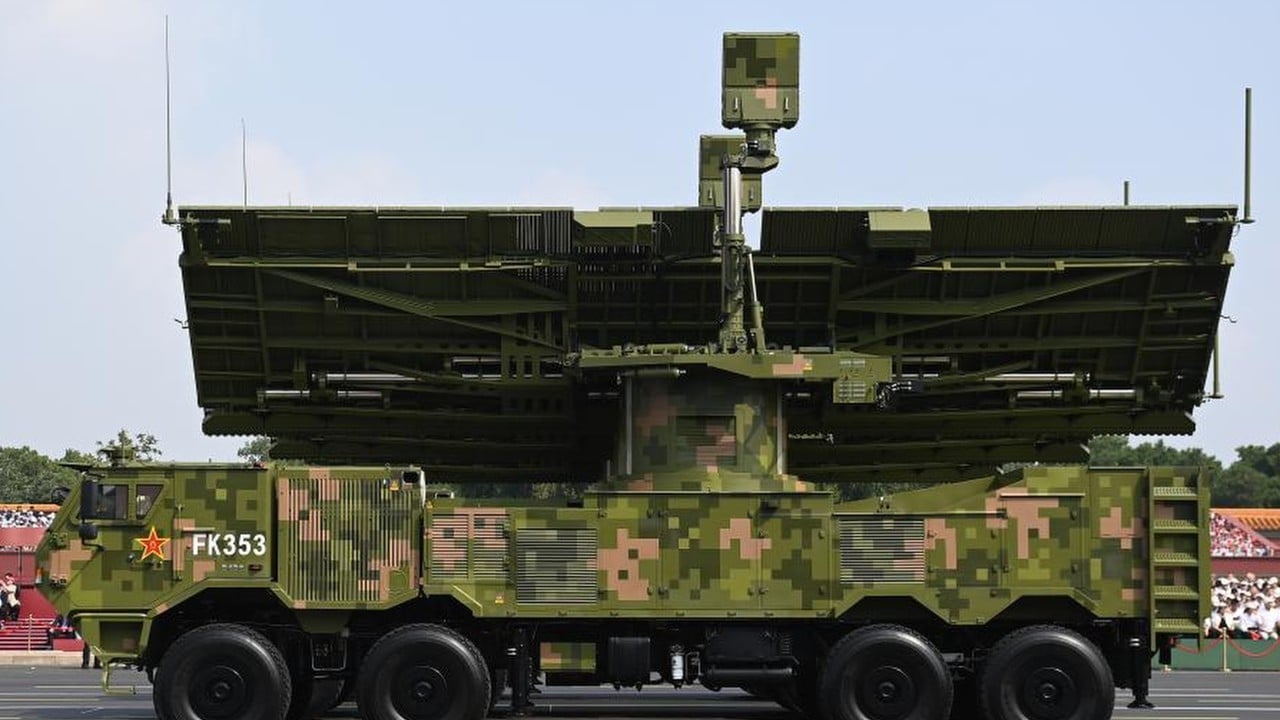

China Wraps Up Taiwan Military Drills as Developer Reveals Advanced Anti-Drone Microwave Weapon
Beijing, January 7, 2026 — China has announced the successful completion of military maneuvers near Taiwan, signaling persistent cross-strait tensions, just as details emerged on a new high-power microwave weapon system designed to neutralize drone swarms.
The People's Liberation Army (PLA) concluded its latest exercises around Taiwan on December 31, 2025, describing them as a success. These maneuvers, which began on the same day, underscore Beijing's ongoing military pressure on the self-ruled island amid heightened geopolitical friction. Taiwan's Ministry of National Defense has routinely monitored such activities, reporting increased PLA aircraft and vessel incursions into its air defense identification zone (ADIZ) in recent months.
Simultaneously, state-owned defense contractor Norinco disclosed key specifications this week for the Hurricane 3000, a truck-mounted high-power microwave (HPM) system first showcased during China's massive military parade in September 2025. According to Norinco, the weapon boasts an effective interception range exceeding 3 kilometers (1.86 miles) against light and small unmanned aerial vehicles (UAVs) and drone swarms. This range surpasses that of comparable U.S. military systems, the developer claimed, positioning it as a significant advancement in counter-drone technology.
The Hurricane 3000 operates by emitting powerful microwave pulses that disrupt or destroy electronic components in incoming drones, rendering swarms ineffective without traditional ammunition. Norinco's revelation, reported by the South China Morning Post, marks the first public disclosure of detailed performance metrics since its parade debut. The system's mobility—mounted on a standard military truck—enhances its deployability across diverse terrains, including potential maritime or island-chain scenarios relevant to the Taiwan Strait.
Context of Escalating Tensions
China's military activities near Taiwan have intensified since 2022, following high-profile events such as then-U.S. House Speaker Nancy Pelosi's visit to Taipei and Taiwanese President Lai Ching-te's inauguration in May 2024. Beijing views Taiwan as a breakaway province and has not ruled out the use of force for reunification. The December 31 drills align with a pattern of "routine" exercises that encircle the island, often involving live-fire drills, simulated blockades, and multi-domain operations across air, sea, and electronic warfare domains.
These maneuvers come against a backdrop of strengthened U.S.-Taiwan ties, including arms sales and joint exercises. The U.S. Indo-Pacific Command has repeatedly characterized PLA activities as "destabilizing," while emphasizing freedom of navigation in international waters. Taiwan, for its part, has bolstered its asymmetric defenses, investing in portable anti-drone systems and UAVs of its own to counter numerical PLA advantages.
The timing of the Hurricane 3000 details release amplifies perceptions of China's military modernization drive. Unveiled amid the National Day parade—commemorating the 76th anniversary of the People's Republic—such systems reflect Beijing's focus on "intelligentized" warfare. Drones have emerged as a critical threat in modern conflicts, as seen in Ukraine, where swarms overwhelm traditional air defenses. China's emphasis on HPM technology addresses this, with the Hurricane 3000 complementing laser-based and kinetic interceptors already in PLA service.
Norinco, a subsidiary of China North Industries Group Corporation Limited, is a key player in the country's defense sector, exporting systems globally while prioritizing domestic needs. The weapon's developer highlighted its non-lethal kinetic effects on drones, preserving ammunition for sustained engagements.
Broader Geopolitical Implications
The dual developments—drills' conclusion and weapon specs—occur as global powers recalibrate strategies in the Asia-Pacific. The U.S. has accelerated its own counter-drone initiatives, including microwave systems like the Army's IFPC-HPM, though Norinco claims superiority in range. Allies such as Japan and Australia have voiced concerns over PLA assertiveness, conducting joint drills like Talisman Sabre to deter aggression.
Taiwan reported no unusual incidents during the latest maneuvers, but President Lai has urged vigilance and international support. Beijing's foreign ministry reiterated that the exercises were "legitimate" responses to "separatist activities," without specifying triggers.
Looking ahead, analysts anticipate continued PLA presence around Taiwan, potentially scaling with U.S. elections or regional elections. China's 2027 PLA modernization centennial goal looms large, with anti-access/area-denial (A2/AD) capabilities like the Hurricane 3000 central to any Taiwan contingency.
As tensions simmer, diplomatic channels remain open but strained. U.S. Secretary of State Antony Blinken recently called for restraint, while emphasizing the "one China" policy's status quo. These events reaffirm the Taiwan Strait as a flashpoint in great-power competition, where technological edges could tip balances in future crises.
(Word count: 612)






