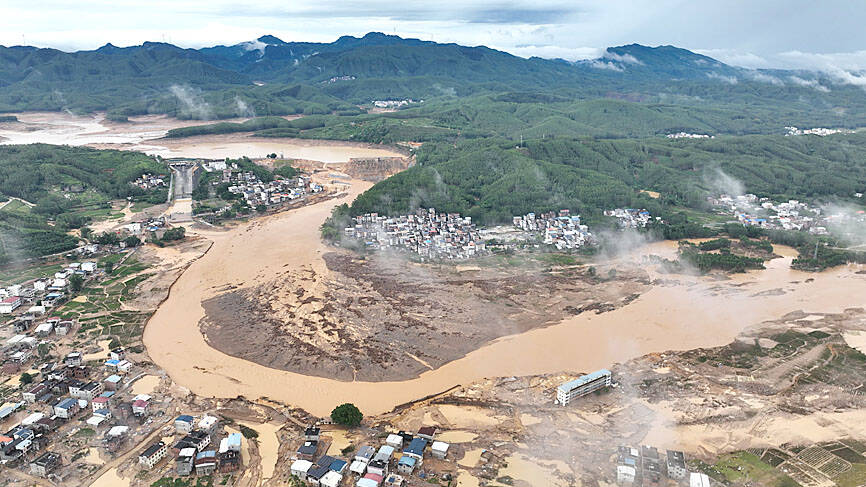

China Floods Death Toll Rises to 39 After Dam Breach in Guangxi
Flooding triggered by Tropical Storm Maysak in southern China's Guangxi region has killed 39 people in the China floods, most of them after a dam breach east of Nanning, with nine others missing as rescue operations continue. [1]
Rising Death Toll from Maysak Flooding
Authorities in southern China said the death toll from flooding after Tropical Storm Maysak rose to 39. [2] Most of the deaths were related to the breach of the Liulan reservoir dam in Hengzhou under Nanning's jurisdiction, which claimed 26 lives. [1] The previous death toll stood at six before rising to 39. [1] Nine people were missing in the broader Guangxi region. [1] Nanning Vice Mayor Ding Wei told a news conference that most deaths stemmed from the dam breach east of Nanning. [1] Similar reports confirmed 39 fatalities linked to the Maysak-triggered flooding in southern China. [3]
Record Rainfall and Dam Breach
Maysak brought record rainfall to Guangxi from Saturday, with cumulative totals of 10-40 cm in some areas and over 90 cm in the hardest-hit zones, breaching reservoirs and flooding towns. [1] Heavy rain battered southern Guangxi for days, with cumulative rainfall of 10cm to 40cm in some areas and more than 90cm in hard-hit areas, according to the national meteorological center. [1] The reservoir breaches sent torrents of water into towns and cities. [1] Maysak made landfall in the southern island province of Hainan on Friday before its second landfall on Sunday in Vietnam. [5] Officials in Nanning raised the city's flood control emergency response to the highest level after torrential rain breached dams. [5]
Flooding from Tropical Storm Maysak kills 39 people after dam breach in Guangxi, China. — Source: newsmax
Massive Rescue and Evacuation Efforts
About 130,000 people have been evacuated, with drones and roughly 5,700 boats deployed in rescue efforts amid strong currents and debris. [1] Drones and about 5,700 boats have been used in a massive relief and rescue operation to reach people trapped by the waters, with rescuers battling stiff currents and debris. [1] Earlier reports noted that authorities evacuated at least 48,000 people as of Monday evening due to heavy rains and severe flooding from Typhoon Maysak. [5] Floodwaters turned a wide road into a lake in Guigang, submerging cars, while in Fangchenggang a small car was washed down a street. [5]
Recovery Operations in Hengzhou
Floodwaters are now receding but more rain is forecast. [1] Ding said that the floodwaters are receding, but more rain is expected in some areas in the next two days. [1] Crews are clearing mud and debris, disinfecting towns in Hengzhou, repairing roads, and have restored electricity to more than 60,000 homes. [1] Crews have been deployed to clear mud and debris and disinfect several towns in hard-hit Hengzhou city, which is east of Nanning and under its jurisdiction. [1] Road repairs are ongoing and electricity has been restored to more than 60,000 homes. [1] Heavy rainfall is expected across Guangxi, Guizhou, Hunan and other regions in the coming days. [5]
Approaching Threat from Typhoon Bavi
As the region recovers, Taiwan and China's east coast are bracing for Super Typhoon Bavi, forecast to bring heavy rain and make landfall in Zhejiang or Fujian province. [1] Typhoon Bavi is forecast to pass just north of Taiwan, bringing heavy rain to the nation, and make landfall in China’s Zhejiang or Fujian province tomorrow. [1] China is also on alert for Super Typhoon Bavi, which is making its way across the Pacific Ocean towards Taiwan. [5] Weather authorities warned that Bavi will bring strong winds and heavy rain to eastern China from Thursday. [5] The U.S. National Weather Service said it was packing winds of up to 180 miles per hour as it made its way across Guam, Tinian, Saipan and Rota on Monday. [5]
Government Response and Broader Context
China's state planner released 100 million yuan for relief work in Guangxi, while the finance ministry and emergency management authorities provided 160 million yuan to support flood and typhoon response efforts across six provincial-level regions, including Guangxi. [5] Thunderstorms and strong winds have killed at least eight people in central China, with tornadoes reported in some areas of Hubei Province. [5] Scientists warn the intensity and frequency of global extreme weather events will increase as the planet continues to heat up because of fossil fuel emissions. [5] China faces growing threats from extreme weather, which meteorologists link to climate change. [5]
What to watch next: Super Typhoon Bavi is expected to bring heavy rain and strong winds to Taiwan and eastern China as recovery continues in Guangxi.