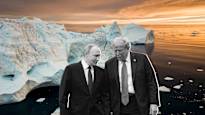

Arctic Tensions Escalate: Expert Warns Finland Caught in U.S.-Russia Power Play
Helsinki, Finland – The Arctic region has emerged as a pivotal battleground in great power politics, with Finland squarely in the crosshairs of intensifying U.S.-Russia rivalry, according to a prominent Finnish academic. Assistant Professor Rinna Kullaa has cautioned that "Finland is in the middle of the game" as former U.S. President Donald Trump and Russian President Vladimir Putin appear poised to divide influence over the resource-rich and strategically vital Arctic.
In a recent analysis published by Yle, Finland's public broadcaster, Kullaa highlights how the melting polar ice cap is transforming the Arctic from a zone of scientific cooperation into a theater of geopolitical competition. This shift, she argues, directly threatens Finland's national security due to its 1,340-kilometer border with Russia along the Arctic Circle. The professor's comments come amid reports of renewed U.S. interest in Arctic dominance under a potential second Trump administration and Russia's ongoing militarization of the region.
Kullaa, an expert in Nordic and Russian history at Tampere University, emphasizes that control over Arctic sea routes, untapped oil and gas reserves, and rare earth minerals will shape global power dynamics for decades. "The Arctic has risen to become a central stage for great power politics. Finland's security will be decided there," she stated, underscoring the stakes for Helsinki as NATO's newest frontline member.
Growing Strategic Stakes in the High North
The Arctic's geopolitical significance has accelerated in recent years, driven by climate change that has shortened shipping routes like the Northern Sea Route and exposed vast hydrocarbon deposits. Russia, which controls over half of the Arctic coastline, has invested heavily in military infrastructure, including new bases, icebreakers, and hypersonic missile deployments. Since annexing Crimea in 2014 and escalating its invasion of Ukraine in 2022, Moscow has framed the Arctic as a sphere of exclusive influence.
On the Western side, the United States has ramped up its presence through initiatives like the Arctic Strategy updated in 2022, focusing on alliances with NATO partners. Finland's full NATO accession in April 2023—prompted by Russia's war in Ukraine—has integrated its Arctic territories into the alliance's northern flank, prompting Russian warnings of countermeasures. Sweden's subsequent NATO membership in March 2024 further solidified the bloc's Arctic posture.
Kullaa's warning draws attention to reported overtures between Trump, who assumed office for a second term in January 2025, and Putin. U.S. media have speculated on Trump's past praise for Putin and his skepticism toward NATO, potentially opening doors for bilateral deals on Arctic resource sharing. Such an arrangement, Kullaa implies, could sideline smaller nations like Finland, forcing it to navigate a delicate balance between alliance commitments and direct Russian proximity.
Finnish officials have long monitored these developments. In 2024, Helsinki hosted NATO exercises in the Baltic Sea region, simulating Arctic contingencies, while bolstering its own capabilities with F-35 fighter jets and enhanced border surveillance.
Historical Context and Finland's Arctic Role
Finland's Arctic entanglement is rooted in its geography and history. As home to Finnish Lapland, the country manages significant Sami indigenous territories and participates in the Arctic Council, a forum paused by Western members after Russia's 2022 invasion. Historically neutral during the Cold War under the Finno-Soviet "Paasikivi-Kekkonen doctrine," Finland shifted decisively post-Ukraine, doubling its defense spending to 2.3% of GDP by 2025.
Broader Arctic tensions include China's "Polar Silk Road" ambitions, positioning Beijing as a "near-Arctic state" with investments in Greenland and Iceland. Yet, the U.S.-Russia dynamic remains dominant, with incidents like Russian bomber intercepts near Alaskan airspace underscoring the volatility.
Kullaa's analysis aligns with reports from the U.S. Geological Survey estimating the Arctic holds 13% of undiscovered global oil and 30% of natural gas. Competition over these resources, combined with military posturing, risks militarizing an area previously governed by treaties like the 1920 Svalbard Treaty.
Implications for Finland and Beyond
For Finland, the Arctic's weaponization amplifies hybrid threats from Russia, including cyberattacks, disinformation, and border provocations observed since 2023. Prime Minister Petteri Orpo's government has prioritized Arctic defense in its 2025 security strategy, emphasizing multilateralism through NATO and the EU.
Experts like Kullaa urge proactive diplomacy to safeguard Finnish interests. "The Arctic is not just about resources; it's about securing sea lanes and preventing escalation," she notes, calling for strengthened Nordic cooperation.
As of January 9, 2026, no concrete U.S.-Russia Arctic pact has materialized, but the rhetoric has heightened vigilance. NATO Secretary General Jens Stoltenberg recently affirmed the alliance's commitment to Arctic security during a visit to Oslo.
The situation remains fluid, with medium-severity tensions per monitoring assessments. Finland's position—bridging Europe and the Arctic—positions it as a key player, but one vulnerable to great power machinations. Ongoing diplomatic efforts and military readiness will be crucial as the ice melts and ambitions rise.
(Word count: 712)






