The World Now

Stock · Catalyst AI Analysis

Nvidia Stock Prediction 2026

AI-powered nvidia stock prediction connecting real-time geopolitical events to Nvidia price movements

Current Price

$209.25

24h Change

-1.8%

Loading chart...

What you're looking at

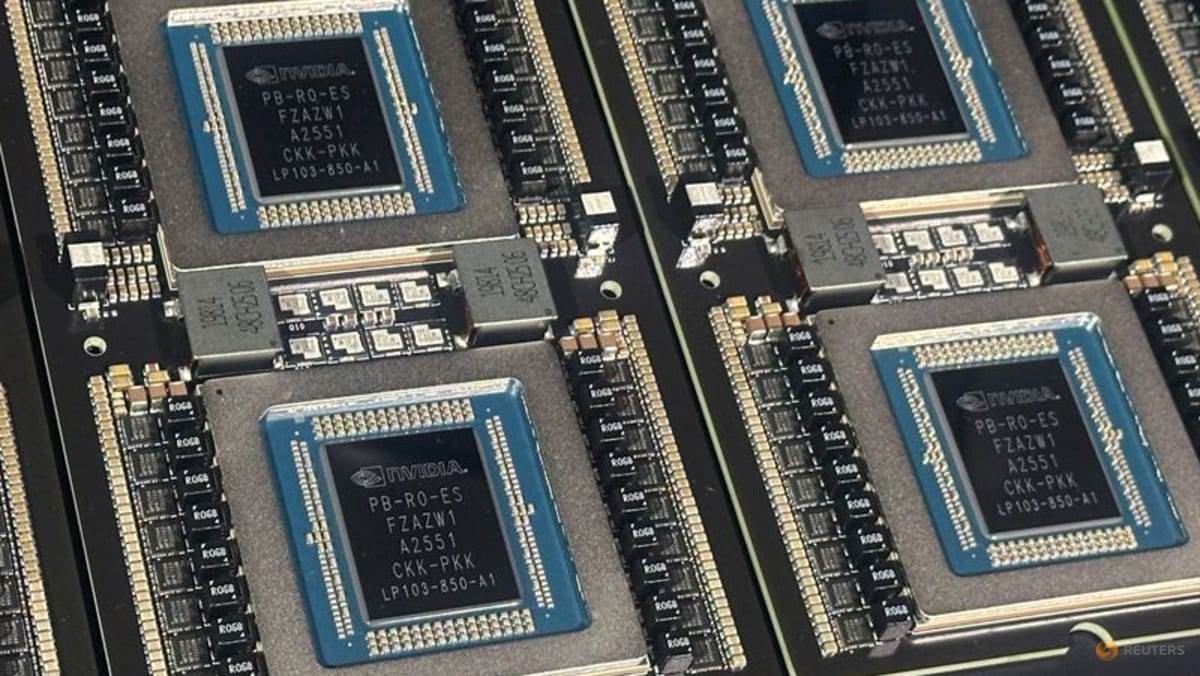
Nvidia is the dominant supplier of AI accelerators powering the 2024-2025 datacenter capex cycle, with its Hopper (H100) and Blackwell (B200, GB200 NVL72) GPUs serving as the substrate for nearly all frontier model training at Microsoft, Meta, Amazon, Google, and Oracle. Datacenter now drives roughly 88% of revenue, eclipsing the legacy gaming segment. The stock's directional path is tightly coupled to hyperscaler capex guidance, the H100→B200 product transition, and US export-control policy toward China — making it the single most geopolitically exposed mega-cap in the S&P 500.

Most NVDA coverage focuses on quarterly EPS and analyst price targets. Catalyst tracks the causal chain other outlets ignore: how Commerce Department export-control announcements, Taiwan Strait military activity, TSMC CoWoS capacity disclosures, and hyperscaler capex revisions transmit into Nvidia's forward revenue. The page connects live geopolitical events to specific revenue lines (China datacenter, sovereign AI, networking) rather than treating NVDA as a pure tech-sector beta play.

Chart Nvidia live on TradingView
Open chart →

Geopolitical Events Affecting Nvidia

Click any event to expand the AI's reasoning, multi-timeframe predictions, and the related coverage from The World Now archive.

No recent geopolitical events affecting Nvidia. Check back soon — Catalyst monitors events 24/7.

Recent Catalyst Reports

No Catalyst reports mentioning Nvidia yet.

Historical price catalysts

5 notable Nvidia moves of the past 15 years

Past geopolitical and macro events that produced verifiable NVDA price moves, with the actual percentage impact, the duration of the move, and what happened in the 30 days that followed.

+24.4%over 1 dayAccelerated

Q1 FY2024 earnings: $11B Q2 guidance vs $7B expected

Nvidia reported Q1 FY2024 results on May 24, 2023 after-hours and stunned the market with Q2 revenue guidance of $11B against the $7.2B Wall Street consensus, citing surging AI training demand. The stock gapped up 24.4% on May 25 — the largest single-day market-cap creation in US history at the time. Shares continued higher in subsequent weeks as analysts repeatedly raised price targets.

+14%over 1 dayAccelerated

Q4 FY2023 earnings: AI inflection guidance commentary

Nvidia's Q4 FY2023 earnings on February 22, 2023 produced cautious near-term guidance but management explicitly framed generative AI as a transformational driver going forward. Shares rallied roughly 14% the next session as buyers positioned for the AI capex cycle. Datacenter revenue acceleration showed up materially in subsequent quarters, validating the narrative.

+20.3%over 1 dayReverted

Q3 FY2022 earnings beat with metaverse + datacenter strength

Nvidia's Q3 FY2022 results on November 17, 2021 beat consensus on both gaming and datacenter, with management leaning into the metaverse Omniverse narrative. Stock rallied 20% intraday before the broader 2022 tech selloff dragged it back. By mid-2022, NVDA had given back the entirety of the November rally as rising rates and crypto-mining demand collapse pressured GPU pricing.

-12.2%over 5 daysMixed

Analyst downgrade on imminent crypto-mining demand collapse

An analyst downgrade in May 2018 flagged that crypto-mining GPU demand had peaked and would likely collapse, presaging a major revenue headwind for the gaming segment. Nvidia fell roughly 12% over the following week. The crypto-mining revenue cliff materialized in subsequent quarters, but the broader AI/datacenter ramp partially offset the hit through 2019.

-17%over 1wAccelerated

Global financial crisis credit freeze hammers semis

During the late-October 2008 GFC liquidity crunch, Nvidia and the broader semi sector were sold off heavily on demand-collapse fears. NVDA fell roughly 17% in a week. The decline continued through November 2008, with the stock ultimately bottoming below $7 in early 2009 before the multi-year recovery.

Prediction Markets

Data from Polymarket

Will NVIDIA be the largest company in the world by market cap on December 31?

72% Yes▲ +2% 7d
$452K vol·Ends Dec 31
View on Polymarket

Will NVIDIA be the largest company in the world by market cap on June 30?

84% Yes▼ -7% 7d
$963K vol·Ends Jun 30
View on Polymarket

Latest analysis

Recent Nvidia coverage from The World Now

Live news and analysis tagged to Nvidia, drawn from the full World Now archive. Each story informs the Catalyst AI engine's real-time prediction.

Cyber Warfare in the Middle East: The Overlooked Digital Escalator of Geopolitical Tensions

Cyber Warfare in the Middle East: The Overlooked Digital Escalator of Geopolitical Tensions

Iran threatens 'annihilation' of Microsoft & Nvidia amid Middle East cyber warfare escalation. Explore digital threats, Hormuz risks, market predictions in this in-depth analysis.

Middle East Strike: US Geopolitics and the AI Export Dilemma in the Shadow of Iran Tensions

Middle East Strike: US Geopolitics and the AI Export Dilemma in the Shadow of Iran Tensions

Middle East strike escalates US AI export dilemma amid Iran tensions: Super Micro Nvidia bust, Trump peace push, market predictions. Explore geopolitics & risks.

Epstein's Echoes: How 2026's Elite Crimes and Stock Market Prediction Are Redefining US Justice

Epstein's Echoes: How 2026's Elite Crimes and Stock Market Prediction Are Redefining US Justice

Epstein Zorro Ranch probe exposes 2026 elite crimes, AI scams, hackers. Rihanna shooting, Nvidia smuggling impact stock market prediction & US justice.

How Do Wars Affect the Stock Market? AI Chip Smuggling: The Internal Erosion of US Technological Supremacy

How Do Wars Affect the Stock Market? AI Chip Smuggling: The Internal Erosion of US Technological Supremacy

How do wars affect the stock market? $2.5B AI chip smuggling bust erodes US tech supremacy as Nvidia chips flow to China. Insider threats, predictions & analysis.

China's AI Arms Race: Geopolitical Implications of Technological Self-Reliance in 2026

China's AI Arms Race: Geopolitical Implications of Technological Self-Reliance in 2026

China's 2026 AI arms race: Nvidia H200 ban, PLA refueling tech, Taiwan drills fuel digital sovereignty. Geopolitical analysis, market predictions & risks.

Navigating the Economic Landscape: The Impact of Tariff Policies and AI on the Future of the U.S. Economy

Navigating the Economic Landscape: The Impact of Tariff Policies and AI on the Future of the U.S. Economy

Explore how tariff policies and AI are reshaping the U.S. economy in 2026, impacting trade, jobs, and growth.

What Affects Nvidia Stock Price?

An accurate nvidia stock prediction requires understanding both company-specific fundamentals and the broader geopolitical environment that shapes market conditions. Nvidia's stock price is driven by earnings growth, revenue trajectory, competitive positioning, sector dynamics, and macroeconomic conditions including interest rates, inflation, and global trade flows. Geopolitical events add an additional layer of complexity by disrupting supply chains, shifting regulatory landscapes, and altering consumer and enterprise spending patterns.

Our Catalyst AI engine connects geopolitical events to specific stock impacts through causal chain analysis. Rather than generic statements about market volatility, Catalyst identifies the precise transmission mechanism — from event to sector impact to company-specific revenue or cost implications — providing nvidia stock prediction intelligence grounded in fundamental analysis.

Geopolitical Risk and Nvidia

Geopolitical events affect individual stocks through multiple channels: direct revenue impact from affected regions, supply chain disruptions that increase costs or delay production, regulatory changes that alter competitive dynamics, and broad market sentiment shifts that reprice risk assets. The specific exposure varies significantly by company — a firm with 30% of revenue from a sanctioned country faces fundamentally different risks than a domestically focused competitor.

For Nvidia, our Catalyst engine evaluates geographic revenue exposure, supply chain dependencies, and regulatory sensitivity to determine how specific geopolitical events will transmit to the stock price. The 2018 US-China trade war demonstrated how tariff escalation can cause 20-30% drawdowns in exposed technology stocks, while the 2022 energy crisis showed how supply disruptions create both winners and losers within the same sector.

Sector rotation during geopolitical crises creates additional dynamics — investors shift capital from high-beta growth stocks to defensive sectors during risk-off periods, then reverse these flows when uncertainty subsides. Understanding where Nvidia sits in this rotation framework is essential for accurate short-term predictions.

Supply Chain and Regulatory Exposure

Modern technology companies are deeply integrated into global supply chains, making them sensitive to trade disruptions, export controls, and manufacturing concentration risks. Semiconductor supply chain disruptions in 2021-2022 demonstrated how component shortages can constrain revenue even when demand is strong. For Nvidia, understanding these supply chain vulnerabilities is critical for predicting how geopolitical events will affect operational performance and earnings.

Regulatory risk has become increasingly important for nvidia stock prediction as governments worldwide implement new frameworks around data privacy, artificial intelligence, antitrust, and digital markets. The EU's Digital Markets Act, US executive orders on AI, and various national data sovereignty laws create both compliance costs and competitive advantages depending on company positioning. Our Catalyst engine tracks these regulatory developments and assesses their company-specific impact.

Historical Precedents: Nvidia During Market Stress

Historical market corrections provide calibration for nvidia stock prediction during geopolitical stress. The COVID-19 crash of March 2020 saw major tech stocks decline 30-40% before staging historic recoveries, while the 2022 rate-hiking cycle caused a more prolonged repricing of growth stock valuations. The speed and magnitude of recovery depends on whether the shock is temporary (pandemic lockdowns) or structural (persistent inflation).

These precedents inform our AI prediction model, which evaluates current geopolitical events against historical analogues to estimate likely drawdowns and recovery timelines for Nvidia. By quantifying the specific transmission mechanism and comparing event severity to historical benchmarks, Catalyst generates calibrated predictions rather than generic directional calls.


Frequently Asked Questions

How did the October 2023 export controls and the 2024 H20 restrictions affect Nvidia's China revenue?

Before the October 2022 controls, China (including Hong Kong) accounted for roughly 20-25% of Nvidia's datacenter revenue. The October 2023 update banned the A800 and H800 — the China-specific variants Nvidia had engineered to comply with the original rule — collapsing Greater China datacenter sales to mid-single-digit percentages of the segment by mid-2024. Nvidia subsequently designed the H20 specifically for the Chinese market under tighter performance ceilings, but in April 2025 the US imposed an effective ban on H20 shipments to China, with Nvidia disclosing roughly $5.5B in associated charges. The cumulative effect is that the addressable Chinese hyperscaler GPU market has been progressively walled off, redirecting Alibaba, ByteDance, Baidu, and Tencent toward domestic alternatives like Huawei's Ascend 910B/910C. Per the most recent 10-Q, China remains a meaningful but structurally diminished revenue contributor.

What does the H100→Blackwell B200 transition mean for Nvidia's 2025-2026 margins?

The Hopper-to-Blackwell transition is the most consequential margin event in Nvidia's recent history. Blackwell uses TSMC's N4P process with chip-on-wafer-on-substrate (CoWoS-L) packaging — a more complex and lower-yielding configuration than Hopper's CoWoS-S. Management flagged on the Q2 FY2025 call that initial Blackwell ramp would compress gross margin from the high-75% range toward the low 70s before recovering as yields improve and the GB200 NVL72 rack-scale system mix climbs. The directional thesis is that gross margin troughs in the first two-to-three Blackwell quarters, then expands again as Nvidia captures higher per-system ASPs from full NVL72 racks (which bundle GPUs, NVLink switches, BlueField DPUs, and Spectrum-X networking). A slower-than-expected yield curve or an air-cooled SKU mix shift would extend the margin trough.

Is hyperscaler AI capex sustainable past 2026, and how would a slowdown hit NVDA?

The four largest customers — Microsoft, Meta, Amazon, and Google parent Alphabet — have collectively guided 2025 capex to roughly $300B+, the bulk of which flows through Nvidia. Sustainability hinges on whether AI workload monetization (Copilot, Gemini, Bedrock, Meta ad-targeting uplift) generates returns sufficient to justify the spend. The bear case: capex plateaus or contracts in 2026 as ROI scrutiny tightens, an outcome that would compress NVDA forward revenue growth from triple-digit to flat-to-modest, with a derivative hit to gross margin as utilization on advanced packaging falls. The bull case: training-cluster scaling laws continue to demand exponentially more compute for each model generation, and inference workloads (a structurally larger market than training) ramp into Blackwell. Catalyst flags hyperscaler earnings calls and capex revisions as the single highest-weighted signal for NVDA.

How exposed is NVDA to a Taiwan Strait military escalation?

Severely and asymmetrically. Nvidia is fabless — every leading-edge GPU (H100, H200, B100, B200, GB200) is manufactured at TSMC fabs concentrated in Hsinchu and Tainan, with CoWoS advanced packaging also predominantly in Taiwan. A PLA blockade or kinetic action affecting TSMC operations would create an immediate supply gap for which there is no near-term substitute: Samsung Foundry's leading-edge yields lag, and TSMC Arizona's first N4 line is volume-limited and will not run CoWoS at scale until later in the decade. Even a sub-conflict scenario — a quarantine, cable-cutting incident, or sustained PLA exercises — could prompt insurance-driven price spikes, customer pre-buying, and equity multiple compression. Catalyst monitors PLA exercise frequency, US Navy transit cadence, and Taiwanese government statements as direct NVDA risk inputs.

What competitive threat does AMD's MI300X and the hyperscaler ASIC trend pose to Nvidia's datacenter share?

AMD's MI300X and the upcoming MI325X/MI350 series target Nvidia's H100/H200 inference workloads with higher HBM capacity per package, and Microsoft, Meta, and Oracle have all disclosed material MI300X deployments. AMD has guided datacenter GPU revenue into the multi-billion-dollar range, taking share at the margin but not displacing Nvidia at the frontier. The more durable threat is hyperscaler-custom ASICs: Google's TPU v5p/Trillium, AWS's Trainium2, Microsoft's Maia, and Meta's MTIA. These chips are designed for narrow internal workloads where the cost-per-token math beats merchant GPUs. Nvidia's defensive moats are CUDA software lock-in, NVLink/NVSwitch interconnect at rack scale, and the Mellanox-derived networking stack — none of which AMD or in-house ASIC programs match end-to-end. Share loss is a slow-bleed risk, not a cliff event.

Why are Nvidia's datacenter gross margins at a multi-decade high, and what could compress them?

Datacenter gross margin sat above 75% through much of fiscal 2025, the highest level in Nvidia's modern history, driven by three factors: scarcity pricing on H100/H200 during a supply-constrained ramp, an accretive software and systems mix (DGX, networking, AI Enterprise licensing), and operating leverage on a fixed R&D base. The compression vectors are well-defined: (1) Blackwell's lower initial yields and more expensive CoWoS-L packaging, (2) competitive pricing pressure as MI300X-class alternatives mature, (3) sovereign AI deals that tend to carry below-corporate-average margins, and (4) any inventory write-down if a Blackwell-to-Rubin transition arrives faster than guided. A normalized long-run datacenter gross margin in the high-60s to low-70s is a reasonable bear-case anchor.

How does TSMC CoWoS advanced packaging capacity gate Nvidia's revenue?

Chip-on-wafer-on-substrate (CoWoS) is the packaging step that bonds GPU dies to high-bandwidth memory stacks, and it has been the binding supply constraint for Nvidia GPUs since 2023. TSMC has roughly doubled CoWoS capacity each year through 2025 and guided to further expansion, but Nvidia's bookings have continually exceeded available wafers, producing the multi-quarter lead times reported across the hyperscaler customer base. The implication: Nvidia's near-term datacenter revenue is supply-determined, not demand-determined. Catalyst tracks TSMC capex announcements, CoWoS expansion timelines, and HBM supply commentary from SK hynix, Samsung, and Micron as leading indicators for NVDA's forward revenue ceiling. A faster CoWoS ramp is bullish; a yield setback or an HBM3E qualification delay is bearish.

How does the CHIPS Act change Nvidia's geopolitical risk profile?

The CHIPS and Science Act is structurally bullish for Nvidia's medium-term supply chain resilience but does not materially de-risk the next two-to-three years. Direct Nvidia benefit is indirect: the company is fabless, so awards flow to TSMC ($6.6B announced for Arizona), Intel, Samsung, and Micron rather than to Nvidia itself. TSMC Arizona Phase 1 began limited N4 production in 2025, with Phase 2 (N3) and Phase 3 (N2) targeted later in the decade — and CoWoS packaging is not yet committed to Arizona at scale. Until US-located leading-edge logic plus advanced packaging plus HBM supply form a complete domestic stack, every Nvidia GPU's critical path still passes through Taiwan. Catalyst treats CHIPS Act milestones as long-duration positive signals while keeping Taiwan-conflict risk weighted as the dominant near-term geopolitical variable.

What does Nvidia's sovereign AI revenue line mean and why is it growing?

Sovereign AI refers to GPU clusters purchased by national governments or government-backed entities to develop in-country language models, defense applications, and research infrastructure on hardware that is not controlled by a foreign hyperscaler. Management has flagged sovereign deals as a low-double-digit-billion-dollar pipeline, with announced or reported buyers including Saudi Arabia (Humain), the UAE (G42), the UK, France, Japan, India, and several EU member states. The strategic value to Nvidia is twofold: it diversifies the customer base away from the Big Four hyperscalers (reducing concentration risk) and creates demand that is partly insulated from US enterprise capex cycles. The geopolitical risk is that sovereign deals — especially in the Gulf — face periodic Commerce Department licensing reviews under the AI Diffusion Framework, introducing approval uncertainty that can delay revenue recognition.

Get Real-Time Nvidia Predictions

Access the full Catalyst dashboard with live event feeds, AI predictions for 28 assets, and detailed market impact reports.

Disclaimer: The predictions and analysis on this page are generated by AI based on geopolitical event analysis and should not be considered financial advice. Past performance and historical patterns do not guarantee future results. Always conduct your own research and consult a qualified financial advisor before making investment decisions.