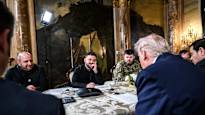

Zelensky Pushes for UK, French Troops in Ukraine Peace Deal as US Engagement and Recovery Efforts Intensify
Kyiv, Ukraine – Ukrainian President Volodymyr Zelensky has called for the deployment of British and French military forces in Ukraine as a cornerstone of any viable peace agreement with Russia, emphasizing the need for robust security guarantees amid ongoing geopolitical tensions. The proposal, voiced on January 4, 2026, underscores Kyiv's insistence on international peacekeeping presence to deter future aggression, even as parallel developments highlight growing calls for deeper U.S. involvement in peace support and international aid for Ukraine's war-ravaged agriculture sector.
Zelensky's statement marks a significant escalation in Ukraine's diplomatic strategy, framing foreign military presence as non-negotiable for lasting stability. Speaking on the heels of stalled negotiations, the Ukrainian leader argued that only a physical commitment from key NATO allies like the United Kingdom and France could ensure compliance with a potential ceasefire. This comes at a time when Russia continues its military operations in eastern Ukraine, with recent reports indicating intensified fighting around key Donbas cities despite intermittent diplomatic overtures.
The proposal arrives amid broader international discussions on Ukraine's future. A recent report from Finnish public broadcaster Yle highlights mounting pressure for the United States to assume a more assertive role in bolstering peace efforts. Published on January 6, 2026, the article details sentiments from European stakeholders urging Washington to deepen its involvement, potentially through enhanced diplomatic mediation or additional security assurances. This aligns with historical U.S. commitments, including over $60 billion in military aid since Russia's full-scale invasion in February 2022, though recent U.S. policy shifts under successive administrations have emphasized burden-sharing among NATO allies.
"Stronger U.S. engagement is seen as pivotal to tipping the scales toward a sustainable peace," the Yle piece notes, reflecting views from Nordic and Baltic leaders who view American leadership as essential to counterbalance Russian influence. While specifics on U.S. responses remain unclear, the call echoes prior frameworks like the 2022 NATO Strategic Concept, which designated Russia as the most significant threat to allied security.
Complementing these security-focused developments, humanitarian and economic recovery initiatives are gaining traction. On the same day as the Yle report, the Food and Agriculture Organization of the United Nations (FAO) unveiled a comprehensive three-year emergency and early recovery plan tailored for Ukraine's agricultural sector. Prioritizing vulnerable rural families and small-scale farmers, the initiative focuses on safeguarding food production, restoring productive assets, and rehabilitating damaged farmland.
Ukraine, once known as Europe's breadbasket, has suffered devastating losses since 2022, with over 20% of its arable land contaminated by mines and explosives, according to UN estimates. The FAO plan, detailed in a ReliefWeb report, aims to address these challenges through targeted interventions, including seed distribution, equipment provision, and land clearance programs. "This is about not just survival, but rebuilding resilience in the face of protracted conflict," an FAO spokesperson stated in the announcement.
Background on Ukraine's Geopolitical Stalemate
The Russia-Ukraine war, now entering its fifth year, stems from Moscow's February 2022 invasion, which it justified as a "special military operation" to "denazify" and demilitarize Ukraine. Kyiv and its Western backers have consistently rejected these claims, viewing the conflict as an unprovoked act of aggression violating international law, including the 1994 Budapest Memorandum where Russia pledged to respect Ukraine's sovereignty in exchange for its nuclear disarmament.
Previous peace initiatives, such as the 2014-2015 Minsk agreements and 2022 Istanbul talks, faltered over issues like troop withdrawals, territorial control, and security guarantees. Zelensky's latest demand for UK and French forces revives discussions of "peacekeeping" models seen in past European conflicts, such as the UN missions in the Balkans during the 1990s. France and the UK, as permanent UN Security Council members and nuclear powers, have provided substantial aid—France over €3 billion in military support and the UK £7.8 billion since 2022—making them logical candidates for such a role.
However, Russia has repeatedly dismissed foreign troop deployments on its borders as provocative, with Kremlin spokespeople labeling them "NATO expansionism." Moscow's demands in negotiations have centered on Ukraine's neutrality, demilitarization, and recognition of annexed territories like Crimea and parts of Donetsk and Luhansk.
Outlook Amid Recovery Push
As diplomatic rhetoric heats up, the FAO's agricultural plan signals a dual-track approach: immediate security alongside long-term reconstruction. With Ukraine's grain exports critical to global food security—accounting for 10% of world wheat trade pre-war—the recovery effort could mitigate famine risks in Africa and the Middle East, where disruptions have already driven up prices.
Analysts note that Zelensky's proposal tests Western resolve, particularly with U.S. elections and European budgetary constraints looming. NATO Secretary General Jens Stoltenberg has previously endorsed "credible security guarantees" for Ukraine, though specifics remain elusive. The convergence of U.S. involvement calls, Zelensky's military ask, and FAO initiatives paints a picture of multifaceted international support, yet the path to peace hinges on breakthroughs in high-level talks.
For now, Ukraine balances frontline defenses with recovery imperatives, as global attention refocuses on ending a conflict that has claimed hundreds of thousands of lives and displaced millions.
(Word count: 712)






