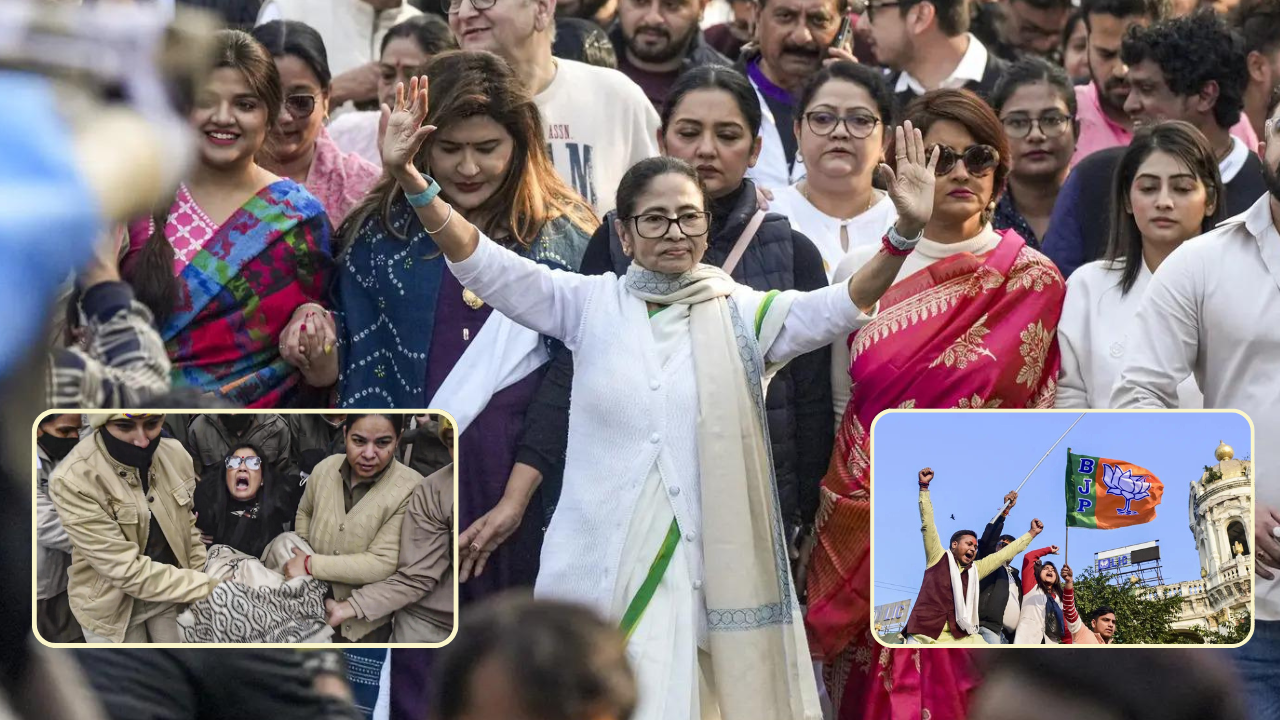

West Bengal Erupts in Political Tensions as Mamata Banerjee Leads Protest Against Enforcement Directorate Raids
Kolkata, India – West Bengal Chief Minister Mamata Banerjee took to the streets on Friday, leading a protest against the Enforcement Directorate (ED) amid accusations of central government misuse of investigative agencies ahead of upcoming state elections. The demonstration, which escalated into significant public unrest, follows ED raids on I-PAC, a political consultancy firm linked to Banerjee's Trinamool Congress (TMC), triggering a cascade of legal and political confrontations including an FIR against ED officials and courtroom disruptions.
The events unfolded on January 9, 2026, intensifying the already charged political atmosphere in poll-bound West Bengal. Banerjee, spearheading the protest, publicly accused the BJP-led central government of weaponizing the ED to target opposition leaders and undermine the state's ruling TMC ahead of the 2026 assembly elections. Her rally drew large crowds, highlighting growing public discontent over perceived federal overreach in state matters.
At the heart of the controversy are ED raids conducted on offices of I-PAC, the Indian Political Action Committee, a firm that provided strategic consulting services to the TMC during previous election campaigns. The raids, part of an ongoing probe into alleged financial irregularities, prompted Banerjee to intervene, reportedly pressuring authorities to halt the operations. This alleged interference led to sharp rebukes from central agencies and the BJP, who accused the chief minister of obstructing justice.
In a dramatic escalation, an FIR was filed against ED officials following the protests, with TMC supporters alleging misconduct during the raids. Simultaneously, a related court hearing descended into chaos, resulting in an adjournment as heated exchanges unfolded between lawyers representing the TMC and the ED. Both sides traded accusations: the TMC claimed the raids were politically motivated harassment timed to derail their campaign machinery, while the ED and BJP countered that the actions were routine enforcement against money laundering and electoral bond violations.
Escalating Legal and Street-Level Clashes
The courtroom pandemonium underscored the deepening rift. Witnesses described scenes of shouting matches and procedural halts, with the judge postponing proceedings to restore order. This legal turmoil coincided with street protests led by Banerjee, where demonstrators blocked key roads in Kolkata, raising slogans against the "misuse of central agencies." Police reported minor skirmishes but no major injuries, classifying the unrest as medium severity with potential for wider mobilization if tensions persist.
Banerjee's direct involvement marks a bold escalation in her long-standing feud with the center. During the rally, she reiterated familiar grievances, framing the ED actions as part of a broader pattern of vendetta politics. "The Centre is using agencies to crush democracy in Bengal," she was quoted as saying in reports from the scene, vowing to protect her party's workers and consultants from what she called "witch hunts."
Opposition voices from the BJP dismissed the protests as theatrical distractions. State BJP leaders argued that the ED raids exposed TMC's opaque funding through electoral bonds and consultancy deals, urging judicial independence over political theater.
Background: A History of Agency-State Frictions
West Bengal's political landscape has been marked by recurrent clashes between the TMC-led state government and central probe agencies since Banerjee's 2011 victory, which ended three decades of Left Front rule. The ED and CBI have conducted multiple high-profile investigations into alleged scams, including the multi-crore school jobs recruitment irregularities, cattle smuggling rackets, and coal pilferage cases involving TMC functionaries. Banerjee has consistently labeled these as "payback" by the BJP after her party's strong performance in the 2021 assembly polls and 2024 Lok Sabha elections, where TMC emerged as the third-largest party nationally.
I-PAC's role adds a contemporary layer. The consultancy firm gained prominence for its data-driven strategies that helped TMC secure victories, but it has faced scrutiny over payments routed through electoral bonds, which the Supreme Court recently declared unconstitutional. The ED probe into I-PAC stems from these transactions, alleging violations of the Prevention of Money Laundering Act (PMLA).
This episode fits into a national pattern where opposition-ruled states accuse the Modi government of selective enforcement. Similar protests have erupted in states like Maharashtra and Jharkhand, where ED actions against ruling party leaders preceded assembly elections.
Outlook: Simmering Tensions Ahead of Polls
As West Bengal braces for the 2026 assembly elections, Friday's events signal heightened mobilization on both sides. The TMC is likely to leverage the protests to rally its base against "Delhi's interference," potentially galvanizing voter turnout. Conversely, the BJP aims to capitalize on anti-corruption narratives, positioning itself as a check against alleged TMC malfeasance.
Authorities remain vigilant, with additional police deployments in Kolkata to prevent unrest from spilling over. Legal battles over the FIR and raids will continue, possibly reaching higher courts. Analysts note that while the protests have not yet disrupted daily life significantly, sustained demonstrations could test the state's law-and-order machinery.
The incident underscores the fragile balance of federalism in India, where investigative autonomy intersects with electoral politics. With polls looming, both camps are bracing for a fiercely contested battleground, where agency raids have become as much a campaign flashpoint as traditional issues like unemployment and welfare schemes.
(Word count: 712)






