
Volcano Philippines: U.S. Deploys Anti-Ship Missiles for Balikatan 2026 Exercises
In the escalating Volcano Philippines regional dynamics, U.S. anti-ship missiles have been deployed to the Northern Philippines near the Luzon Strait for planned military exercises during Balikatan 2026, involving around 1,300 Marines and Sailors.[1] This deployment comes amid heightened activities, including China's live-fire drills in waters near Luzon featuring sea-air coordination and rapid maneuvers to test combat capabilities,[2] Japan's participation in military exercises in the Philippines,[2] the Philippines' push for a South China Sea code of conduct by year-end as articulated by Foreign Affairs Secretary Theresa Lazaro,[4] former President Rodrigo Duterte's impending International Criminal Court trial for crimes against humanity linked to alleged extrajudicial killings,[3] and President Ferdinand Marcos Jr.'s scheduled state visit to Japan, the first by an incumbent Filipino leader since 2015.[5]
These developments underscore a multifaceted landscape of military posturing, diplomatic maneuvering, and legal accountability in the Philippines and surrounding waters, where strategic waterways like the Luzon Strait and South China Sea remain focal points for international attention.
Current Military Deployments and Exercises
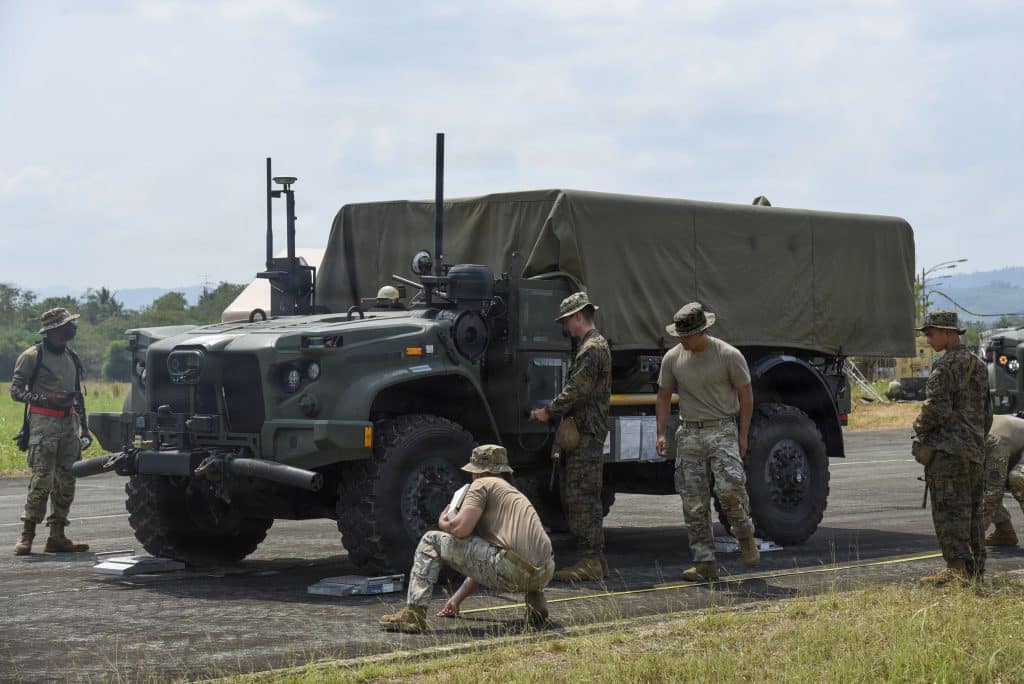
The United States has positioned American anti-ship missile launchers in the Northern Philippines, specifically near the Luzon Strait, as part of preparations for Balikatan 2026.[1] This strategic placement supports planned maritime strike, coastal defense, and sea denial operations, reflecting a focus on enhancing capabilities in contested maritime environments.[1] Approximately 1,300 Marines and Sailors from the Hawaii-based 3rd Marine Littoral Regiment have arrived in the Southeast Asian archipelago to participate in what is described as Washington and Manila's largest annual military exercise.[1]
Balikatan, a longstanding bilateral exercise between the U.S. and the Philippines, emphasizes interoperability and readiness in the region. The involvement of the 3rd Marine Littoral Regiment highlights the U.S. Marine Corps' emphasis on littoral operations, which are critical for operations in island chains and near-shore areas like those around Luzon.[1] The Luzon Strait, positioned between the main Philippine island of Luzon and Taiwan, serves as a vital chokepoint for maritime traffic, making the deployment particularly noteworthy in the context of regional security concerns.[1]
Complementing these U.S. efforts, Japan is actively participating in military exercises in the Philippines alongside these developments.[2] This trilateral alignment—U.S., Philippines, and Japan—signals deepening alliances aimed at bolstering collective defense postures in Southeast Asia. The exercises are timed against a backdrop of ongoing regional tensions, where such deployments and drills serve to demonstrate resolve and capability in potential conflict scenarios.[1][2] The scale of the U.S. contingent, numbering around 1,300 personnel, underscores the commitment to sustaining a robust presence, with anti-ship missiles positioned to counter potential naval threats effectively.[1]
These activities are not isolated; they form part of a broader pattern of allied military engagements designed to ensure freedom of navigation and deterrence in key straits and seas.[1][2]
Regional Security Drills by China
China has conducted live-fire drills in waters near Luzon, incorporating a range of tactical elements to evaluate its forces' performance.[2] The exercises featured live-fire shooting, sea-air coordination, rapid maneuvers, and maritime replenishments, all aimed at testing integrated joint combat capabilities.[2] These drills, occurring in proximity to Philippine territory, highlight Beijing's focus on refining operational proficiency in dynamic maritime settings.[2]
The inclusion of sea-air coordination points to an emphasis on synchronized operations between naval vessels and aircraft, a critical aspect for modern naval warfare.[2] Rapid maneuvers suggest training for high-speed tactical repositioning, potentially to evade threats or seize advantages in contested waters.[2] Maritime replenishments, meanwhile, demonstrate logistical sustainment at sea, essential for extended operations far from home bases.[2] Taken together, these components form a comprehensive test of China's ability to execute complex, multi-domain combat scenarios near the Luzon area.[2]
In the context of Volcano Philippines tensions, these Chinese activities occur parallel to U.S. and allied deployments, raising questions about escalation dynamics in the region.[2] The proximity to Luzon, a key Philippine island facing the South China Sea and Luzon Strait, amplifies the strategic implications, as such drills could signal preparedness for scenarios involving territorial disputes or blockades.[2] While the drills are framed by China as routine capability assessments, their timing alongside Balikatan preparations and Japanese involvement in Philippine exercises adds layers to the regional security calculus.[1][2]

Chinese forces conduct live-fire drills in waters near Luzon. — Source: japantimes
Diplomatic Efforts in the South China Sea
The Philippines is advocating for the finalization of a code of conduct in the South China Sea by the end of the year, a position emphasized by Foreign Affairs Secretary Theresa Lazaro.[4] Speaking at a panel at Atma Jaya University in Jakarta, Lazaro described completing the code this year as "something that we owe the world as well as the..."—underscoring Manila's sense of international responsibility amid protracted negotiations.[4]
This push aligns with the Philippines' role as chair of the ASEAN bloc, particularly as Southeast Asian leaders gathered in Cebu for the 48th ASEAN summit on May 8.[4] While immediate issues like the global energy crunch dominated the agenda, the year-end deadline for the long-delayed code looms large.[4] The code of conduct, intended to manage tensions among claimant states including China and ASEAN members, has been in discussion for years, with the Philippines positioning itself as a proactive mediator.[4]
Lazaro's remarks reflect a diplomatic strategy blending urgency with multilateralism, aiming to establish binding rules for behavior in the resource-rich and strategically vital South China Sea.[4] This effort occurs against the backdrop of frequent incidents involving Philippine and Chinese vessels, making the code a potential stabilizing measure.[4] The Philippines' insistence on a timely conclusion signals confidence in ASEAN's collective leverage, even as external powers like the U.S. and Japan engage in nearby military activities.[1][2][4]
These diplomatic initiatives complement military postures, forming a dual-track approach to safeguarding Philippine interests in disputed waters.[4]
Legal Proceedings Involving Philippine Leadership
Former Philippine President Rodrigo Duterte is set to face trial at the International Criminal Court (ICC) in The Hague for crimes against humanity.[3] ICC judges confirmed charges against Duterte on Thursday related to dozens of alleged extrajudicial killings carried out during his tenure.[3]
The proceedings stem from Duterte's controversial war on drugs, which resulted in thousands of deaths, many attributed to police operations and vigilante actions.[3] The ICC's involvement follows Manila's withdrawal from the court in 2019, but the court retained jurisdiction over alleged crimes committed while the Philippines was a member.[3] Confirmation of the charges marks a significant step, paving the way for a full trial where prosecutors will present evidence of systematic killings qualifying as crimes against humanity.[3]
Duterte's case draws international scrutiny to issues of accountability for high-level officials in domestic security campaigns.[3] The trial's outcome could set precedents for similar cases globally, particularly in nations grappling with narcotics-related violence.[3] For the Philippines, it represents a moment of legal reckoning amid ongoing political transitions under President Marcos.[3]
This development unfolds parallel to external pressures in the South China Sea and military alliances, illustrating the multifaceted challenges facing Philippine leadership.[3]

Former Philippine President Rodrigo Duterte faces an ICC trial for crimes against humanity. — Source: africanews
Upcoming International Visits and Summits
Philippine President Ferdinand Marcos Jr. is scheduled to undertake a state visit to Japan, marking the first such trip by an incumbent Filipino leader since 2015.[5] This high-level engagement signals strengthening bilateral ties between Manila and Tokyo, key allies in countering regional challenges.[5]
The visit follows patterns of elevated diplomacy, including the recent ASEAN summit in Cebu where South China Sea issues were prominent.[4] Marcos' itinerary with Japan emphasizes economic, security, and strategic cooperation, building on Japan's participation in Philippine military exercises.[2][5] As the first state visit in nearly a decade, it holds symbolic weight, reinforcing commitments forged through frameworks like the Quadrilateral Security Dialogue's broader Indo-Pacific partnerships.[5]
Concurrently, the Philippines' hosting of the 48th ASEAN summit highlighted its chairmanship priorities, with the South China Sea code of conduct as a centerpiece.[4] Foreign Affairs Secretary Lazaro's advocacy for year-end finalization ties into these summits, positioning Marcos' Japan visit as a complementary outreach to non-ASEAN partners.[4][5]
These events collectively aim to weave diplomatic gains with security enhancements, addressing Volcano Philippines pressures through diversified international relations.[4][5]
Japan's Participation in Regional Military Exercises
Japan's involvement in military exercises in the Philippines represents a key pillar of trilateral cooperation amid rising regional tensions.[2] As China conducts live-fire drills near Luzon, Japan's decision to join these activities alongside the U.S. and Philippines underscores a unified front.[2]
The exercises provide opportunities for Japan Self-Defense Forces to integrate with allies, focusing on interoperability in maritime domains.[2] This participation aligns with Tokyo's strategic pivot toward Southeast Asia, where shared concerns over sea lanes and territorial integrity prevail.[2] In the context of Balikatan 2026 preparations, Japan's role enhances the overall exercise's scope, incorporating advanced capabilities in sea-air coordination and joint maneuvers.[1][2]
Japan's engagement extends beyond drills to diplomatic support, as evidenced by hosting President Marcos, fostering momentum for collective deterrence.[2][5] This multifaceted involvement bolsters the Philippines' position, creating a network of alliances to navigate provocations like China's nearby drills.[2]
What to watch next: Monitor progress on the South China Sea code of conduct deadline set by the Philippines for year-end,[4] outcomes from President Marcos' state visit to Japan,[5] and any escalation in military drills near Luzon by China or U.S.-led exercises.[1][2]