
US Strikes Hit Iranian Cities and Railway Bridge as Iran Launches Attacks on Gulf Bases
US forces carried out fresh Iran strikes on multiple sites across the country, including southern cities and a northeastern railway bridge, after which Iran launched missile and drone attacks on US bases in Kuwait and Bahrain.
US Launches New Strikes Across Iran
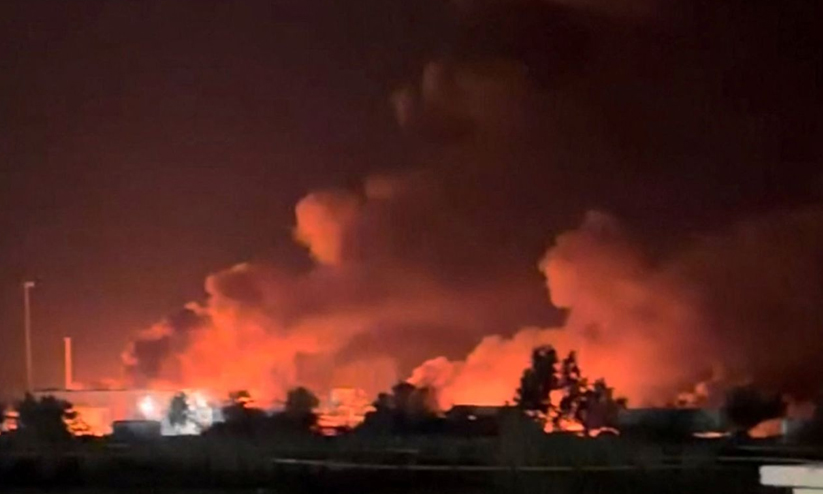
US military strikes hit Iranian cities including Iranshahr, Bandar Abbas, Bushehr, Konarak, Chabahar and Aq Qala. [1] The attacks targeted an airport in Iranshahr, a maritime control tower and a depot in Chabahar, and a railway bridge in Aq Qala. [1] At least three deaths were reported in one location, with an Iranian firefighter killed during the strike on the Iranshahr airport. [1] Iranian media reported that the US carried out the attacks on Wednesday following strikes the previous day on Bandar Abbas and Bushehr. [1] The operations formed part of a broader response to incidents involving commercial vessels in the Strait of Hormuz. [4]
Iran Retaliates Against US Bases in Gulf
Iran responded by launching missiles and drones at US military centers in Kuwait and Bahrain. [1] Air raid sirens sounded across Kuwait after drones and missiles crossed the border early in the morning, and Kuwaiti forces reported intercepting the incoming projectiles. [1] In Bahrain, air raid sirens also activated in response to the Iranian strikes. [1] An Iranian parliament National Security Committee spokesperson warned that Iran would deliver a strong response to the US actions. [1] These moves came as the second consecutive day of escalation in the Gulf region. [1]
Trump Declares Ceasefire Over
US President Donald Trump declared the June Memorandum of Understanding over and stated he no longer wanted to deal with Iranian officials. [3] He warned that further Iranian attacks would be met with harsher measures, including a possible full naval blockade or strikes on power and water facilities. [1] Trump indicated that the United States would not hesitate to seize Iran's Kharg Island if needed. [1] He also noted that Iran had recently contacted the United States seeking a new agreement but expressed doubt about whether Iranian officials would honor any deal. [5] Trump added that any future Iranian offensive would face a response twenty times stronger than the initial action. [5]
Strait of Hormuz at Center of Conflict
The latest round of fighting followed the collapse of the June Memorandum of Understanding that had aimed to end prior conflict and reopen the Strait of Hormuz to full shipping traffic. [1] Under the agreement, Iran had pledged to restore merchant vessel transit through the strait to pre-war volumes within 30 days, while the United States had agreed to lift its naval blockade. [3] Disputes over freedom of navigation persisted, with Iran asserting it would decide security arrangements and the United States maintaining that the waterway is an international route open to all vessels. [1] Earlier tanker attacks in the strait prompted the renewed US operations. [2] CENTCOM stated that the strikes sought to degrade Iran's ability to threaten navigation in the strait. [4]
Oil Prices Spike on Escalation Fears
Oil prices rose about 1% on global markets amid fears over disruption to the Strait of Hormuz, through which one-fifth of world oil supply passes. [2] Brent crude increased 78 cents to $78.80 per barrel, while West Texas Intermediate rose 74 cents to $74.26 per barrel. [2] The gains followed earlier jumps of more than $1 per barrel after the start of the latest US strikes. [2] Analysts noted that recent increases in oil shipments through the strait were unlikely to continue as ship owners adopted a more cautious stance. [2]
Expanding Scope of US Operations
US operations expanded to northern Iranian targets such as the Aq Qala railway bridge, located far from the southern strait. [4] The strike on the bridge occurred roughly 900 miles from the Strait of Hormuz, marking a widening of the operational area. [4] CENTCOM described the additional strikes as intended to protect freedom of navigation by reducing Iran's capacity to threaten shipping. [4] Iranian reports confirmed damage to the railway bridge and noted explosions heard in the Golestan region. [4] The shift followed an earlier focus on southern military infrastructure near the strait. [4]
What to watch next: Further statements from CENTCOM on additional targets and any Iranian parliamentary response to the latest exchanges remain key developments to monitor.