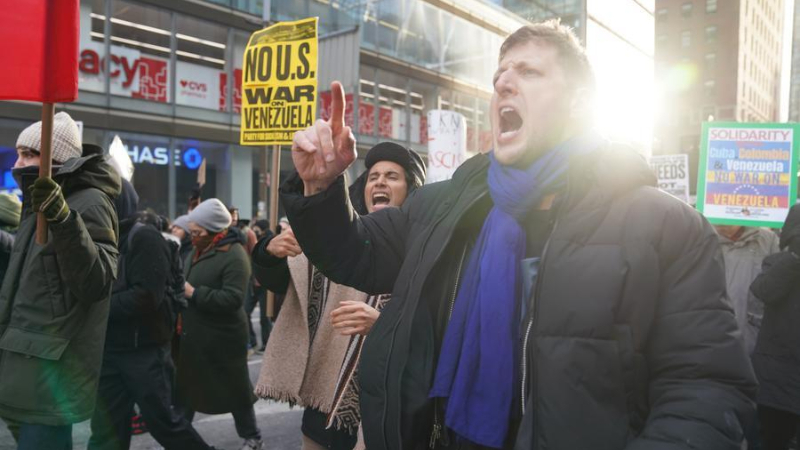

US Special Forces Conduct Raid in Caracas, Seizing Maduro Amid Reports of Explosions
Caracas, Venezuela — Early on January 3, 2026, at least seven explosions rocked Venezuela's capital, Caracas, coinciding with sightings of low-flying aircraft overhead. US special forces carried out a raid in the city, seizing President Nicolas Maduro and his wife, Cilia Flores, according to reports from international media. The operation has plunged the oil-rich nation into political uncertainty, with US President Donald Trump stating that the United States would "run" the country.
The incident, described as a critical strike event, began around 07:22 GMT on Saturday, January 3. Eyewitness accounts and initial reports highlighted the dramatic nature of the pre-dawn activity, with explosions reported across key areas of Caracas and military-style aircraft maneuvering at low altitudes. While specific casualty figures remain unconfirmed, the severity has been rated as critical by monitoring sources.
Details of the raid emerged in subsequent coverage. France24's media analysis program "Scoop," aired on January 9, detailed how US forces targeted Maduro's residence or nearby locations in the capital. The program referenced Trump's public remarks following the operation, in which he asserted direct US involvement in Venezuela's governance. "The United States would 'run' the country," Trump was quoted as saying, leaving the nation's political and economic future in limbo. Venezuelan writer Vicente Ulive appeared on the show, discussing the role of international media in preceding events.
Conflicting International Perspectives
Global reactions have been sharply divided. A commentary from China's Xinhua News Agency, published on January 9, framed the US action as a "defining moment in the erosion of American hegemony." The piece criticized the strike as an overreach, linking it to broader geopolitical shifts where US influence is perceived to be waning amid challenges from rising powers. Xinhua portrayed the event as emblematic of Washington's aggressive foreign policy tactics in Latin America.
France24's segment, meanwhile, examined Western media coverage in the lead-up to January 3. It questioned whether mainstream outlets had "manufactured consent" for the US intervention by emphasizing Venezuela's economic collapse, human rights abuses under Maduro, and ongoing political opposition. The discussion highlighted how reporting on hyperinflation, mass emigration, and disputed 2018 and 2024 elections may have shaped public opinion, potentially paving the way for military action.
No official statements from the Venezuelan government were immediately available following the raid, given Maduro's detention. Opposition figures and interim leaders have not yet commented publicly in the cited sources.
Background on Venezuela-US Tensions
Venezuela has been mired in crisis since 2013, when Maduro succeeded Hugo Chávez amid protests over economic mismanagement. Hyperinflation peaked at over 1 million percent in 2018, prompting millions to flee. The US has imposed sanctions since 2017, targeting Maduro's regime for alleged corruption, election fraud, and human rights violations. In 2019, the US recognized opposition leader Juan Guaidó as interim president, though his influence waned.
Trump's administration escalated pressure, including asset freezes and bounties on Maduro allies. Maduro retained power through contested votes, backed by Russia, China, Cuba, and Iran. Recent years saw partial sanctions relief under Biden but renewed hawkishness post-Trump's 2024 reelection. The January 3 raid marks the most direct US military involvement to date, diverging from prior covert operations like those against Colombian drug cartels or Iranian proxies.
The operation echoes historical US interventions in the region, such as the 1989 Panama invasion or 1965 Dominican Republic occupation, though on a smaller scale. Low-flying aircraft and explosions suggest precision strikes, possibly involving drones or helicopters, consistent with special forces tactics.
Uncertainty Looms Over Venezuela's Future
Venezuela's political landscape remains fluid. With Maduro and Flores in US custody, questions swirl about succession, oil production (vital to global markets), and regional stability. Neighboring countries like Colombia and Brazil have expressed concern over potential refugee surges or border tensions.
International observers await clarity on Maduro's legal status and US intentions. Trump's "run the country" comment raises fears of a transitional administration, potentially involving opposition exiles or US advisors. Economic recovery hinges on lifting sanctions and stabilizing PDVSA, the state oil company.
As of January 9, 2026, no further military actions have been reported, but the strikes underscore deepening US-Latin America frictions. Global powers continue to monitor developments closely.
(Word count: 612)






