
U.S. Military Action in Venezuela Marks Significant Escalation in Foreign Policy
In a dramatic turn of events, the United States has initiated military action against Venezuela, culminating in the capture of President Nicolás Maduro. This operation, which began on January 3, 2026, represents a significant escalation in U.S. foreign policy and a decisive attempt by President Donald Trump to effect regime change in Caracas.
Early on Saturday, U.S. forces executed coordinated strikes across multiple targets in the Venezuelan capital, Caracas. According to reports, these actions were aimed at dismantling Maduro's hold on power. President Trump confirmed the operation in a statement, asserting that the U.S. will oversee Venezuelan governance until a "proper" transition can be established. "We will run Venezuela for now," he declared, emphasizing the United States’ commitment to restoring stability in the region.
Details of the Military Operation
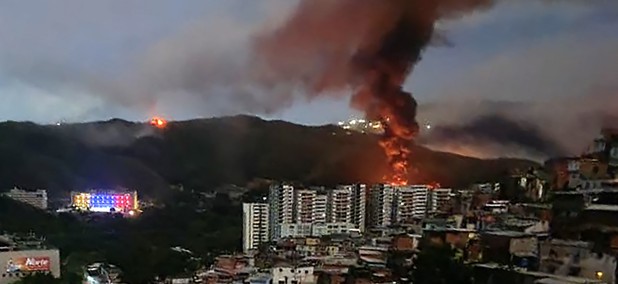
The U.S. military action appears to have been swift and decisive, with reports indicating that Maduro was captured during the assault. Eyewitness accounts from Caracas describe explosions and heavy gunfire as U.S. forces targeted key government facilities. While specific details regarding the operation's execution remain scarce, Trump’s administration has framed the intervention as a necessary response to the ongoing humanitarian crisis in Venezuela, which has seen millions displaced and suffering from severe economic instability.
The operation has drawn mixed reactions domestically and internationally. Supporters of the military action argue that it is a necessary step to liberate the Venezuelan people from authoritarian rule, while critics caution against the potential for further destabilization in an already fragile region.
Reactions and Implications
The international community has been closely monitoring the situation. While some countries have expressed support for U.S. actions, others, particularly within Latin America and among nations such as Russia and China, have condemned the intervention as an infringement on Venezuela's sovereignty. The Organization of American States (OAS) is expected to convene an emergency session to address the unfolding crisis.
In the wake of the military action, there are concerns regarding the potential for violence and unrest within Venezuela. Humanitarian organizations are warning that the situation could deteriorate further, with millions already facing food shortages and health crises. The U.S. has stated that it will prioritize humanitarian efforts in the region as it seeks to stabilize the country.
Background Context
The backdrop to this military action is Venezuela’s prolonged political and economic crisis, which has roots in years of mismanagement, corruption, and failed policies under Maduro’s government. The country has been mired in a humanitarian disaster, with hyperinflation and widespread poverty prompting mass emigration and protests.
Previous attempts at diplomatic solutions have largely failed, and the U.S. had previously imposed sanctions on Maduro and his inner circle in an effort to pressure his government to relinquish power. This latest military intervention marks a significant shift from prior strategies, reflecting the Trump administration's willingness to engage militarily in pursuit of its foreign policy objectives.
Conclusion
As the situation develops, the world will be watching closely to see how the U.S. manages its new role in Venezuela. The potential ramifications of this military action could reshape not only Venezuelan politics but also U.S. relations across Latin America and beyond. With both supporters and detractors of the operation voicing strong opinions, the coming days and weeks will be critical in determining the future of Venezuela and the broader geopolitical landscape in the region.






