Ukraine Conflict Sees Russian Battlefield Advances Lose Momentum
Russian advances on the battlefield in the Ukraine conflict have slowed despite months of intensified bombardment of Ukrainian towns and cities, according to analysts, while Russian military bloggers express alarm over Ukraine’s repeated successful drone and missile strikes on Russian energy and defense industry targets deep inside Russia. [1][2]
Slowing Russian Ground Offensive
Analyst assessments indicate that Russian battlefield advances in the Ukraine conflict have lost momentum after more than four years of invasion. The Russian defense ministry’s statements claiming captures of towns and villages have become less frequent. In some areas, Ukrainian forces have managed to gain a foothold. [1] More than four years into its invasion, these statements claiming to have captured settlements have become less regular. Ukrainian troops have achieved counter-gains in certain sectors, signaling a loss of steam on the ground despite earlier momentum. [1] The pattern shows fewer regular announcements of territorial gains by Russian forces, which analysts tie directly to the slowing offensive pace. [1]
Intensified Russian Bombardment of Ukrainian Cities
The contrast between ongoing Russian strikes on urban areas and the slowing ground progress remains stark. Ukrainian towns and cities have suffered months of intensifying Russian bombardment. [1] One such strike hit Dnipro on June 3, with smoke rising over the city following the attack. [1] This bombardment continues even as Russian claims of captured settlements grow less frequent, highlighting the divergence between aerial pressure and ground results. [1] Pedestrians in Dnipro witnessed the immediate aftermath, underscoring the sustained focus on cities amid the battlefield slowdown. [1]
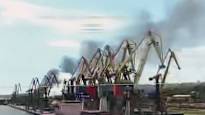
Russian military bloggers warn that Russian air defense could not withstand war against Western countries. — Source: ylenews
Ukrainian Strikes Deep Inside Russia
A Ukrainian strike using FP-5 Flamingo cruise missiles targeted an electronics factory in Cheboksary, central Russia. The facility produced satellite antennas resistant to electronic jamming for Russian missiles, and the attack left the plant completely ruined. [2] One or more FP-5 Flamingo missiles struck the strategically important site. Images posted on X show the factory fully destroyed. [2] The missiles flew more than a thousand kilometers over Russian territory and remained airborne for at least one hour and fifteen minutes. [2] They lacked stealth features and did not fly low following terrain, yet reached the target. [2] Ukraine fired five Flamingo missiles at the factory, and Russian forces intercepted three of them. [2] Public-source analysis by CyberBoroshno mapped the missiles’ route, which was designed to confuse defenses. [2]
Russian Military Bloggers’ Alarm Over Air Defense Failures
Prominent Russian bloggers such as Maxin Kalashnikov and Fighterbomber have voiced shock at Ukraine’s ability to strike energy and arms production facilities repeatedly. [2] They highlight major gaps in Russian air defense, noting that even simple cruise missiles the size of small jet aircraft flew straight from Ukrainian territory without being detected or shot down by fighters or air defenses. [2] Kalashnikov stated on Telegram that Russian air defense has huge holes because the missiles were not intercepted despite lacking any stealth capability. [2] Fighterbomber expressed surprise that the Flamingos were not shot down, pointing out that helicopters and anti-aircraft guns are ineffective against cruise missiles but other weapons have countered them for fifty years. [2] The bloggers conclude that either air defense failed or was absent altogether. [2] Ukraine’s own calculations show it has destroyed Russian air defense systems at an average rate of more than one per day. [2] Because Russia is a vast country, its air defenses now cover only the most important targets. [2]
{IMAGE_3}
Implications for a Potential Conflict with NATO
Bloggers conclude that Russia would be unable to counter hundreds or thousands of NATO cruise missiles in a potential conflict with the West. [2] Kalashnikov warned that if the United States or NATO countries attack and launch hundreds or thousands of Tomahawk, Storm Shadow or JASSM cruise missiles, Russia would suffer huge losses similar to Iraq in 1991 or Yugoslavia in 1999. [2] Russkii Inzhener noted that European military-industrial complexes are accelerating production of new missiles, with Ukraine expected to receive two new types in the autumn: the German-made Rutan and the U.S.-made Barracuda. [2] One Ukrainian aircraft can launch up to eight of these missiles, and twenty aircraft operating together could send 150 missiles simultaneously, overwhelming Russia’s limited air defenses. [2] Russkii Inzhener also forecasts Ukraine’s future use of ballistic missiles, with production reaching 500–700 per year, enabling launches of dozens at once. [2] The bloggers call for an urgent defense committee meeting to develop countermeasures, noting that no such body has been established even in the fifth year of the war. [2]
Emergence of AI-Driven Battlefield Systems
Ukrainian officials foresee future warfare evolving into a contest between AI-driven operating systems that process battlefield data faster and more effectively than human commanders. [3] Danylo Tsvok, director of the AI Research Center under Ukraine’s Ministry of Defense, stated that AI will create an entirely new model of warfare that has already begun. [3] Within three to five years, if the conflict continues, AI systems would connect into a unified network to monitor and coordinate the entire battlefield, turning the confrontation into a “war between operating systems.” [3] The system with more data, better understanding of that data, and superior optimal solutions would gain the advantage. [3] The center was established in March this year under Defense Minister Mykhailo Fedorov to integrate AI and data-driven decision-making into Ukraine’s core defense capabilities. [3] Ukraine already uses multiple AI tools in command-and-control systems for its approximately one-million-strong force, with a long-term goal of building a unified “battlefield operating system” that supports decisions from frontline units to strategic command. [3] The system would process vast data from the 1,200-kilometer front and provide operational recommendations to human commanders. [3] Both Ukraine and Russia are accelerating AI integration, with Moscow increasingly applying it to plan UAV and missile strikes on Ukrainian cities. [3] Ukraine maintains that final combat decisions must remain with humans, yet Tsvok warned that AI systems could soon process information and propose options faster than humans can react. [3]
What to watch next: Ukrainian production of new cruise missiles such as the Rutan and Barracuda, alongside 500–700 ballistic missiles annually, alongside continued expansion of AI battlefield networks by both sides. [2][3]