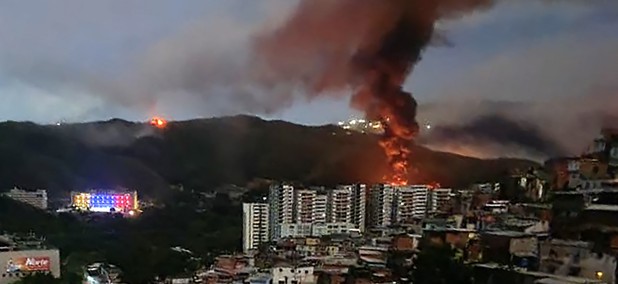

U.S. Military Action in Venezuela Marks Major Escalation in Foreign Policy
In a significant shift in foreign policy, the United States has launched military action against Venezuela, resulting in the capture of President Nicolás Maduro. This operation, which President Donald Trump described as a regime-change initiative, commenced early on January 3, 2026, and has resulted in the U.S. asserting control over the country until a "proper" transition can be established.
In a series of coordinated strikes, U.S. military forces targeted key sites in the Venezuelan capital, Caracas, leading to the swift capture of Maduro. President Trump announced the operation during a press conference, stating, “We will run Venezuela for now until we can ensure a stable and democratic government is in place.” The decision to intervene militarily comes amid a prolonged economic crisis and political turmoil in Venezuela, which has seen the country spiraling into chaos for years.
Details of the Military Operation
The U.S. military operation involved airstrikes and ground forces, which were deployed to secure critical infrastructure and government buildings in Caracas. According to reports from Defense One, the strikes targeted multiple locations to minimize resistance from Maduro's loyalists, who are known to control various sectors of the military and police forces. Early reports indicated that U.S. forces met minimal opposition as they moved to seize control of government facilities and communications.
The operation has been met with mixed reactions from the international community. While some countries have expressed support for the U.S. intervention as a means to restore democracy, others have condemned it as an act of aggression. "The sovereignty of Venezuela is paramount," said a spokesperson for the Russian government, echoing sentiments of several nations that view the U.S. actions as imperialistic.
Background Context
Venezuela has been embroiled in a multifaceted crisis for several years, characterized by hyperinflation, shortages of basic goods, and mass emigration. Maduro’s government has faced increasing pressure from both domestic opposition and international entities. In 2019, U.S. support for opposition leader Juan Guaidó marked the beginning of a series of escalating tensions, which have now culminated in military intervention.
The U.S. has long accused Maduro of authoritarianism and human rights abuses, and the current military action reflects a culmination of these concerns. Since President Trump took office in January 2025, his administration has adopted a more aggressive stance toward countries perceived as adversaries, with Venezuela being a focal point of this approach.
Implications for the Region
The U.S. military action in Venezuela could have significant ramifications for regional stability in Latin America. Neighboring countries, such as Colombia and Brazil, are closely monitoring the situation, aware that a shift in power dynamics could lead to new waves of migration or destabilization. The Organization of American States (OAS) has called for immediate dialogue among Venezuelan factions to prevent further violence.
“This military action is a double-edged sword; while it may bring an end to Maduro's regime, it also risks inciting further conflict and resistance,” warned a political analyst from the University of Caracas.
Conclusion
As the U.S. assumes control over Venezuela, the international community watches closely to see how this situation unfolds. President Trump’s commitment to oversee a transition to democracy raises questions about the duration of U.S. involvement and the future political landscape of Venezuela. With significant challenges ahead, both the U.S. and Venezuela are at a critical juncture that could redefine relations in the region for years to come.






