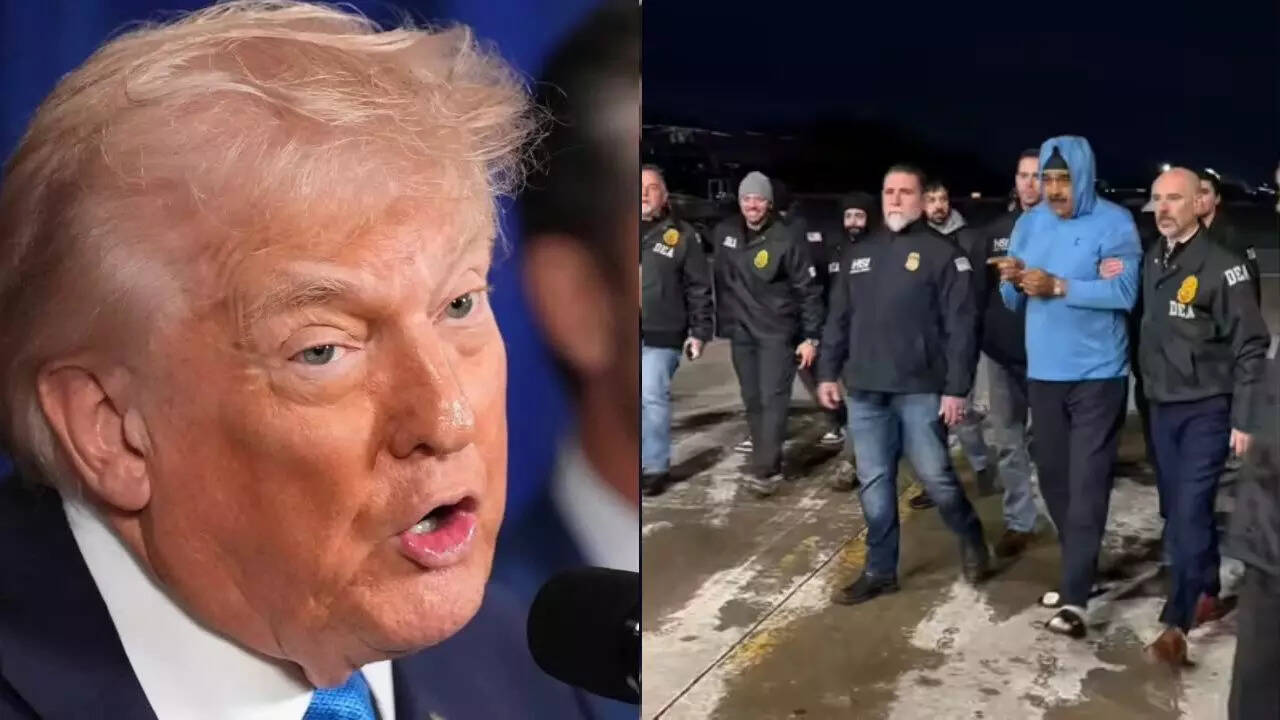

US Conducts Major Strike in Venezuela, Captures President Maduro Amid Explosions in Caracas
In a stunning escalation of tensions between the United States and Venezuela, US forces conducted a large-scale military operation in the South American nation, resulting in the capture of Venezuelan President Nicolás Maduro and his wife, Cilia Flores. The operation, which included pre-dawn airstrikes and at least seven reported explosions in the capital, Caracas, on January 3, 2026, marks an unprecedented use of military force in the region. US President Donald Trump announced the detention of Maduro, stating that he and his wife will face narco-terrorism and drug trafficking charges in New York.
The strikes began early Saturday morning, with low-flying aircraft observed over Caracas and multiple explosions rocking the city. Just days prior, on December 31, 2025, President Trump had announced a separate US drone strike targeting a facility allegedly linked to drug trafficking in Venezuela, reportedly involving a CIA-operated drone. These actions follow months of heightened US pressure on Maduro’s government, which Washington has long accused of leading a narco-terrorist organization and contributing to regional instability through drug trafficking, corruption, and support for illegal immigration.
According to reports, the operation to capture Maduro was executed with precision, though details about the exact circumstances of his detention remain scarce. The US has accused Maduro of orchestrating drug trafficking networks for years, charges that led to a $15 million bounty on his head by the US Department of Justice in 2020. Maduro now faces terrorism and drug-related charges in New York, raising questions about the legal and geopolitical ramifications of his capture.
Legal and International Concerns
The legality of the US operation has sparked intense debate among international law experts. Some argue that the strike and subsequent capture of a sitting head of state may violate international norms and Venezuela’s sovereignty. The Times of India reports that critics are questioning whether President Trump had the authority to order such an action without explicit congressional approval or broader international consensus. While the US justifies the operation as a necessary strike against narco-terrorism, the move risks inflaming tensions with Venezuela’s allies, including Russia, China, and Iran, who have historically supported Maduro’s regime.
Background: A History of Tension
US-Venezuela relations have been strained for decades, particularly since the rise of Hugo Chávez, Maduro’s predecessor, who positioned Venezuela as a counterweight to US influence in Latin America. Under Maduro’s leadership since 2013, Venezuela has faced economic collapse, hyperinflation, and widespread humanitarian crises, prompting millions to flee the country. The US has imposed sanctions, recognized opposition leader Juan Guaidó as the legitimate president in 2019, and repeatedly called for Maduro’s ouster. Accusations of drug trafficking against Maduro and his inner circle have been central to US policy, culminating in the recent military actions.
The strikes also come against the backdrop of Venezuela’s vast oil reserves, a critical factor in US interest in the region. As the Times of India notes, control over resources, alongside concerns about illegal immigration and regional security, likely influenced the decision to act decisively against Maduro’s government.
What Comes Next?
The capture of Maduro raises significant questions about Venezuela’s future. With the country’s leadership in disarray, a power vacuum could exacerbate existing instability, potentially leading to further violence or political upheaval. The international community is watching closely to see how the US handles Maduro’s prosecution and whether this operation will lead to broader military engagement in the region.
For now, the streets of Caracas remain tense following the explosions and military activity. The Venezuelan people, already burdened by years of crisis, face an uncertain path ahead as global powers weigh in on this dramatic turn of events. As the situation develops, the world awaits further clarity on the US’s next steps and the response from Venezuela’s allies on the international stage.






