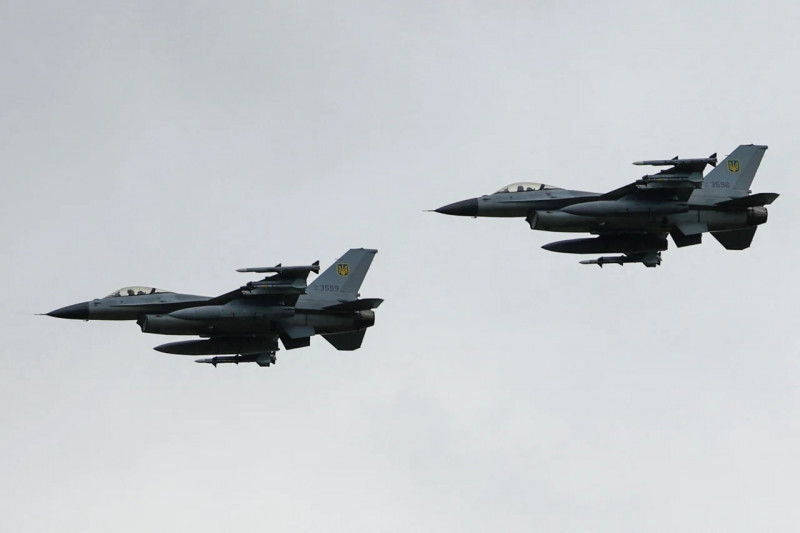

Ukrainian F-16 Pilots Pioneer Low-Altitude Tactics to Challenge Russian Air Superiority
Kyiv, Ukraine – Ukrainian pilots flying Western-supplied F-16 Fighting Falcons have reportedly developed innovative low-altitude combat tactics to evade Russian air defenses and deliver precise strikes against ground forces, marking a tactical evolution in the ongoing Russo-Ukrainian war.
The development, highlighted in recent reports from Taiwanese media outlet Liberty Times Net on January 7, 2026, underscores the adaptability of Ukrainian aviators amid a protracted conflict now entering its fourth year. Dubbed "贴地死鬥" or "low-altitude death fight" in Chinese-language coverage, the tactic involves pilots hugging the terrain at extremely low altitudes to avoid detection by Russian radar systems, allowing for close air support missions against advancing troops and armored units.
This adaptation comes as Ukrainian forces continue to grapple with Russia's numerical superiority in air power and advanced surface-to-air missiles (SAMs), such as the S-400 Triumph systems deployed across occupied territories. According to the report, standard NATO training doctrines for F-16 operations have proven insufficient against the dense Russian integrated air defense network, prompting Ukrainian pilots to improvise their own high-risk maneuvers.
Tactical Innovation Amid Resource Constraints
The new approach represents a departure from conventional high-altitude strikes, which expose aircraft to long-range threats. By flying "nap-of-the-earth" – skimming just above treetops, rivers, and urban landscapes – pilots minimize their radar cross-section and exploit the terrain for cover. This method, while increasing the risk of ground collisions and anti-aircraft fire from man-portable systems like the Pantsir-S1, enables surprise attacks on Russian convoys and fortifications.
Ukrainian military sources, as cited in the Liberty Times article, indicate that these tactics were born out of necessity following the delivery of F-16s in mid-2024. The jets, pledged by NATO allies including Denmark, the Netherlands, Norway, and Belgium, began combat operations last summer after Ukrainian pilots underwent accelerated training in Romania, Denmark, and the United States. Over 80 F-16s have been transferred or are en route, bolstering Ukraine's depleted air force, which has lost dozens of Soviet-era MiG-29s and Su-27s since Russia's full-scale invasion in February 2022.
The innovation highlights the pilots' combat experience. Many have logged hundreds of hours in dogfights and ground-attack missions, transitioning from older platforms to the multirole F-16, equipped with advanced avionics, AIM-120 AMRAAM missiles, and precision-guided munitions like JDAMs. "NATO tactics failing?" the article's headline questions rhetorically, suggesting that doctrinal rigidity from Western training clashed with the asymmetric realities of the eastern front.
Broader Context of the Air War
The Russo-Ukrainian conflict, triggered by Moscow's annexation of Crimea in 2014 and escalated by the 2022 invasion, has seen air superiority remain a decisive factor. Russia maintains an edge with over 1,300 combat aircraft, including Su-35 Flankers and Su-34 bombers, supported by layered defenses. Ukraine, by contrast, relies on a mix of donated Western jets, drones, and legacy Soviet aircraft, operating from dispersed bases to evade strikes.
F-16 integration has yielded mixed results. In late 2024, Ukrainian F-16s downed Russian cruise missiles and Shahmed drones during large-scale barrages, but losses to SAMs have been reported, including at least one jet in September 2024. The low-altitude tactic aims to shift the balance, particularly in hotspots like Donetsk and Kharkiv oblasts, where Russian mechanized offensives persist.
International observers note parallels to historical precedents, such as U.S. A-10 Thunderbolt pilots in Afghanistan employing terrain masking against Taliban MANPADS. NATO has acknowledged Ukraine's contributions to tactical knowledge-sharing, with briefings at Ramstein Air Base informing allied doctrines.
Ongoing Conflict Dynamics
As of early 2026, the front lines remain fluid. Russian forces control approximately 20% of Ukrainian territory, including Crimea and parts of Donbas, but advances have slowed due to Ukrainian counteroffensives, Western aid, and manpower mobilization. Kyiv's military reports over 700,000 Russian casualties, while Moscow claims similar figures for Ukraine. U.S. and European sanctions continue to strain Russia's war economy, though domestic production of munitions sustains the effort.
The F-16 tactic's emergence signals no immediate end to hostilities. Ukrainian President Volodymyr Zelenskyy has repeatedly called for additional air defenses and long-range weapons, while Russia vows to neutralize all NATO-supplied aircraft. Analysts from the Institute for the Study of War (ISW) track daily escalations, noting intensified Russian glide-bomb campaigns met by Ukrainian drone swarms.
Outlook for Aerial Operations
While the low-altitude strategy offers tactical gains, its sustainability depends on pilot training, aircraft attrition rates, and electronic warfare support. Sweden's planned delivery of more F-16s and potential F-35 discussions could further empower Ukraine's air arm. However, Russian adaptations, including enhanced low-level radars and hypersonic missiles, pose ongoing challenges.
This development reaffirms the conflict's role as a laboratory for modern warfare, where innovation bridges capability gaps. As fighting grinds on, Ukrainian F-16 pilots' ingenuity may prove pivotal in reclaiming skies over their homeland.
(Word count: 712)






