
Ukraine War Fuel Shortages Hit Moscow Petrol Stations as Strikes Target Refineries
In the ongoing Ukraine war, Russia is experiencing widespread fuel shortages and long queues at petrol stations across Moscow and other regions as Ukrainian drone and missile strikes target its oil refineries, while Russian forces lost another 1,260 soldiers in the past day according to Ukrainian estimates.
Fuel Crisis Grips Russian Capital and Regions
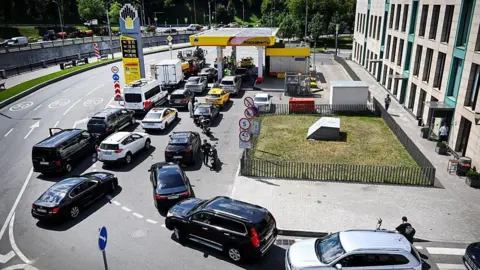
A fuel crisis is currently gripping Russia with long, daily queues at petrol stations. If you want to get a sense of the fuel crisis gripping Russia, all you need to do is spend a day driving around Moscow. At almost every petrol station we passed there was a queue of cars and lorries. Some lines were long, some short; some static, others moving steadily. If there was no queue, that meant the garage had run out of fuel entirely and was closed. Remember: this is Moscow, the wealthy, populated capital that draws in so much of Russia's vast resources. Even here the authorities cannot ensure there is enough petrol and diesel to keep Muscovites on the road. [1]
Yet, in the queues, the mood was more frustrated than angry. Yekaterina told us she was "not happy" and there was "panic because everybody thinks there will be no oil". But it would OK, she said, "we just need to reorganise the oil distribution". The situation according to Elmar was "very bad" and he complained prices were going up as fuel stocks ran low. "You are wasting hours to fill up," he said. "At the moment I am planning a trip to Dagestan but I don't know if I should drive there or not because there are so many problems with petrol." I asked him who was to blame. "In our country, you can't say what is to blame and who is to blame," he said, with a knowing smile. [1]
In Russia, criticism of the president, or even the Kremlin, is not something most feel they can do in public. Valery said it was strange having to queue in a country that extracts so much oil. He blamed the lack of Russian preparedness as much as Ukrainian missiles. "I have no desire to get used to queues," he said. "I hope the situation will change soon and won't be continued." [1]
Social media is awash with images of drivers queuing for petrol. Some tailbacks go on for miles. Posts show fights breaking out. In the Black Sea resort of Anapa, Cossacks have been deployed to keep order in queues. Rationing is widespread and many areas have banned the use of jerry cans. One mayor in Siberia is laying on portable toilets for drivers. In some areas bus services and rubbish collections have been reduced. Farmers fear for this summer's harvest. The anxiety is real and widespread. [1]
Ukrainian Strikes on Oil Infrastructure
Long queues of cars and lorries form at a Moscow petrol station amid Russian fuel shortages. — Source: ukrainskapravda
Ukrainian drones and missiles have been targeting oil refineries in Russia including those near Moscow. What is harder for the authorities to ignore are the increasing number of Ukrainian drone and missile strikes deep into Russian territory, targeting oil refineries, darkening the skies over Moscow and St Petersburg. Add to that internet shutdowns restricting the spread of information, and now the fuel shortages. Russia, one of the world's biggest oil producers, is struggling to refine enough fuel to meet domestic demand. [1]
Massive air attacks on Kyiv and possible expansion of hybrid threats in Europe indicate not a strong position of the occupying Russian army, but the despair of the aggressor against the background of tangible frontline successes of the Ukrainian troops. Successful use of the latest robotic systems and regular long-range strikes on the enemy's strategic infrastructure made it possible to change the course of hostilities and deal a devastating blow to the economy of the attackers. [3]
Andrei was queuing for the first time, with his wife Yekaterina. He blamed what he called "geopolitics" and accepted the situation could get worse. "We hope that all sides will start moving towards each other and discuss conditions for a peace deal," he said. "But now unfortunately we don't see it from our European partners. So perhaps the situation will only get worse." He remained phlegmatic: "We survived the 90s. We remember times that were much more difficult. It doesn't scare us." [1]
Kremlin Response and Economic Measures
President Vladimir Putin has worked hard to insulate most people from the consequences of what he calls his special military operation, now well into its fifth year. On the streets of Moscow, one can see little sign of the war, just a few posters about heroic soldiers. [1]
The Kremlin is certainly paying attention. Putin is concerned enough to address the fuel shortage publicly on state TV, insisting the Ukrainian attacks are "obviously creating problems" but insisting "it's not critical". That said, authorities are taking no chances and have already begun increasing fuel imports, subsidising fuel prices and allowing the sale of lower-grade fuel that some fear could damage engines. [1]
Christopher Weafer, head of regional consultancy Macro Advisory, says the fuel crisis may be a "game-changer" for economic growth in Russia. "The costs of the conflict are rising," he says. "While the full impact from the fuel crisis will not be seen in the statistics until July, the likelihood of lasting crisis has significantly dimmed the growth prospects for the remaining part of the year." [1]
Russian Military Losses and Battlefield Developments
Long queues of cars and lorries form at Moscow petrol stations amid Russian fuel shortages. — Source: gdelt
Russia has lost 1,260 soldiers killed and wounded over the past day, bringing its total number of personnel losses to 1,413,510. The total combat losses of the Russian forces between 24 February 2022 and 8 July 2026 are estimated to be as follows: approximately 1,413,510 (+1,260) military personnel, 12,100 (+3) tanks, 24,903 (+4) armoured combat vehicles, 45,569 (+61) artillery systems, 1,918 (+1) multiple-launch rocket systems, 1,478 (+0) air defence systems, 436 (+0) fixed-wing aircraft, 353 (+0) helicopters, 1,853 (+5) ground robotic systems, 396,920 (+2,074) operational-tactical UAVs, 4,887 (+0) cruise missiles, 33 (+0) ships/boats, 2 (+0) submarines, 117,547 (+462) vehicles and fuel tankers, 4,398 (+4) special vehicles and other equipment. [2]
Ukrainian innovations are breaking the Kremlin's imperial plans and changing the course of the war. Ukrainian innovations are breaking the imperial plans of the Kremlin and changing the course of the war. The massive air attack on Kyiv and the possible expansion of hybrid threats in Europe indicate not a strong position of the occupying Russian army, but the despair of the aggressor against the background of tangible frontline successes of the Ukrainian troops. Successful use of the latest robotic systems and regular long-range strikes on the enemy's strategic infrastructure made it possible to change the course of hostilities and deal a devastating blow to the economy of the attackers. [3]
Shifting Public Opinion in Russia
Putin and his advisers also know the shortages are shaping public opinion. The latest poll by independent organisation Levada Center suggests Putin's approval rates are dipping to around 74%. It also suggests the number of Russians who believe the country is heading in the right direction has fallen to just 52%, down from 61% in May. Polling organisation Gallup suggested last week Russians were more pessimistic about the state of their economy than at any time in the past 20 years, with 60% of respondents saying economic conditions where they lived were getting worse. Even state-run Russian Public Opinion Research Centre (VCIOM) suggests public trust in Putin fell by 3.4 percentage points to 73% in the space of a week. [1]
As a result of targeted strikes on oil infrastructure, Russia was unable to benefit financially from the global jump in oil prices caused by tensions between the US, Israel and Iran. The transfer of hostilities to the territory of the aggressor has become the only effective tool for undermining the regime of Russian dictator Vladimir Putin. The obedience of the Russian population was threatened by the rising price of war and isolation from the world. Recent mass internet outages in the country clearly demonstrated the contemptuous attitude of the Russian authorities to the basic needs of their citizens. According to the independent Levada Center, the number of people in the aggressor state who believe that the country is moving in the wrong direction is steadily growing. [3]
Nina Khrushcheva, professor of international affairs at The New School in New York, told the BBC that Putin was unlikely to bend. "The more pressure he feels, the more likely he would act aggressively and repressively," she said. "I think it is serious, but the Western expectation that Russians are going to just take down the regime is very far-fetched." Russians had been feeling a lot of anger and desperation, but also "a lot of resignation about what's going on", she added. [1]
Diplomatic Context at NATO Summit in Ankara
During the NATO summit in Ankara, it was reported that the conflict between Russia and Ukraine remains at the center of discussions. Trump said that both the Ukrainian president and the Russian president want an agreement and expressed hope of reaching it soon. The meeting continues with meetings between representatives of the allies and the parties involved in the conflict. [4]
Last Friday Putin was filmed in military fatigues, meeting commanders where he claimed victories on the front line and promised to take yet more territory. "The Russian Armed Forces continue to confidently hold the strategic initiative in the special military operation zone," he declared. But then Putin told his generals to analyse the involvement of Ukraine's European allies in "real combat actions" that he claims are extending the war. "We need this analysis for taking responsible decisions in the future," he said without expanding. [1]
The Kremlin says direct Western involvement turned the Ukraine operation into a full-scale war. Peskov says the EU makes the greatest mistake ever by believing Russia can be strategically defeated. [5]
What to watch next: The question being asked in Western capitals is what Putin might do next. Will he escalate? And if so, how?