Ukraine Strikes 19 Russian Tankers Supplying Occupied Crimea
In the Ukraine conflict, Ukrainian forces have carried out large-scale strikes on Russian shadow tankers, fuel infrastructure and refineries, worsening an energy crisis in occupied Crimea and causing fuel shortages across Russia, while Russian attacks continue to inflict civilian casualties.
Ukrainian Strikes on Russian Fuel Supplies to Crimea
Ukraine appeared to have begun large-scale strikes against Russian shadow tankers attempting to supply occupied Crimea with fuel, as an energy crisis on the peninsula worsens. [1] Between July 6 and 8, Ukrainian forces struck 19 Russian tankers, a cargo ship and a ferry supplying occupied Crimea, following the disabling of the Novorossiysk oil terminal. [1] Ukrainian Navy spokesman Dmytro Pletenchuk told newspaper Suspilne that Russia had rerouted fuel supplies to Crimea after Ukraine deprived it of overland routes. [1] “They had few options left. It’s either a land corridor or a sea connection,” Pletenchuk said. [1] “As far as we know, they don’t use the Kerch Bridge for such transportation in the necessary volumes,” he said, referring to the bridge connecting Crimea to Russia. [1] Ukraine pivoted to attacking Crimea in the past few weeks after disabling the oil offloading terminal at Novorossiysk, on the opposite Russian coast, Ukrainian President Volodymyr Zelenskyy told the Financial Times. [1] “We were slowing down the militarisation of our peninsula occupied by Russia,” he said. [1] “We cut off the logistics and took control of the fuel and energy complex. We showed what it means to operationally control the sky at a specific point, at a specific time.” [1] The Ukrainian Presidential Office in Crimea said these strikes had caused “a management crisis on the peninsula”. [1] In Sevastopol, fuel has stopped being sold to civilians, and more than a dozen Crimean regions are suffering from electricity blackouts. [1] Ukraine continued strikes on the peninsula in the past week, destroying seven Sukhoi aircraft and two sheds containing Shahed aerial drones at the Saky airfield on July 3, the Kerch oil transhipment terminal on July 6 and three hangars at the Guardsman airfield on the same day. [1]
Attacks on Russian Refineries and Energy Infrastructure
Ukraine struck the Omsk refinery in Siberia for the first time, along with the Slavneft Yanos refinery in Yaroslavl, the Ust-Luga refinery and the St Petersburg oil terminal, contributing to Russia losing 42.7 percent of its refining capacity and $13.5bn in oil infrastructure damage over the past year. [1] The SBU said it struck and set alight the St Petersburg oil terminal on July 4, which it described as “one of the largest oil product transshipment terminals in the Baltic region”. [1] Zelenskyy posted video purporting to show the terminal in flames. [1] On Sunday, Ukraine’s General Staff said its forces had struck the Slavneft Yanos refinery in Yaroslavl, 700km from Ukraine, the Ust-Luga refinery on the Baltic Sea, and the Omsk Refinery. [1] Russia’s defence ministry said it had shot down 613 of 625 Ukrainian drones detected in the airspace overnight. [1] Ukraine’s Air Force said that Russia had lost 42.7 percent of its refining capacity over the past year, and suffered $13.5bn of damage to oil infrastructure. [1] These strikes have cumulatively caused petrol and diesel shortages in the Russian market, with consumers in urban hubs lining up to fill their cars. [1] During the week, Ukraine also struck the Kremny EL Group in Bryansk, which it said manufactured microchips, semiconductors and other electronics for the armed forces. [1]
Ukrainian forces strike Russian shadow tankers supplying fuel to occupied Crimea. — Source: euobserver
Russian Missile and Drone Attacks on Ukraine
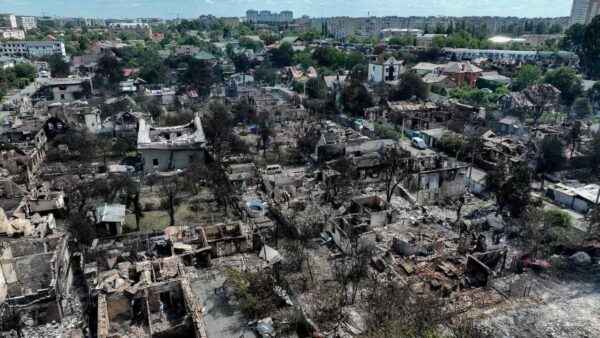
Russian strikes on Ukraine killed at least seven civilians in one incident and caused 730 civilian deaths and 4,427 injuries between March and May 2026, with May recording the highest monthly civilian casualties since April 2022. [5] The consequences for the neighbourhood are catastrophic. [2] The website Hromadske reported that seven people were killed, 26 were wounded and about 100 buildings were destroyed. [2] Hundreds of residents had to be evacuated, and the air remained acrid for hours after the incident. [2] One resident told reporters that shortly after the explosion no one was extinguishing the fire because shrapnel was flying through the air. [2] Several residents moved into their basements, but had to flee when smoke penetrated them and they began to suffocate. [2] Immediately after the raid from 6 to 7 July, we published in the Ukraine Battlefield update a video showing a large explosion. [2] It was followed by secondary detonations, a clear sign that a military target had been hit. [2] It is now known that this was the Kyiv suburb of Vyshneve. [2] The Ukrainians confirmed that they had an ammunition depot there and launched an investigation into how this was possible, since it is an unacceptable practice prohibited under the laws of war. [2] In a video shot near the depot, you can see exploding ammunition landing on surrounding family houses. [2] Zelenskyy stated that the object in Vyshneve, which was hit during the Russian shelling, was a warehouse of ammunition of Ukroboronprom. [2]
Developments on the Front Line and Territorial Claims
Russia claims to have seized 3,000 square kilometres of Ukraine this year including advances toward Kostiantynivka in Donetsk, but independent assessments estimate far smaller gains of about 97 square kilometres in the first six months and only 30 square kilometres in June. [1] Putin relaunched the narrative that Moscow will overrun the eastern Ukrainian region of Donetsk, four-fifths of which Russia already controls. [1] In a televised meeting with his top generals on July 3, Putin was told that Russia has seized 3,000sq km of Ukraine so far this year, and “liberated” 133 settlements. [1] His commander in chief, Valery Gerasimov, also claimed to control the cities of Kupiansk in Kharkiv, and Kostiantynivka in Donetsk. [1] The Institute for the Study of War, which uses geolocated footage to assess advances, estimated that Russian forces have a presence in 2.4 percent of Kupiansk and 37 percent of Kostiantynivka – and most of that in the form of infiltrations, not firm control. [1] The Ukrainian military has estimated the number of Russian servicemen in Kostiantynivka at between 100 and 250. [1] Putin was told that Russian forces seized 636sq km of Ukraine in June alone. [1] The ISW estimates the real number at 30sq km. [1] Kostiantynivka is politically important to the Kremlin because it is the first of four heavily fortified cities, including Kramatorsk and Sloviansk, which Moscow must seize to take control of Donetsk. [1]

Ukrainian strikes hit 19 Russian tankers supplying fuel to occupied Crimea. — Source: neweasterneurope
Air Defence, Drones and Electronic Warfare
Ukrainian forces destroyed seven Sukhoi aircraft, drone sheds and hangars at Crimean airfields, while launching over 400 drones toward Moscow on July 7, the largest such strike in two years. [1] Ukraine’s Unmanned Systems Forces commander Robert Brovdi said his forces had struck 19 Russian tankers, a cargo ship and a ferry between July 6 and 8, including nine tankers on the night of July 7. [1] Ukraine also kept up pressure on Russia, launching what mayor Sergei Sobyanin said was its largest strike on Moscow in two years. [1] More than 400 Ukrainian drones were downed while heading for the city on July 7, which was the first day of a NATO summit in Ankara. [1] “When our drones weren’t flying to Moscow and St Petersburg, [Russian president Vladimir] Putin didn’t think much about it. He understood that the war was far from the Kremlin,” Zelenskyy told the Financial Times. [1] “When not a hundred drones, but a thousand would start flying to Moscow, and when he would feel and see this, he would be advised to move somewhere beyond the Urals. This would be a moment like a new page on the path to ending the war.” [1] They cannot be shot down, so they must be eliminated differently – two ways Ukraine is trying to neutralise Iskanders. [2] These ballistic missiles are already a major problem today. [2] If it cannot be solved, Ukrainian cities face an even harsher winter than the last one. [2] After recent raids on the capital, the Ukrainian army reported each time that it had failed to shoot down a single Iskander ballistic missile. [2] The Ukrainians have made it clear that they have run out of interceptor missiles for their Patriot air-defence systems and are desperately trying to obtain new ones. [2] The Ukrainian army is therefore working to mitigate the threat ahead of the approaching winter, during which Russia will certainly again bomb power plants. [2] This is happening in two ways: through systematic attacks on the Iskander production chain and through advances in electronic jamming. [2] As for destroying factories, since March Ukrainian drones have struck and to varying degrees damaged six plants in the cities of Bryansk, Zelenograd, Cheboksary, Voronezh, Volgograd and Penza. [2] In July alone, Russia fired 50 at Kyiv. [2] The targeted factories produced various components, from launch systems to microelectronics. [2] The plants in Voronezh and Volgograd suffered very serious damage. [2] The second tool is an electronic jamming system. [2] The system in question was named precisely after Lima. [2] As the website Militarnyj explained, the Lima system simultaneously produces several forms of electronic jamming. [2] It targets the supersonic Kinzhal missiles launched from specially modified MiG-31 aircraft, thanks to which 61 of these weapons have been neutralised. [2]
Broader Strategic Context and Warnings
Zelenskyy said the air war would prove “decisive”, because in 2026 Ukraine’s ground troops had effectively stopped Russia’s slow advance of the last two years. [1] Independent assessments have suggested that Russia gained a total of 97 square kilometres in the first six months of the year. [1] “The war is ongoing, but the front line is no longer moving. When the front line is almost not moving, and the enemy cannot invade by sea, the sky remains,” Zelenskyy said. [1] US President Donald Trump handed Zelenskyy a major victory at the NATO summit in Ankara on Wednesday, saying he would license Ukraine to produce interceptor missiles for anti-air systems. [1] Zelenskyy has been campaigning for a licence to build Patriot interceptors, which he believes Ukraine can do faster and more cheaply than the US or European manufacturers. [1] But Zelenskyy said Patriots ultimately are not the answer for European air defence, announcing his intention to develop FREYA, a Ukrainian-designed anti-ballistic system like Patriot “but with a higher production capacity and at a lower cost”. [1] Zelenskyy’s commander-in-chief warned against dismissing Russia too easily. [1] “It’s still too early to talk about a qualitative turning point in the war,” Oleksandr Syrskii wrote on his Telegram messaging channel. [1] “The aggressor is showing signs of exhaustion, but retains significant offensive potential,” adding that Russia “plans to extend the front line, which already exceeds 1,250 kilometres.” [1] Russia’s ongoing aggression against Ukraine is changing the dynamics affecting nearby Transnistria. [3] Once existing in relative obscurity, the disputed area is now becoming a key part of calculations on both sides. [3] Putin has just signed into law a bill that essentially naturalizes all Transnistrians as Russians. [3] Ukraine’s President Volodymyr Zelenskyy, familiar with this strategy, issued an unusually blunt statement that implies a staging ground is being prepared near Transnistria. [3] The government is now “coordinating a response with Moldova” and awaiting “proposals from Ukraine’s special services”. [3] It is Kyiv’s first such public comment on potential action in Transnistria, and suggests Ukraine no longer views it as a nuisance but as a real threat. [3]
What to watch next: Zelenskyy’s push for domestic Patriot missile manufacturing and the FREYA system, alongside Syrskii’s caution against declaring a turning point and developments in Transnistria as a potential new front.