Hamas Dissolves Gaza Government and Offers Power Transfer to Technocrats
Hamas announced the dissolution of its de facto governing body in Gaza this week and stated it is prepared to transfer power to a technocratic committee appointed by Donald Trump's Board of Peace, even as Israeli forces continue military operations and maintain control over more than 60 percent of the territory. [1]
Hamas Dissolves Governing Body in Gaza
Hamas announced this week that it had dissolved the de facto government, saying it was ready to hand over power to a group of technocrats appointed by Donald Trump's Board of Peace. [1] Israel dismissed the move as a stunt. [1] With the Israeli military continuing to bomb Gaza despite the ostensible ceasefire, while controlling more than 60 per cent of the territory, and with the technocratic committee still outside the enclave, questions remain about who is really in charge. [1] The announcement came amid ongoing displacement, as shown in images of displaced Palestinians walking between tents in Deir al-Balah, central Gaza Strip, on Saturday July 4, 2026. [1]
The decision by Hamas to dissolve its governing body marks a formal step away from direct administration in the enclave. [1] Israeli forces have maintained operations that include continued bombing even after the ceasefire framework took effect. [1] Control over more than 60 per cent of the territory remains with the Israeli military according to reports on the current situation. [1] The technocratic committee appointed by Donald Trump's Board of Peace has not yet entered Gaza, leaving a gap in local administration. [1]
Uncertainties Over Gaza Governance and Ceasefire
Senior fellow Khaled Elgindy at the Quincy Institute for Responsible Statecraft argues that dissolving the Hamas government is a significant step in the ceasefire process and could pave the way for the technocratic committee to return to Gaza. [1] Questions remain over whether the US is willing to implement its own plan for the enclave. [1] The technocratic committee remains outside the territory, creating uncertainty about immediate governance arrangements. [1] Israeli dismissal of the dissolution as a stunt adds to doubts about acceptance of the proposed transition. [1]
Expert analysis highlights that the move by Hamas aligns with elements of the ceasefire framework but faces practical hurdles due to the committee's location. [1] Continued Israeli military control over more than 60 per cent of Gaza territory complicates any handover process. [1] The ostensible ceasefire has not halted all bombing operations, according to current reporting on conditions inside the enclave. [1] Implementation of the US-backed plan through Donald Trump's Board of Peace depends on factors still under discussion. [1]
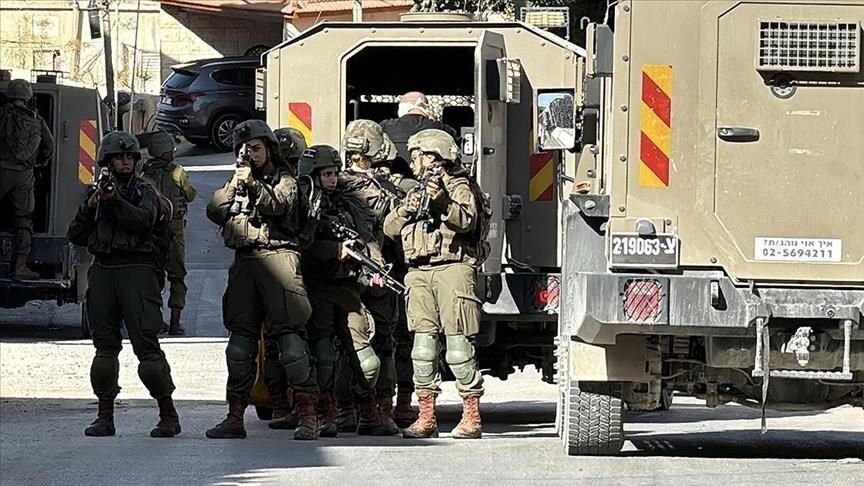
Israeli forces wound Palestinian and detain medics in West Bank raid. — Source: anadolu
Israeli Operations Continue in the West Bank
Israeli forces wounded a Palestinian and detained medics during a raid in the occupied West Bank, with the Palestinian Red Crescent treating a 60-year-old man who was shot. [2] The man received treatment from Palestinian Red Crescent teams after being shot by Israeli forces and was then transferred to hospital. [2] In a separate incident, Israeli forces injured six Palestinians, detained ambulance crews, uprooted more than 300 trees, and cut water lines supplying farmland in the northern Jordan Valley. [3]
The raid involving the 60-year-old man led to detentions of medics alongside the wounding. [2] Palestinian Red Crescent personnel provided initial care before hospital transfer. [2] The second operation in the northern Jordan Valley resulted in six injuries and detentions of ambulance crews. [3] Destruction included the uprooting of more than 300 trees and cutting of water lines that supply farmland. [3] Both incidents occurred during Israeli military activities in the occupied West Bank. [2] [3]
Amnesty Investigation into Lebanon Airstrikes
Amnesty International concluded that three Israeli airstrikes on civilian homes in Lebanon between March 6 and 13 constituted war crimes, killing 24 people including 12 children, after failing to distinguish between civilian and military targets. [4] The organization analyzed the strikes and found reasonable grounds to conclude that Israeli forces violated international humanitarian law in each case. [4] Amnesty stated that Israeli forces failed to distinguish between civilian and military targets, attacked civilian persons and objects, and did not take all feasible precautions to limit harm to civilians. [4]
Kristine Beckerle, Amnesty's deputy director for the Middle East and North Africa, noted that within a week the Israeli military wiped out entire families, including twelve children, in Lebanon, showing cruel contempt for civilian lives. [4] Amnesty contacted Israeli authorities, who responded that some attacks targeted Hezbollah military objectives while others were referred for review, and that they remain committed to limiting civilian harm during operations. [4] No specific information was provided on the three analyzed strikes or their intended targets. [4] Israel's defense minister Israel Katz stated that the attacks in Lebanon were a response to attacks from Hezbollah. [4]
Rebel Attack on Convoy in Northern Mali
In northern Mali, Tuareg-led rebels from the Azawad Liberation Front attacked a convoy of over 200 Russian fighters from the Africa Corps and more than 100 Malian soldiers near Tabankort, claiming control of the town of Anefis amid ongoing fighting with jihadist and separatist groups. [5] The convoy was carrying over 200 Russian fighters and more than 100 Malian soldiers when it was ambushed. [5] The Azawad Liberation Front claimed responsibility through spokesperson Mohamed Elmaouloud Ramadane, who described combat near Tabankort against a reinforcement force composed 90 percent of Russian mercenaries and Malian soldiers. [5]
Rebels from the Azawad Liberation Front claimed control of Anefis, a location viewed as crucial for influence over the northern town of Kidal. [5] Russian paramilitaries and Malian soldiers retained control of a military camp in Anefis following the attack. [5] The incident occurred as fighting intensified between Malian forces, Russian paramilitaries, and groups including the Azawad Liberation Front and the Al Qaeda affiliate Jama'at Nusrat al-Islam wal Muslimin since an April operation. [5] That earlier operation killed Mali's then-defense minister and struck the capital Bamako's airport. [5]
Broader Conflict Trends Across Regions
Developments in Gaza involve Hamas dissolving its de facto governing body while Israeli forces maintain control over more than 60 per cent of the territory and continue operations. [1] Separate raids in the occupied West Bank resulted in wounds to Palestinians, detentions of medical personnel, and destruction of trees and water infrastructure. [2] [3] In Lebanon, Amnesty International documented three airstrikes between March 6 and 13 that killed 24 people including 12 children and violated international humanitarian law. [4] In northern Mali, rebels ambushed a convoy near Tabankort and claimed gains around Anefis during intensified clashes that began after an April operation. [5]
These events reflect distinct conflict dynamics in each area without a single shared trigger. [1] [2] [3] [4] [5] Gaza faces questions over governance transition amid ongoing military control. [1] West Bank operations include specific incidents of injuries and infrastructure damage. [2] [3] Lebanon strikes prompted calls for investigation as war crimes. [4] Mali experiences continued insurgencies involving multiple armed groups. [5]
What to watch next: Further steps on the technocratic committee's potential return to Gaza, additional West Bank raids, any Israeli responses to the Amnesty report on Lebanon, and rebel claims around Anefis in Mali.