
Ukraine conflict: Ukraine Strikes 116 Russian Vessels in Nine Days Across Sea of Azov
Ukraine has intensified its maritime drone campaign in the Sea of Azov, striking Russian vessels including grain-carrying ships, while its forces conducted the first fully unmanned amphibious raid using USVs and UGVs on the Russian-held Kinburn Spit. [1] [2]
Escalation in the Sea of Azov
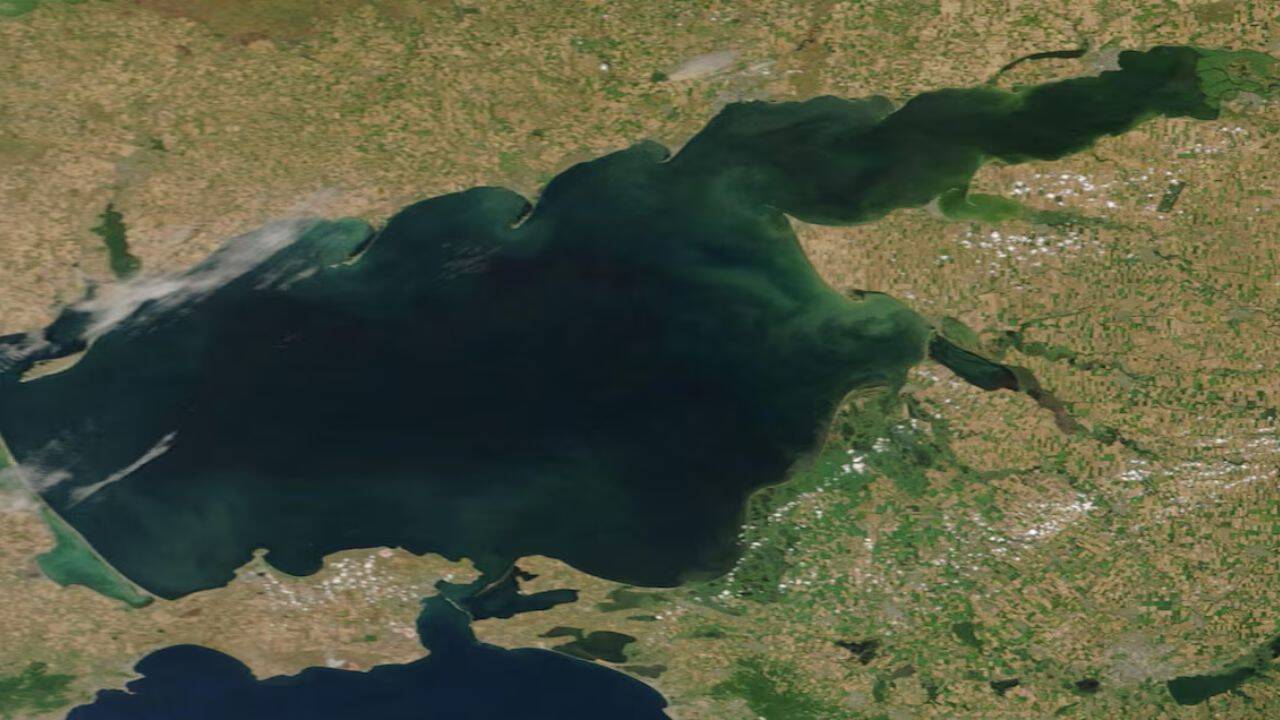
Russia has accused Ukraine of terrorism over its escalating strikes on shipping vessels in the Sea of Azov. [1] The shipping route is important for Russia, as it handles a quarter of its grain export. [1] Russian foreign minister Sergei Lavrov said, “What the Ukrainian regime is doing goes beyond even piracy. Pirates, at least, plunder and keep the spoils for themselves. But here, it benefits neither them nor anyone else, the goal is simply to cause damage and intimidate. It is terrorism, pure and simple.” [1] The Sea of Azov is a strategically important inland sea connected to the Black Sea through the Kerch Strait. [1] Bordered by southern Russia and Russian-occupied parts of Ukraine, it serves as a vital route for Russia’s grain exports, commercial shipping and military logistics. [1] The sea also provides ocean access to key Russian port Rostov-on-Don. [1] A Ukrainian military source told Reuters that Kyiv strikes only targets that contribute to Russia’s combat capability. [1] “Civilian cargoes are not among them. By talking about attacks on civilian vessels, Russia is looking for a pretext to justify its cynical strikes on Ukrainian civilian infrastructure,” the source stated. [1] Ukraine’s expanding maritime drone campaign is increasing pressure on one of Russia’s most important logistics and export corridors, while Moscow is scrambling to ensure that disruptions do not affect its grain exports or wartime supply chains. [1]
Ukrainian Strikes on Russian Shipping
Ukraine has intensified its maritime drone campaign in the Sea of Azov. [1] Ukrainian drone forces commander Robert Brovdi said on Telegram that 11 Russian vessels were struck overnight, including five tankers, five dry cargo vessels and one tugboat. [1] He claimed that the total number of vessels hit over the previous nine days had reached 116. [1] Reuters reported that industry sources, speaking on condition of anonymity due to the sensitivity of the matter, said that several grain-carrying vessels were hit on July 13 and July 14 and caught fire. [1] A Ukrainian military source told Reuters that Kyiv strikes only targets that contribute to Russia’s combat capability. [1]
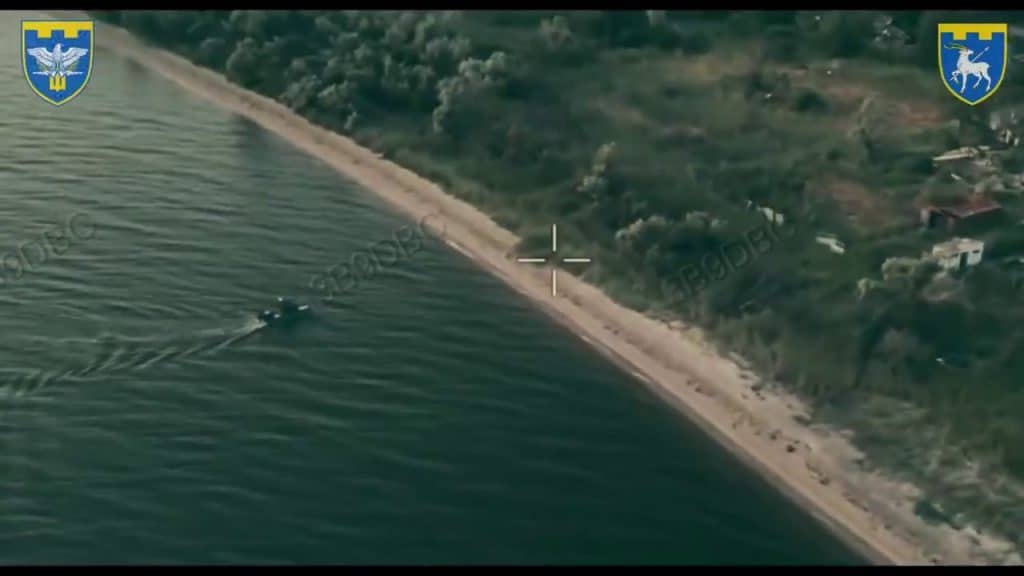
Ukrainian unmanned surface vessels and ground vehicles conduct first fully unmanned amphibious raid at Kinburn Spit. — Source: naval-news
Impact on Russian Grain Exports
Russia is the world’s largest wheat exporter, supplying roughly one-fifth of global wheat exports. [1] Its grain is a vital source of food for dozens of countries across Africa, the Middle East and Asia, making uninterrupted Russian exports important for global food security. [1] Russia will fully meet its grain export commitments to foreign partners despite the situation in the Sea of Azov, Russia’s union of grain exporters and producers said. [1] Russia has begun harvesting new crops in southern regions but the new grain is only starting to arrive in ports. [1] “The main goal of the work is to minimise the impact of temporary logistical difficulties on the sale of the new harvest by farmers,” said local authorities in Rostov, a leading grain-producing region. [1] Russia has accused Ukraine of terrorism over its escalating strikes on shipping vessels in the Sea of Azov. [1]
First Unmanned Amphibious Raid on Kinburn Spit
The Ukrainian armed forces have reportedly conducted a groundbreaking amphibious raid against Russian-held positions at the Kinburn Spit. [2] Executed entirely by unmanned vehicles operating across the sea, land, and air domains, the operation marks the first completely automated amphibious assault in military history conducted under wartime conditions. [2] The raid, reportedly conducted by Ukraine’s 123rd Territorial Defence brigade, was done by delivering an unmanned ground vehicle (UGV) on a beach at the Kinburn Spit by means of an Unmanned Surface Vehicle (USV). [2] Once delivered on the beach, the UGV took up position and allegedly engaged an enemy position located further on the waterfront. [2] Footage of the amphibious raid was provided by an unmanned aerial vehicle (UAV) flying overhead to monitor the deployment. [2] The UAV films how a USV is transporting a UGV, most likely a Ukrainian-made Rys UGV developed by Roboneers and equipped with a 7.62mm PKT machine gun. [2] Once the ramps of the USV are lowered, the UGV proceeded to roll off the USV and quickly take up position in the nearby vegetation. [2] In the next shot of the video, the UGV is shown deployed at the water edge looking over the beach and firing at a target in the distance. [2] A close up of the position shows the UGV firing at least three rounds at the target with two rounds hitting the sand in front of the target. [2] The last round appears to be a tracer round showing the round flying in an arc indicating that the UGV is possibly firing at its maximum range. [2] Ukrainian company DevDroid has reported that its Wolly 7.62 remotely operated combat module was used during a combat operation conducted by the 123rd Separate Territorial Defence Brigade on the Kinburn Spit. [3] DevDroid said the Wolly 7.62 combat module was mounted on a ground robotic system that was transported to the occupied coastline by an uncrewed surface vessel. [3] After landing, the robot carried out its combat mission. [3] DevDroid CEO Yurii Poritskyi stated, “Our mission on the Kinburn Spit demonstrated the potential of multi-domain robotic operations, in which naval and ground unmanned systems work together as part of a single mission.” [3]
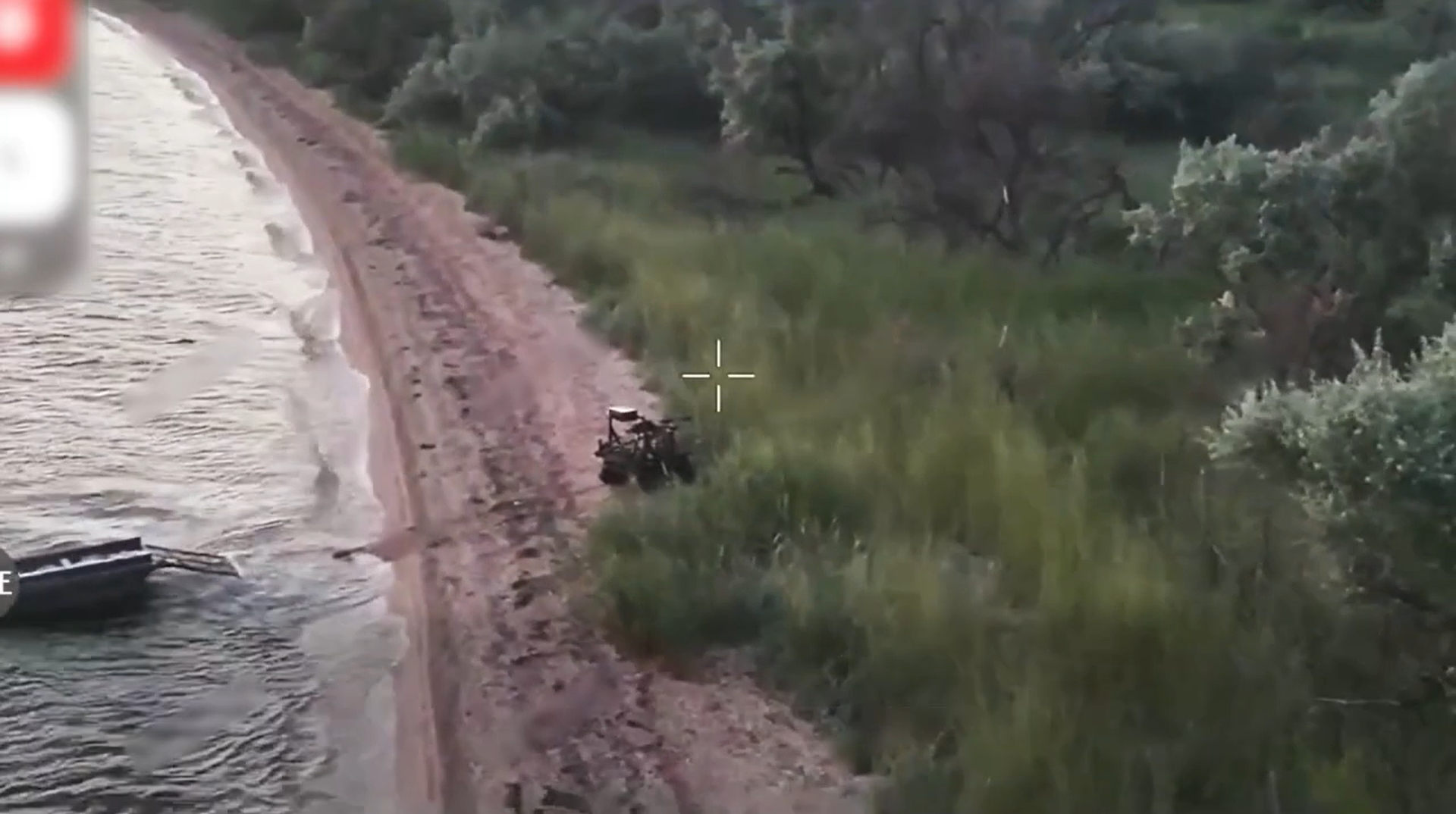
DevDroid turret deploys during unmanned Ukrainian ground robot landing on Kinburn Spit. — Source: ukrainskapravda
Context of Kinburn Spit Vulnerability
Tensions on the Kinburn Spit in Southern Ukraine have been rising in recent weeks with Russian war bloggers anticipating a Ukrainian amphibious operation in the near future as a result of deteriorating Russian logistics in this region. [2] Ukrainian forces have previously planted a Ukrainian flag at the Kinburn Spit on June 25th, most likely by use of a UAV. [2] The video showing the Ukrainian flag also included footage of airstrikes at the Kinburn Spit, indicating that Ukraine is pressuring the Russian positions for a while now. [2] Ukraine’s mid-range drone strikes in recent weeks have been targeting Russian logistics in Southern Ukraine and the Crimea with drones striking the overland routes between Mariupol and the Crimea. [2] These mid-range drones target Russian military trucks transporting among other things fuel and ammunition to and from the frontlines. [2] Russian forces have reportedly suffered significant losses, undermining its capabilities to keep frontline troops adequately supplied. [2] Ukrainian partisan movement ATESH has recently reported that Russian forces garrisoned on the Kinburn Spit withdrew as they could no longer be supplied. [2] According to ATESH, units of Russia’s 337th Regiment withdrew from the northern and western parts of the Kinburn Spit due to the absence of food, ammunition, and fuel deliveries. [2] If true, this would make the Kinburn Spit vulnerable for an amphibious invasion by Ukrainian forces. [2]
Implications for Future Operations
Ukraine’s amphibious raid with the Rys UGV has most likely started a new chapter on how amphibious operations will be undertaken in the future. [2] The presence of unmanned combat systems, most notable in the use of USV and FPV drones, has made amphibious operations more risky than they already were. [2] Unmanned systems allow the defender to observe and strike large littoral areas without the need of spreading troops out. [2] Given the success of recent Ukrainian USV strikes in the Black Sea and UAV strikes both on land and in the Sea of Azov, it isn’t hard to imagine that conventional amphibious operations are in severe risk of becoming no longer an option on a modern battlefield. [2] USV and FPV drones would be able to pick off the slow moving amphibious landing ships as they move to their designated landing zones or while they are gathered offshore supporting an actual landing. [2] Once ashore, marines risk being targeted by FPV drones before a beachhead can be secured. [2] Ukraine however appears to be demonstrating that unmanned combat systems could revive amphibious operations by using these unmanned systems for reconnaissance, raids, suppression of known enemy positions, and create an initial assault force that paves the way for regular amphibious troops to land. [2] DevDroid CEO Yurii Poritskyi said this expands the operational reach of ground robotic systems and opens up new possibilities for operations in the most dangerous areas. [3] The company said the Wolly 7.62 is a remotely operated combat module designed to provide fire support and battlefield surveillance without requiring the operator to be present on the front line. [3] It can be deployed at fixed positions, checkpoints and observation posts, or integrated into ground robotic systems. [3] Taking the Kinburn Spit would be a first step for Ukraine to try and reopen the maritime entrance to the Dnipro river and the port of Mykolaiv. [2]
What to watch next: The recent amphibious raid by the 123rd Territorial Defence Brigade could be seen as the first steps in assessing if the Kinburn Spit could be retaken, with Ukraine using UGVs to assess how well the area is still defended by Russian forces while also putting pressure on Russian positions.



