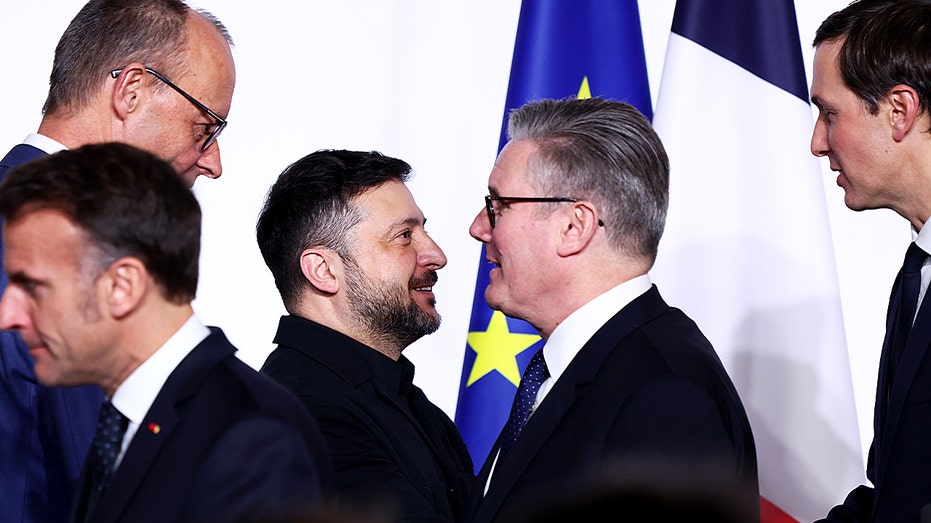
UK and France Forge New Security Pact for Ukraine as Zelensky Insists on Allied Military Presence for Peace

Latest from X
UK and France Forge New Security Pact for Ukraine as Zelensky Insists on Allied Military Presence for Peace
Kyiv/London/Paris — In a significant escalation of international involvement in the Russia-Ukraine conflict, the United Kingdom and France have signed a new security agreement with Ukraine, backed by the United States, establishing a multinational force and ceasefire monitoring framework. The pact comes amid Ukrainian President Volodymyr Zelenskyy's public insistence that any peace deal must include a sustained British and French military presence on Ukrainian soil to deter future aggression.
The agreement, described as a cornerstone of the "Coalition of the Willing," was formalized on January 7, 2026, as reported by Fox News. It aims to provide robust security guarantees and enforcement mechanisms for a potential ceasefire, with the U.S. taking a leading role in monitoring compliance. This development follows Zelenskyy's statements earlier in the week, starting around January 4, where he emphasized the necessity of foreign troops to ensure the credibility of any truce with Russia.
Zelenskyy has argued that previous ceasefire attempts, such as the Minsk agreements, failed precisely because they lacked enforceable international military backing. Posts from Zelenskyy on X highlight that military officials from France, the United Kingdom, and Ukraine have already coordinated extensively on deployment specifics, including troop numbers, weapon types, and operational components of the forces. These details, he noted, are now in place to enable effective deterrence.
The timing aligns with broader diplomatic momentum. Recent posts on X from Zelenskyy also reference ongoing discussions with U.S. representatives, including Steve Witkoff and Jared Kushner from the U.S. President's team, focusing on diplomatic pathways to end the war. The U.S. has signaled readiness to offer comprehensive backstops, encompassing security guarantees and ceasefire oversight. Separately, a post from Fox News referenced the UK prime minister outlining a Ukraine peace deal framework, to which Zelenskyy responded amid domestic pressures, including calls for his resignation.
Details of the Security Pact
According to the Fox News report, the pact creates a structured multinational force designed to station personnel in Ukraine post-ceasefire. This "Coalition of the Willing" — comprising the UK, France, Ukraine, and supported by the U.S. — formalizes commitments to rapid response capabilities and verification protocols. While exact troop numbers and locations remain classified for operational security, the agreement emphasizes interoperability among allied forces.
Zelenskyy's advocacy for this model stems from lessons of past diplomacy. He has publicly stated on X that agreements like Minsk were merely "temporary pauses" exploited by Russia due to the absence of a strong U.S. deterrent presence, leaving only limited involvement from France, Germany, Ukraine, and Russia itself.
This pact builds on earlier Western pledges. In 2024 and 2025, bilateral security agreements were signed between Ukraine and individual NATO members, including the UK and France, committing billions in military aid and training. The new multilateral framework elevates these to a collective defense posture, potentially involving rotational deployments similar to peacekeeping missions in the Balkans during the 1990s.
Historical Context and Previous Peace Efforts
The Russia-Ukraine war, now entering its fifth year since Moscow's full-scale invasion in February 2022, has seen multiple stalled peace initiatives. The Minsk I and II accords of 2014-2015 aimed to resolve eastern Ukraine's Donbas conflict but collapsed amid mutual accusations of violations, paving the way for escalation.
More recent talks, including the 2022 Istanbul negotiations and Swiss-hosted summits in 2024, faltered over core issues: Russia's demands for territorial concessions, Ukraine's insistence on full sovereignty, and NATO membership aspirations. Ceasefire proposals have repeatedly surfaced, often tied to U.S. election cycles. With the current U.S. administration under President-elect Donald Trump — set for inauguration in late January 2026 — prioritizing rapid de-escalation, Washington has pivoted toward enforcement roles, reducing direct combat involvement while bolstering allies.
European leaders have filled the gap. UK Prime Minister Keir Starmer and French President Emmanuel Macron have championed "reassurance forces" in Ukraine, drawing parallels to the 1995 Dayton Accords that ended the Bosnian War through NATO-led stabilization.
Reactions and Challenges Ahead
Ukrainian officials view the pact as a breakthrough, enhancing Kyiv's bargaining power in potential talks with Russia. However, Moscow has dismissed foreign troop deployments as provocative, with Kremlin spokespeople warning of "escalatory red lines." Russian state media has framed the moves as NATO encroachment, echoing pre-invasion rhetoric.
Western allies remain cautious. The U.S. emphasis on ceasefire monitoring suggests a preference for non-combat roles initially, avoiding direct confrontation with Russian forces. Posts on X reflect mixed sentiment: Zelenskyy's updates underscore optimism about detailed planning, while broader discourse highlights skepticism over Russia's compliance history.
Analysts note logistical hurdles, including Ukraine's battered infrastructure and the need for parliamentary ratification in London and Paris. Funding, estimated in the tens of billions annually, will strain budgets amid domestic economic pressures.
Outlook for Peace
This security pact signals a fragile path toward de-escalation, contingent on Russia's willingness to engage. With U.S. mediation gaining traction, January 2026 could mark a pivotal moment. Yet, as Zelenskyy has cautioned, true peace demands not just signatures but sustained presence to prevent history's repetition. As negotiations intensify, the presence of UK and French forces may prove the linchpin — or flashpoint — in Ukraine's quest for lasting security.
(Word count: 712)
Track this story live
Live World Map
Monitor global events in real time with a live activity map and hotspot summaries.
Markets
Connect live events to Catalyst market signals across crypto, commodities, indices, and forex.
Geopolitical Risk
Live geopolitical risk index tracking conflict zones, sanctions, and global threat levels.
Original Sources
- •
Editorial process: This article was synthesized from the original sources cited above using The World Now's AI editorial system, with byline accountability from our editorial team. We grade every story for source grounding, factual coherence, and on-topic match before publication. Read more about our editorial standards and contributors. Spot something inaccurate? Let us know.
Last updated: February 17, 2026






