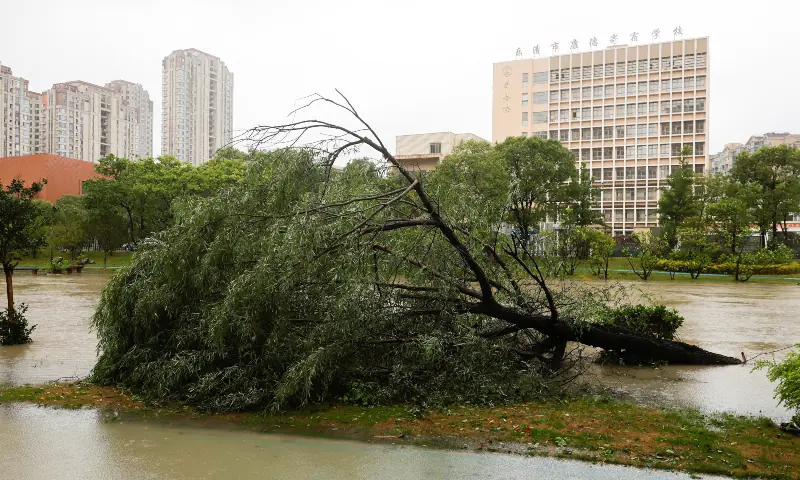

Typhoon Bavi Makes Landfall in Eastern China After Killing 18 in Philippines
Reporting based primarily on dawn.com.
Typhoon Bavi made landfall in eastern China's Zhejiang province on Saturday night as a typhoon with 144 km/h winds, was downgraded to a severe tropical storm, and prompted the evacuation of nearly 2 million people with no immediate reports of casualties in China. [1]
Bavi Makes Landfall in China
Bavi first made landfall at around 11:20pm on Saturday in Zhejiang province with winds of 144 kilometres an hour. [1] The core impact zone experienced fierce winds and heavy rain, with rapid runoff forming on the ground and roadside trees being uprooted. [1] It then hit Yueqing city, where firefighters, rescue workers and municipal employees were clearing more than 1,300 trees that had fallen or been uprooted. [1] The eye of the storm had moved near the Zhejiang provincial capital Hangzhou at around 10am on Sunday with force 10 winds of around 108kmh. [1] Bavi had been downgraded to a typhoon as it moved across the Pacific Ocean after hitting Guam and the Northern Mariana Islands on Monday as a super typhoon. [1] Bavi was downgraded to a severe tropical storm on Sunday after making landfall in eastern China. [1]
Mass Evacuations and Preparations
Around 1.72 million people had been evacuated to safe places by Saturday in Zhejiang. [1] More than 130,000 people have fled their homes in Fujian province and around 34,000 people from Shanghai’s coastal areas and high-risk areas. [1] Torrential rain further north prompted the evacuation of more than 100,000 people from their homes in Beijing. [1] Classes, work, transport and outdoor activities were suspended ahead of the storm’s arrival, and more than 300 flights were cancelled in Zhejiang province. [1] Another 684 flights and 1,620 train services have been cancelled in Shanghai. [1] Images shared online on Sunday showed streets in Zhejiang’s Wenzhou city submerged in floodwaters. [1] The Wenzhou government said in a statement it was sparing no effort or cost to guard against the worst-case scenario. [1] Residents used planks to reinforce metal shutters protecting shops and taped windows. [1]
Impacts Across East Asia
In the Philippines, at least 18 people were killed in landslides and other incidents triggered by heavy rains driven by Bavi, most on the southern island of Mindanao. [1] Nearly 11,000 people across the archipelago fled their homes, and dozens of ports remain closed. [1] In northern Taiwan, more than 14,000 people were evacuated from their homes and hundreds of flights were cancelled. [1] More than 170,000 households across the island were hit by power outages. [1] In Japan, thousands of households and facilities across Okinawa also lost power. [1] Before reaching China, the storm lashed northern Taiwan and Japan’s remote southwestern islands, toppling trees and leaving tens of thousands without power. [1]
Prior Severe Weather Toll in China
Extreme weather already wreaked havoc on southern and central China in the past week, with storms leaving at least 39 dead and causing dozens of rivers to overflow and a reservoir to burst. [1]
Forecast and Ongoing Risks
The storm is now forecast to move northeast while gradually weakening, before reaching the Yellow Sea on Tuesday and transforming into an extratropical cyclone. [1] The provinces in its path across China’s east are likely to experience heavy downpours until Monday. [1] Zhejiang provincial officials forecast torrential rain in coastal regions and the possibility of flash floods, warning of transport disruptions, rivers overflowing and farmland being inundated. [1]
Role of Warmer Oceans and El Nino
Oceans have experienced their hottest June on record and could set fresh highs in the months ahead. [1] Warmer oceans intensify tropical storms and add more moisture, which can fall as heavy rain. [1] Adding to the mix is the return this year of El Nino, a natural climate phenomenon that warms Pacific Ocean surface temperatures and typically occurs every two to seven years. [1]
What to watch next: The storm is expected to continue moving northeast while gradually weakening before reaching the Yellow Sea on Tuesday and transforming into an extratropical cyclone, with provinces across China’s east likely to experience heavy downpours until Monday that could bring flash floods and transport disruptions.