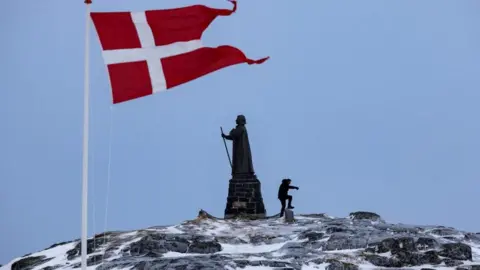
Trump Revives Greenland Acquisition Push, Citing Security Threats from Russia and China After Venezuela Operation

Latest from X
Trump Revives Greenland Acquisition Push, Citing Security Threats from Russia and China After Venezuela Operation
Copenhagen/Washington, January 9, 2026 – U.S. President Donald Trump has reignited calls for American control over Greenland, warning that the strategic Arctic territory must be under U.S. ownership to counter growing influence from Russia and China. The provocative remarks, made in the wake of a recent U.S. military operation in Venezuela, have drawn a firm rebuke from Denmark, which administers the autonomous Danish territory and insists it is "not for sale."
Trump's statements, delivered on January 4, underscore escalating geopolitical tensions in the Arctic region. Speaking at a White House briefing, the president linked the push for Greenland to broader national security imperatives, particularly following what U.S. officials described as a successful operation to neutralize threats in Venezuela. "We need to own Greenland – the easy way or the hard way," Trump declared, according to reports. He argued that without U.S. control, adversaries like Russia and China could dominate the island's vast resources and strategic position, potentially threatening North American security.
Greenland, with its ice-sheet-covered expanse larger than Mexico, holds immense geopolitical value. It is rich in rare earth minerals critical for technology and green energy, and its location provides oversight of Arctic shipping routes increasingly viable due to climate change-induced ice melt. The U.S. already maintains the Thule Air Base there, a key outpost for missile defense and space surveillance. Trump's rhetoric echoes his 2019 proposal to purchase the territory outright, which prompted outrage in Denmark and led to the postponement of a bilateral meeting at the time.
Danish Prime Minister Mette Frederiksen's government has responded swiftly and unequivocally. In keeping with past positions, officials reiterated that Greenland's future is a matter for its people, not a commercial transaction. "Greenland is not Danish. Greenland is Greenlandic," a government spokesperson emphasized, invoking Frederiksen's famous 2019 retort to Trump's initial overture. Recent statements from the prime minister's office highlight Denmark's focus on multilateral Arctic security, including close coordination with allies like Canada amid rising concerns over Russian and Chinese activities.
The timing of Trump's comments aligns with heightened global frictions. Just days earlier, on January 3, Danish leaders publicly called for de-escalation in Venezuela and respect for international law while monitoring the situation alongside allies. This followed reports of a U.S.-led military action in the South American nation, which Trump has framed as a preemptive strike against destabilizing influences potentially backed by adversarial powers. Posts on X from Danish official accounts reflect a broader sentiment of vigilance, stressing solidarity with partners on Arctic defense and global stability.
Strategic Context in the Arctic
The Arctic has emerged as a flashpoint in great-power competition. Russia has militarized its northern frontier, reopening Soviet-era bases and expanding its icebreaker fleet to claim new sea lanes. China, styling itself a "near-Arctic state," has invested heavily in Greenlandic mining projects and infrastructure, raising alarms in NATO circles. A 2023 U.S. Defense Department report warned of Beijing's ambitions to secure rare earth supplies, while Moscow's invasion of Ukraine in 2022 amplified fears of hybrid threats in the High North.
Denmark, as a NATO member, hosts the Arctic Command in Nuuk, Greenland, and participates in exercises like the annual U.S.-led Arctic Edge. Recent diplomatic engagements, such as Frederiksen's January 6 meeting with Canadian Prime Minister Mark Carney, reaffirmed commitments to regional security. "We discussed security in the Arctic," a Danish statement noted, expressing appreciation for Ottawa's support amid the "current situation."
Trump's "easy way or hard way" phrasing has sparked diplomatic unease. Analysts interpret it as a mix of negotiation tactics and pressure, potentially referencing economic incentives or, more controversially, military leverage. The White House has not detailed specifics, but Trump's past administration pursued enhanced U.S. presence in Greenland, including offers of economic aid post-2019.
International Reactions and Outlook
NATO allies have urged restraint. The alliance's Arctic policy emphasizes cooperation over confrontation, with Secretary General Jens Stoltenberg recently highlighting the need for unity against non-Western encroachment. Russia dismissed Trump's comments as "imperialist fantasies," while Chinese state media accused the U.S. of hegemony.
Greenland's local government, led by Premier Múte B. Egede, prioritizes self-determination. In elections last year, pro-independence parties gained ground, though economic ties to Denmark remain strong. Any U.S. bid would likely require Inuit-majority approval via referendum, a process fraught with division.
As Arctic ice retreats – NASA data shows summer melt expanding by 13% per decade – the scramble for influence intensifies. Trump's gambit risks straining transatlantic bonds at a time when unity is paramount. Danish Foreign Minister Lars Løkke Rasmussen signaled readiness for dialogue but drew a red line: "Strategic interests do not override sovereignty."
Whether this escalates to formal talks or fades as bluster remains unclear. For now, Copenhagen's stance is resolute, positioning Greenland as a litmus test for U.S.-European relations in an era of renewed Cold War dynamics.
(Word count: 712)
Track this story live
Live World Map
Monitor global events in real time with a live activity map and hotspot summaries.
Markets
Connect live events to Catalyst market signals across crypto, commodities, indices, and forex.
Geopolitical Risk
Live geopolitical risk index tracking conflict zones, sanctions, and global threat levels.
Original Sources
- •
Editorial process: This article was synthesized from the original sources cited above using The World Now's AI editorial system, with byline accountability from our editorial team. We grade every story for source grounding, factual coherence, and on-topic match before publication. Read more about our editorial standards and contributors. Spot something inaccurate? Let us know.
Last updated: January 17, 2026






