
Trump Replaces Planned 20 Percent Strait of Hormuz Fee with Gulf Investment Deals
US President Donald Trump has shifted away from a proposed fee amid Strait of Hormuz tensions, choosing instead to pursue trade and investment deals with Gulf states while enforcing restrictions on Iranian shipping.
Trump Scraps Hormuz Fee Plan
US President Donald Trump announced on Tuesday that he would replace the 20 percent United States Reimbursement Fee with trade and investment deals from Gulf states after conversations with their leaders. [2] He stated on Truth Social that the decision followed highly productive conversations with Middle East leadership. [2] Trump told reporters he had been contacted by kings and emirs from Saudi Arabia, the United Arab Emirates, Qatar, Bahrain, and Kuwait, who expressed interest in investing billions of dollars in the United States. [4] He noted that this approach aligned with his view that no one should charge a fee for the Strait of Hormuz, though he added it remained unfair that the United States was not compensated in some way for providing protection. [4] The reversal came one day after Trump had declared the United States as the guardian of the waterway and proposed the fee to cover protection costs. [4]
Blockade on Iranian Traffic Continues
The United States will maintain a full naval blockade only on ships coming to and from Iranian ports or carrying Iranian cargo, while keeping the Strait of Hormuz open to all other ship traffic. [2] Trump specified that the blockade would restart at 2000 GMT Tuesday. [4] He emphasized that the waterway would remain open to all ship traffic except for Iran. [2] This measure continues despite the policy change on fees, with the focus remaining on preventing Iranian vessels from using the route. [2]
Context of Renewed US-Iran Conflict
The Strait of Hormuz tensions have intensified following the breakdown of a ceasefire last week, which had been reached after a June agreement. [4] Iran had largely closed the narrow strait after United States and Israeli attacks on 28 February, before beginning to reopen it following the June ceasefire. [4] Fresh US airstrikes and Iranian retaliation have returned Washington and Tehran to open conflict less than a month after a 14-point memorandum of understanding aimed at ending the war. [2] Trump had formally notified Congress on Friday that the country had resumed military operations against Iran. [2] The waterway has become a central focus of military and political leverage for both sides. [1]
Gulf States' Position on Security Payments
Some Gulf states have signaled they are not opposed to economic contributions for security in the Strait of Hormuz if it prevents Iranian control or veto power over transit. [5] Officials briefed on the matter indicated that stability matters more than the financial cost, describing any toll as negligible to their bottom lines. [5] Gulf states reject Iranian control of the waterway and have sent quiet signals to US and European capitals that they prioritize preventing Iran from having the ability to flip a switch on access. [5] Trump consulted leaders from Saudi Arabia, the United Arab Emirates, Qatar, Bahrain, and Kuwait before announcing the shift to investment deals rather than direct fees. [4] These states have publicly rejected Iran's past attempts to impose transit fees. [5]
Impact on Oil Prices and Global Shipping
Renewed hostilities and paralysis in the strait have lifted oil prices, raising concerns that gasoline costs could reach $4 per gallon in the United States. [3] The critical route for global oil supplies has seen traffic affected by the conflict, pushing energy prices higher. [3] Traders have noted the impact on markets following announcements related to the waterway. [4]
Trump's Meeting with Iraqi Prime Minister
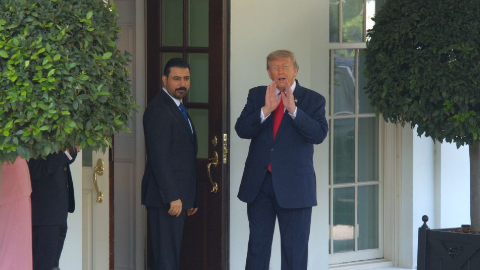
Trump made the announcement during a White House meeting with Iraqi Prime Minister Ali al-Zaidi on July 14, 2026. [2] He hosted the prime minister in the Oval Office while discussing the policy change. [4] The meeting occurred as Trump addressed reporters about conversations with regional leaders and the decision to pursue investments instead of fees. [4]
What to watch next: Further statements from Gulf leaders on investment commitments and any updates on the blockade's implementation at 2000 GMT Tuesday remain key developments to monitor.