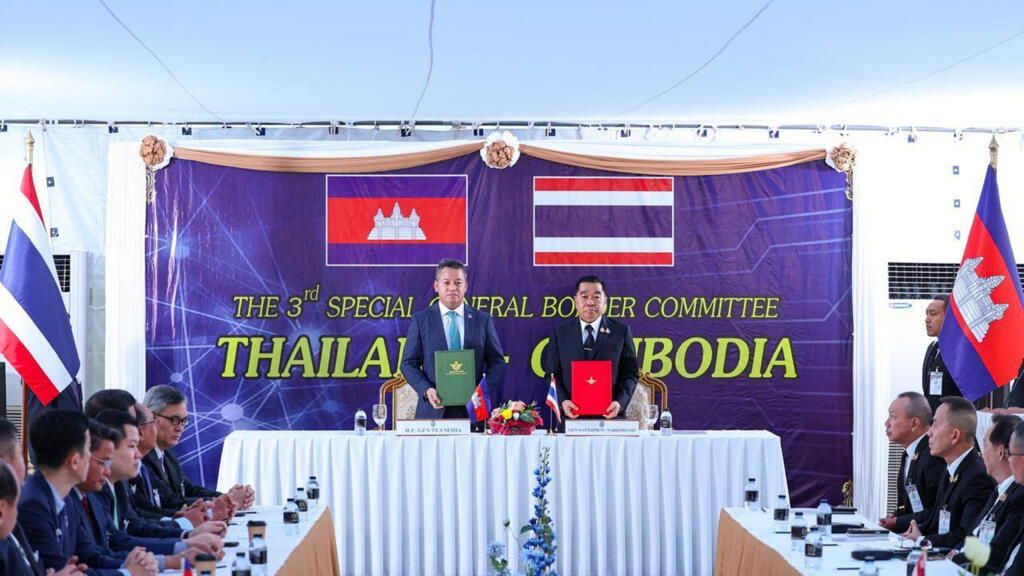

Thai-Cambodia Border Ceasefire Faces Strain After Soldier Release and Accusation of Violation
Bangkok/Phnom Penh – A fragile ceasefire along the disputed Thai-Cambodia border, reached after weeks of deadly clashes that killed dozens and displaced around one million people, has come under immediate pressure. Thailand announced the release of 18 Cambodian soldiers as part of the truce brokered on December 27, 2025, but accused Cambodia on January 6, 2026, of violating the agreement through cross-border fire that wounded a Thai soldier.
The release of the 18 Cambodian troops, which occurred amid high tensions starting around December 31, 2025, was hailed as a key confidence-building measure following three weeks of intense fighting. The clashes, centered on long-contested border areas, had escalated dramatically, forcing mass evacuations and drawing international concern over stability in Southeast Asia. The ceasefire deal aimed to halt the violence, but the subsequent incident has tested its durability.
According to reports, Thailand's military stated that Cambodian forces opened fire across the border in what Bangkok described as an "accident," resulting in one Thai soldier wounded. This accusation came just 10 days after the truce was established, highlighting the precarious nature of the agreement. "This cross-border fire violated the ceasefire," Thai officials were quoted as saying, underscoring the incident's severity amid ongoing de-escalation efforts.
Cambodia has not immediately responded to the allegations in available reports, but the event echoes patterns of mutual recriminations common in the two nations' border disputes. The fighting prior to the ceasefire had already inflicted heavy tolls: dozens killed on both sides, with artillery exchanges displacing approximately one million civilians from border provinces. Humanitarian agencies had warned of a potential refugee crisis, straining resources in both countries.
Historical Context of the Dispute
The Thai-Cambodia border conflict has deep roots, primarily revolving around the 11th-century Preah Vihear temple complex. In 1962, the International Court of Justice (ICJ) ruled that the temple belongs to Cambodia, but disputes over surrounding land persist. Tensions flared periodically, notably in 2008-2011, when clashes killed at least 28 people and displaced tens of thousands. Those incidents led to ASEAN-mediated talks and ICJ clarification in 2013 affirming Cambodia's temple ownership while calling for boundary demarcation.
More recently, overlapping territorial claims in areas like Ta Muen Thom and Ta Krabey temples have fueled skirmishes. The 2025 escalation marked one of the most severe outbreaks in over a decade, triggered by reported encroachments and military buildups. Analysts attribute the violence to nationalist sentiments, domestic political pressures, and unresolved surveys from bilateral commissions established post-2011.
The December 27 ceasefire was negotiated through direct military channels and ASEAN encouragement, with both sides agreeing to withdraw troops and exchange captives. Thailand's release of the 18 Cambodian soldiers—captured during the clashes—signaled compliance, potentially paving the way for reciprocal releases. However, the January 6 incident, described by Thailand as originating from Cambodian positions, risks unraveling these gains.
Broader Regional Implications
The border area, spanning rugged terrain in Thailand's Surin and Buriram provinces and Cambodia's Preah Vihear and Oddar Meanchey provinces, remains heavily militarized. Satellite imagery and eyewitness accounts from prior reports showed artillery positions and minefields reactivated during the recent clashes. The displacement of one million—equivalent to significant portions of local populations—has overwhelmed camps, with the UN and Red Cross providing aid.
Both governments face domestic scrutiny: Thailand's military-aligned leadership emphasized border security amid elections, while Cambodia's long-ruling Hun administration portrayed the conflict as defending sovereignty. International actors, including the U.S., China, and ASEAN, have urged restraint to prevent spillover into trade routes and Mekong River stability.
As of January 6, 2026, no further exchanges of fire were reported, but Thai forces heightened alerts. Military spokespersons from both sides reiterated commitment to the ceasefire, with calls for joint patrols and ICJ oversight. Demarcation talks, stalled since 2011, may resume under pressure.
The sequence of events—from deadly clashes, to the December 27 truce and soldier release, to the fresh accusation—illustrates the volatility of this flashpoint. While the captive exchange offers a glimmer of de-escalation, sustained diplomacy will be crucial to avert renewed conflict in a region pivotal to Southeast Asian security.
(Word count: 612)






