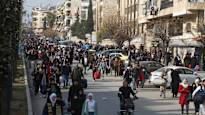

Terror Attack Hits Homs Mosque as Syrian Forces Escalate Bombings in Aleppo Amid Militia Crackdowns
Homs, Syria — A deadly terror attack targeted a mosque in the central Syrian city of Homs on January 1, 2026, killing and injuring worshippers in what security officials described as a high-severity incident linked to ongoing insurgent activity. The strike occurred at 07:30 GMT amid intensified Syrian government crackdowns on ISIS remnants and armed militia groups across the country, including fresh aerial bombardments of Kurdish-held areas in Aleppo reported just days later.
The assault on the Homs mosque unfolded during a period of heightened tensions in Syria's volatile security landscape. Local reports indicate the attack was carried out by unidentified assailants, exploiting the fragile security environment in Homs province, a region long plagued by sporadic violence from jihadist factions and rival militias. No group has officially claimed responsibility, but the timing aligns with renewed operations against ISIS sleeper cells and other non-state actors that have resurfaced following years of relative dormancy.
Just six days after the Homs incident, on January 7, the Syrian Arab Army initiated bombing campaigns targeting Kurdish-controlled districts in Aleppo, according to Finnish public broadcaster Yle. The strikes mark a significant escalation in the government's military posture toward Kurdish forces, often associated with the People's Protection Units (YPG) and the broader Syrian Democratic Forces (SDF). Aleppo's Kurdish areas, located in the northern governorate, have been flashpoints in Syria's protracted civil war, with Turkish-backed Syrian National Army (SNA) factions frequently clashing there as well.
Eyewitness accounts from Aleppo, as summarized in Yle's reporting, describe explosions rocking residential neighborhoods, prompting evacuations and international concern over civilian casualties. Syrian state media has framed these operations as necessary to dismantle "separatist militias" threatening national unity, while Kurdish representatives have decried the bombings as indiscriminate attacks on civilian infrastructure.
Broader Context of Syria's Security Challenges
Syria's conflict, which erupted in 2011 as part of the Arab Spring uprisings, has evolved into a complex web of proxy wars involving regional powers like Russia, Iran, Turkey, and the United States. President Bashar al-Assad's regime, bolstered by Russian airstrikes and Iranian-backed militias, regained control over most major cities by 2020, including Homs and much of Aleppo. However, pockets of resistance persist: ISIS maintains a low-level insurgency in central and eastern deserts, conducting hit-and-run attacks like the Homs mosque strike, while Kurdish forces control oil-rich northeastern territories with tacit U.S. support.
Homs, a strategic crossroads city, has been a focal point for ISIS activity since the group's 2014 caliphate declaration. The terror group was territorially defeated in 2019, but according to United Nations reports, it continues guerrilla operations, with over 2,000 fighters estimated active as of late 2025. The January 1 attack underscores vulnerabilities in urban centers, where mosques and markets serve as soft targets. Syrian authorities have responded with sweeping arrests and joint operations with Russian forces, but critics argue these measures fuel cycles of retaliation.
The Aleppo bombings fit into this pattern of crackdowns. Kurdish areas in Aleppo, distinct from the SDF's northeast stronghold, have seen Turkish incursions since 2016's Operation Euphrates Shield. Turkey views the YPG as an extension of the Kurdistan Workers' Party (PKK), a designated terrorist group. Yle's January 7 dispatch notes the Syrian army's actions as a rare direct intervention in these zones, potentially coordinated with or in response to SNA advances. This comes amid reports of SDF-ISIS clashes elsewhere, blurring lines between anti-terror efforts and inter-factional rivalries.
International observers, including the Syrian Observatory for Human Rights (SOHR), have documented rising strike activity. While casualty figures for the Homs attack remain unconfirmed pending official tallies, Aleppo strikes have reportedly displaced hundreds. The U.N. Security Council has called for de-escalation, emphasizing humanitarian access amid Syria's ongoing economic collapse and 16 million people in need of aid.
Outlook and Regional Implications
As Syrian forces intensify operations against militias, the risk of broader escalation looms. The Homs attack highlights ISIS's enduring threat, potentially drawing in U.S.-led coalition airstrikes, while Aleppo's bombings could provoke Turkish reprisals or SDF counteroffensives. Russia, Syria's key backer, maintains airbases in Hmeimim and Tartus, providing close air support that has tipped past battles.
Diplomatic efforts, including Astana process talks involving Turkey, Russia, and Iran, have stalled over Kurdish autonomy demands. With no immediate ceasefire in sight, analysts anticipate further strikes through early 2026, exacerbating Syria's humanitarian crisis—displacement now exceeds 7 million internally, per U.N. data.
The convergence of these events signals a precarious phase for Syria's stabilization, where counter-terrorism blends with geopolitical maneuvering, leaving civilians caught in the crossfire.
(Word count: 682)






