
Simulation Shows Jeju Air Crash Victims Could Have Survived Without Runway Barrier at Muan Airport
SEOUL — A new computer simulation in the ongoing investigation into South Korea's deadliest aviation disaster has revealed that most victims of the Jeju Air Flight 7C2216 crash might have survived had there been no runway barrier in place, highlighting potential flaws in airport safety infrastructure.
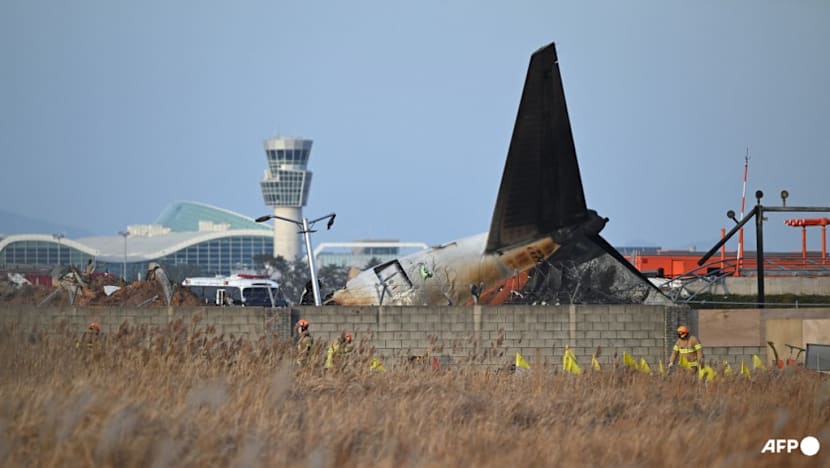
The findings, released as part of the probe into the December 29, 2024, crash at Muan International Airport, indicate that the concrete structure the plane struck after skidding off the runway exacerbated the fatalities. The simulation, detailed in reports from the investigation team, suggests that without the barrier, the aircraft could have come to a stop in the overrun area with significantly less damage, potentially sparing the lives of the 179 people who perished.
Details of the Simulation and Crash Sequence
The simulation reconstructs the final moments of Jeju Air Flight 7C2216, a Boeing 737-800 operating from Bangkok's Suvarnabhumi Airport to Muan in South Jeolla Province. According to the Channel News Asia report published on January 8, 2026, the analysis demonstrates that the absence of the runway barrier — specifically a concrete wall associated with the airport's instrument landing system localizer — would have allowed the plane to decelerate safely after its gear-up belly landing.
In the actual incident, the plane touched down without deploying its landing gear, skidded along Runway 33L for approximately 1,700 meters, veered off into the grassy safety area, and collided with the barrier at high speed. The impact caused the fuselage to disintegrate, leading to a massive post-crash fire that engulfed the wreckage. Of the 181 people on board — 175 passengers and 6 crew members — only two survived: a passenger in seat 11A and a flight attendant in the rear cabin, both rescued from the tail section.
The simulation underscores how the barrier's position, about 250 meters beyond the runway end, turned a survivable overrun into a catastrophic collision. Investigators noted that the plane was traveling at around 700 kilometers per hour (corrected for aviation context, approximately 300-400 km/h post-touchdown based on preliminary data) when it hit the structure, which was not designed as an energy-absorbing engineered materials arrestor system (EMAS), common at many international airports.
Background on the Crash and Investigation
The Jeju Air crash marked the worst aviation accident in South Korea's history, surpassing the 1997 Korean Air Flight 801 disaster in Guam, which killed 228. It occurred amid adverse weather, with reports of bird strikes potentially contributing to the gear failure and mayday calls issued by the pilots citing hydraulic issues and an inability to lower the flaps fully.
South Korea's Ministry of Land, Infrastructure and Transport (MOLIT) is leading the investigation, with assistance from the U.S. National Transportation Safety Board (NTSB), Boeing, and the Federal Aviation Administration (FAA). Both flight data and cockpit voice recorders were recovered shortly after the crash and have been analyzed in labs. Preliminary findings in early 2025 pointed to a possible bird ingestion damaging the engines and hydraulics, prompting a flap-up landing attempt.
Muan International Airport, which opened in 2007 primarily to serve as a hub for the Jeolla region, has faced scrutiny over its runway safety areas (RSA). Runway 33L's runway end safety area (RESA) measures about 90 meters, below the International Civil Aviation Organization (ICAO) recommended 240 meters for Code 4E runways like those handling 737s. The concrete barrier, part of the precision approach path indicator (PAPI) and localizer equipment, was located in the overrun zone, raising questions about compliance with global standards.
ICAO Annex 14 recommends RESAs free of fixed obstacles or equipped with frangible structures to minimize hazards. Post-crash, MOLIT announced plans to install EMAS — crushable foam blocks that decelerate aircraft — at high-risk runway ends nationwide, including Muan.
Broader Implications for Aviation Safety
This simulation adds to a growing body of evidence in the probe, which has already prompted safety audits at 14 South Korean airports with similar runway configurations. Jeju Air, South Korea's largest low-cost carrier, grounded its 737 fleet temporarily for inspections, while Boeing faces ongoing scrutiny amid its 737 MAX history.
The findings echo past incidents, such as the 2005 Mandala Airlines crash in Indonesia or the 2022 China Eastern overrun attempts, where overrun protections proved decisive. In the U.S., over 300 airports have EMAS installations since 2005, credited with saving lives in incidents like the 2019 Jacksonville overrun.
As the investigation continues, expected to produce a final report by mid-2026, authorities are reviewing barrier designs at Muan and similar facilities. Acting MOLIT Minister Jin Kyung-ho stated in December 2024 press briefings that "every lesson from this tragedy will enhance our skies' safety."
Families of the victims, many Thai nationals among the passengers, have called for accountability, filing lawsuits against Jeju Air and airport operators. Compensation payouts totaling over 100 billion won ($72 million) have been disbursed, but legal battles persist.
Outlook
The simulation's revelations could accelerate regulatory changes in South Korea, potentially mandating RESA expansions and barrier mitigations by 2027. Internationally, ICAO may reference the case in updated guidance. While the exact cause of the gear failure remains under analysis — with bird strike confirmed via engine inspections — the emphasis on ground infrastructure underscores that survivability often hinges on what happens after touchdown.
This tragedy has reshaped national discourse on aviation oversight, with President Yoon Suk Yeol's administration pledging comprehensive reforms. As Muan Airport resumes limited operations under enhanced protocols, the focus remains on preventing history's repetition.
(Word count: 712)