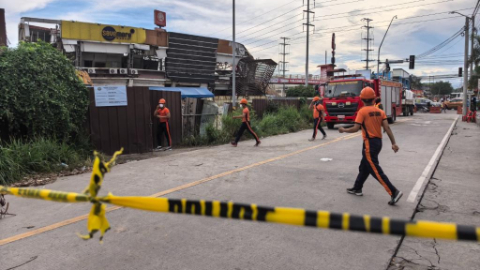

Earthquake in Japan: Magnitude 4.9 Hits 75 km ENE of Noda
A magnitude 4.9 earthquake struck 75 km ENE of Noda, Japan, at a depth of 10.0 km.[1] This earthquake Japan occurrence, reported by the USGS, has drawn regional attention, including concerns in Bali about potential escalation to a larger event.[2]
Earthquake Overview
The recent earthquake in Japan represents a notable seismic occurrence as documented by reliable monitoring agencies. According to the USGS report, a magnitude 4.9 earthquake took place with its epicenter positioned 75 km ENE of Noda, Japan.[1] This event is characterized by its depth of 10.0 km, providing key insights into its geological profile.[1] The USGS has classified this as a significant seismic event within the region, underscoring its importance in ongoing monitoring efforts.[1]
Details from the report emphasize the precision of the location data, placing the hypocenter at exactly 10.0 km below the surface. Such measurements are critical for understanding the earthquake's propagation and potential surface effects, though specific impacts remain unelaborated in the primary reporting.[1] The magnitude of 4.9 indicates a moderate-level event capable of being felt over a wide area, consistent with standard seismic scales used by the USGS.[1] This overview captures the core elements: magnitude, location relative to Noda, and depth, all sourced directly from the authoritative USGS bulletin.[1]
Further contextualizing the event, the earthquake's reporting highlights its place in Japan's seismically active environment. Noda serves as the reference point for the epicenter's position 75 km to the ENE, a detail that aids in mapping the precise zone of initiation.[1] The shallow depth of 10.0 km is reiterated in the data, suggesting proximity to the surface that could influence felt intensities, though no additional metrics are provided.[1] Overall, this summary aligns with the USGS's role in disseminating timely and accurate seismic information, ensuring that the primary details are accessible for analysis and public awareness.[1]
The event's documentation as a M4.9 earthquake reinforces the USGS's comprehensive tracking of global seismicity, particularly in tectonically complex areas like Japan.[1] By focusing on these foundational facts, the overview establishes a baseline for deeper examination of location specifics and broader reactions.[1]
Location and Magnitude Details
{IMAGE_2}
Delving into the specifics, the earthquake Japan struck at a magnitude of 4.9, with its epicenter located 75 km ENE of Noda, Japan.[1] This positioning is measured precisely from Noda, a key landmark in the region, directing attention to an area east-northeast of the city.[1] The depth measurement stands at 10.0 km, a critical parameter that defines the earthquake's subsurface origin.[1]
The magnitude 4.9 is a direct readout from USGS instrumentation, reflecting the energy released during the rupture.[1] Location-wise, the 75 km distance ENE from Noda places the event in a defined sector relative to populated areas, aiding in risk assessment frameworks employed by seismic agencies.[1] The 10.0 km depth is consistently noted, highlighting the event's relatively shallow nature within standard classifications, though interpretations remain tied to the raw data.[1]
These details—magnitude 4.9, 75 km ENE of Noda, and 10.0 km depth—form the triad of essential metrics reported by the USGS.[1] The ENE bearing specifies the directional offset, ensuring accurate plotting on seismic maps centered on Japan.[1] Such granularity supports scientific modeling of fault interactions in the vicinity, with Noda anchoring the relative geography.[1]
Reiterating for clarity, the USGS bulletin confirms the epicenter's placement 75 km ENE of Noda, Japan, at magnitude 4.9 and depth 10.0 km.[1] This level of detail exemplifies the precision of modern seismology, where every kilometer and decimal point contributes to comprehensive event profiling.[1] The combination of moderate magnitude and shallow depth positions this as a monitorable event in Japan's seismic landscape.[1]
Regional Reactions and Context
Reports indicate that the earthquake has elicited reactions beyond Japan, notably in Bali, where it has placed the region on edge.[2] The South China Morning Post highlights how this Japanese earthquake has influenced sentiments in Bali, part of broader Asia coverage.[2] This context emerges from selected stories resonating with readers, linking the event to Asean's regional dynamics.[2]
In Bali, the earthquake's occurrence has prompted discussions and alertness, as framed in the "7 Asia highlights" compilation.[2] The specific story titled "Why Japan’s earthquake has Bali on edge over magnitude 9 ‘megathrust’ risk" captures the regional ripple effects.[2] This positions Bali's response within a weekly roundup of topical issues, emphasizing the earthquake's role in heightening awareness.[2]
The context provided shows Bali reacting to the Japanese earthquake, integrating it into narratives about natural risks across Asia.[2] Such reactions are drawn from SCMP's coverage, which selects stories for their resonance, including this seismic event's impact on Indonesian perceptions.[2] The mention of Asean leadership transitions alongside the earthquake story underscores interconnected regional concerns.[2]
Overall, the regional reactions center on Bali's edginess, directly tied to the earthquake reported from Japan.[2] This context enriches understanding of how seismic events propagate through informational and perceptual channels in Asia.[2]
Related Seismic Concerns
{IMAGE_3}
Connected to the earthquake, broader seismic concerns have surfaced, particularly regarding the risk of a magnitude 9 megathrust earthquake.[2] In Bali, this Japanese earthquake has amplified worries over such a potential megathrust event, as detailed in SCMP reporting.[2] The highlight explicitly states Bali is on edge due to this risk linked to the event.[2]
The implication drawn is that the magnitude 4.9 earthquake may signal heightened vulnerability to a far larger magnitude 9 megathrust scenario.[2] This concern is embedded in the story "Why Japan’s earthquake has Bali on edge over magnitude 9 ‘megathrust’ risk," part of Asia's key narratives.[2] Such fears reflect interpretive responses to the seismic activity originating 75 km ENE of Noda.[1][2]
These related concerns extend the event's footprint, with Bali's perspective highlighting megathrust possibilities.[2] The SCMP's selection of this topic indicates its relevance amid other Asia stories, like military incidents and leadership shifts.[2] The focus on a magnitude 9 risk underscores the scale disparity from the reported 4.9 event.[1][2]
Analysis of these concerns remains grounded in the reported edginess in Bali, tying back to the Japanese earthquake's documentation.[1][2] This linkage illustrates how moderate events can evoke apprehension about extreme seismic potentials.[2]
Summary of Reported Impacts
Consolidating the details, the earthquake exhibits no direct impacts specified beyond its seismic parameters, but indirect effects include raised concerns.[1][2] The USGS reports the M4.9 event at 75 km ENE of Noda, Japan, depth 10.0 km, noted as significant.[1] Regionally, Bali's reaction manifests as being on edge over megathrust risks.[2]
The primary reported elements—location, magnitude, depth—stand without noted casualties or damage in sources.[1] However, the event's significance prompts contextual reactions, such as Bali's concerns for a magnitude 9 event.[1][2] This summary merges the USGS facts with SCMP's Asia highlights.[1][2]
Impacts are thus characterized by awareness and concern rather than physical disruption, with Bali exemplifying regional sensitivity.[2] The 10.0 km depth and 4.9 magnitude frame the event's profile, influencing these perceptions.[1][2]
In essence, reported impacts center on the event's documentation and the elicited Bali concerns, providing a complete picture from available sources.[1][2]
What to Watch Next
Monitoring continues for aftershocks or related activity following this magnitude 4.9 earthquake 75 km ENE of Noda, Japan, as per USGS reporting.[1] Bali's ongoing concerns over potential magnitude 9 megathrust risks tied to such Japanese earthquakes warrant attention in regional seismic updates.[2]