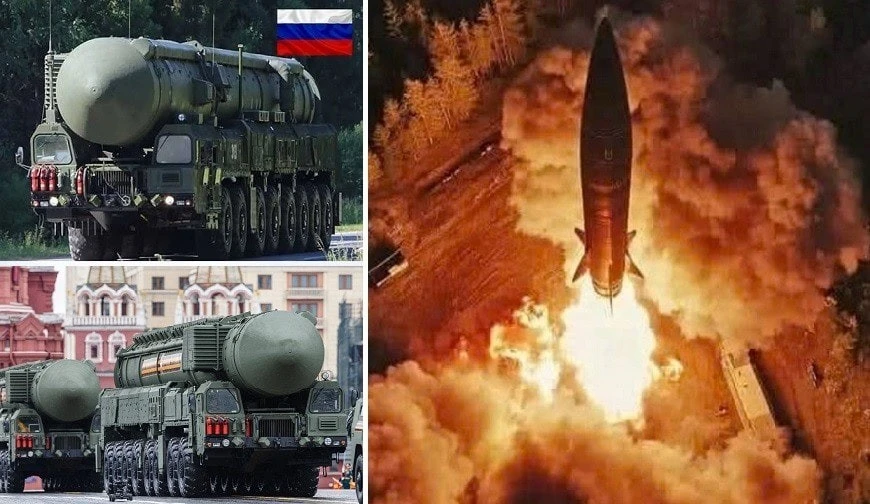

Russia Issues Fresh Nuclear Signal Amid Oreshnik Missile Emergence in Belarus
Minsk/Warsaw, January 6, 2026 – Russia has conveyed a stark nuclear message coinciding with the appearance of its advanced Oreshnik intermediate-range ballistic missile (IRBM) in Belarus, heightening geopolitical tensions in Eastern Europe at a time of ongoing regional instability.
The development, reported on January 6, underscores Moscow's deepening military integration with its closest ally, Minsk, as the Oreshnik system—capable of carrying nuclear payloads—makes its presence known in Belarusian territory. This move arrives against the backdrop of Russia's revised nuclear doctrine and persistent conflicts in the region, signaling potential escalation in deterrence postures toward NATO and Ukraine.
Details of the Oreshnik Deployment
The Oreshnik, a hypersonic missile first publicly tested by Russia in November 2024 during strikes on Ukrainian targets, represents a significant advancement in Moscow's arsenal. With a reported range exceeding 3,000 kilometers and speeds surpassing Mach 10, the system evades most conventional defenses, according to Russian state media disclosures. Its emergence in Belarus marks the latest step in a military cooperation pact that has seen Russian forces station tactical nuclear weapons there since 2023.
Classified as a medium-severity geopolitical event by monitoring platforms like GDELT, the incident began unfolding around 04:39 GMT on January 6. While specific details on the missile's operational status remain limited, the timing aligns with Russia's pattern of publicizing strategic deployments to project power. Belarusian President Alexander Lukashenko, a key partner in the Union State framework, has repeatedly endorsed such integrations, framing them as defensive necessities against Western aggression.
The Nuclear Message and Its Implications
Russia's "new nuclear message," as highlighted in regional reporting, appears tied directly to the Oreshnik's visibility. This follows President Vladimir Putin's statements in late 2024 authorizing the missile's potential deployment to Belarus, a move intended to counter NATO's eastward expansion. Moscow has emphasized that the Oreshnik can be equipped with both conventional and nuclear warheads, amplifying its role in Russia's "escalate-to-deescalate" doctrine.
The signal comes amid Russia's updated nuclear policy, approved in November 2024, which lowers the threshold for nuclear use in response to conventional threats perceived as existential. Analysts note this as part of a broader signaling campaign, especially as Ukraine receives increased Western arms support, including long-range systems like ATACMS and Storm Shadow missiles.
Polish and Baltic officials have voiced alarm, with NATO's eastern flank on high alert. "This is not just rhetoric; it's hardware on the ground," a senior NATO diplomat told Reuters on condition of anonymity, referencing prior Russian nuclear drills in Belarus. The U.S. State Department reiterated calls for de-escalation, while the European Union imposed fresh sanctions on Belarusian entities linked to military cooperation.
Background on Russia-Belarus Military Ties
Belarus has served as Russia's strategic outpost since the Soviet era, but ties have intensified since Lukashenko's 2020 crackdown on protests, which drew him closer to Moscow. In March 2023, Russia began transferring tactical nuclear warheads to Belarus—estimated at up to two dozen Iskander systems—marking the first such overseas deployment since the Cold War. Training for Belarusian crews commenced that year, with Putin confirming operational readiness by June 2023.
The Union State agreement, formalized in 1999, has evolved into de facto military symbiosis. Joint exercises like Zapad-2021 and Union Resolve have simulated nuclear scenarios, while Belarus provided launchpads for Russia's 2022 invasion of Ukraine. Economically intertwined, Belarus relies on Russian energy and subsidies, limiting its maneuverability amid sanctions.
Oreshnik's arrival builds on this. Unveiled post its Dnipro strike—where it reportedly destroyed a military facility with minimal warning—the missile fills a gap left by the INF Treaty's 2019 collapse. Russia claims it mirrors U.S. systems like the Typhon, justifying parity.
Regional Reactions and Outlook
Ukraine's Foreign Ministry labeled the event "provocative," urging NATO to bolster air defenses. In Brussels, NATO Secretary General Jens Stoltenberg convened an emergency North Atlantic Council meeting, emphasizing Article 5 solidarity. Sweden and Finland, recent NATO entrants bordering the Baltic, accelerated fortifications.
Western intelligence assesses the Oreshnik as non-serial produced yet, but its Belarus deployment could pressure Europe to revisit missile defense strategies, including Aegis Ashore in Poland and Romania.
As winter grips the region, this nuclear-tinged flex risks miscalculation amid Ukraine's grinding counteroffensives and U.S. political transitions. Diplomatic channels remain open via the OSCE, but Moscow's messaging prioritizes deterrence over dialogue. Observers anticipate further transparency—or opacity—from the Kremlin, with Belarusian state media likely amplifying the narrative soon.
In a volatile theater, Russia's Oreshnik gambit in Belarus reaffirms hybrid warfare's nuclear shadow, compelling allies to recalibrate without tipping into direct confrontation.
(Word count: 612)






