
Protests Break Out Outside New York Courtroom During Hearing Involving Venezuelan President Nicolás Maduro
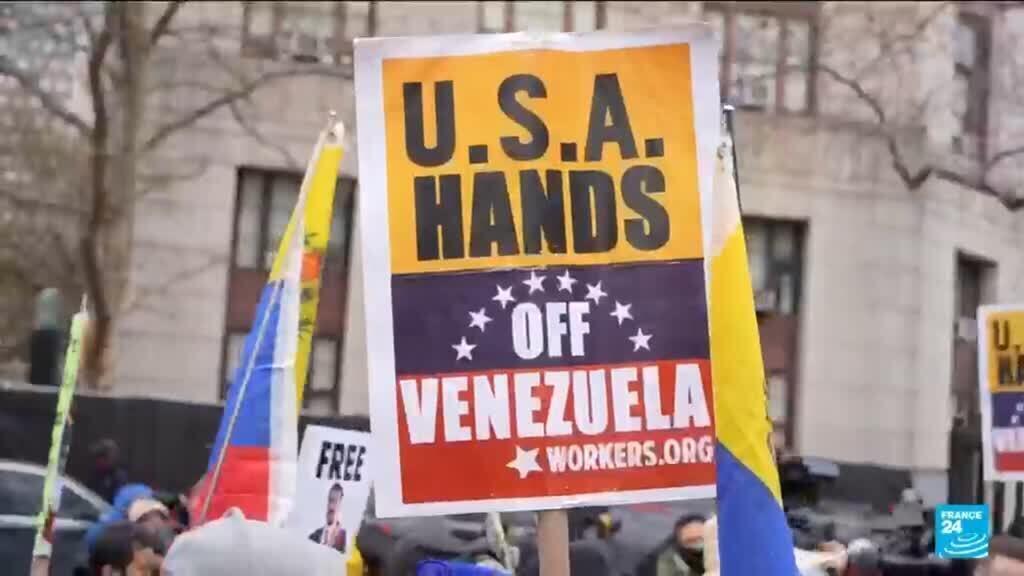
NEW YORK — Demonstrations unfolded outside a federal courtroom in New York on Monday evening as a hearing took place involving Venezuelan President Nicolás Maduro, marking a notable instance of civil unrest tied to international legal proceedings in the United States.
The protests, rated as medium severity by event trackers, began around 5:23 p.m. ET (22:23 UTC) on January 5, 2026. They occurred in proximity to the U.S. courtroom hosting the hearing, drawing attention from onlookers and media amid heightened tensions over Venezuela's political crisis. France 24 correspondent Jessica Le Masurier reported from the scene, providing on-the-ground coverage of the developments.
Details on the scale and specific demands of the protesters remain limited in initial reports, but the gatherings highlight the ongoing divisions within the Venezuelan diaspora and broader international scrutiny of Maduro's leadership. Eyewitness accounts captured by Le Masurier underscored the charged atmosphere outside the courthouse, where participants voiced concerns linked to Maduro's legal entanglements with U.S. authorities.
Context of the Hearing and Maduro's U.S. Legal Challenges
The hearing represents a significant escalation in long-standing U.S. efforts to hold Maduro accountable for alleged criminal activities. Maduro, who has led Venezuela since 2013 following the death of Hugo Chávez, faces multiple indictments from U.S. federal prosecutors. In March 2020, the U.S. Department of Justice unsealed charges against Maduro and several top Venezuelan officials, accusing them of narcoterrorism, drug trafficking, and corruption. Prosecutors alleged that Maduro's regime collaborated with Colombian FARC rebels to flood the United States with cocaine, labeling it a "narco-terrorism" alliance.
This New York proceeding appears connected to those charges, though specifics of the January 5 hearing—such as whether it involved Maduro's virtual appearance, testimony from associates, or arguments on extradition—were not detailed in immediate dispatches. The Southern District of New York, known for handling high-profile international cases, has been a focal point for such litigation. A $15 million bounty on Maduro's head, offered by the U.S. State Department under its Narcotics Rewards Program, remains active, underscoring the gravity of the accusations.
Venezuela's economic collapse under Maduro's rule has fueled mass migration, with over 7.7 million Venezuelans fleeing since 2014, according to United Nations estimates. Many have resettled in the U.S., particularly in Florida and New York, forming vocal communities that closely monitor legal actions against the regime. Protests in U.S. cities have periodically erupted in response to Venezuelan elections, human rights abuses, and U.S. policy shifts.
Broader U.S.-Venezuela Tensions and Protest History
U.S.-Venezuela relations have deteriorated sharply over the past decade. The Trump administration recognized opposition leader Juan Guaidó as interim president in 2019, imposing sweeping sanctions on Maduro's government for undermining democracy and engaging in corruption. The Biden administration maintained most sanctions while pursuing limited diplomatic engagement, including oil license negotiations to stabilize global energy markets amid Russia's invasion of Ukraine.
Civil unrest linked to Venezuelan issues has surfaced in the U.S. before. In 2019, massive rallies in Miami and other cities protested Maduro's disputed reelection. More recently, demonstrations followed Venezuela's contested July 2024 presidential election, where opposition candidate Edmundo González claimed victory amid fraud allegations certified by the Carter Center and the European Union. Maduro's inauguration in January 2025 drew international condemnation, setting the stage for continued legal and public pressure.
New York's Venezuelan community, estimated at tens of thousands, has been active in advocacy. Groups like Venezuelans in New York and the Venezuelan American Caucus have organized vigils and marches, often calling for sanctions enforcement and asylum protections. Monday's protests fit this pattern, potentially involving both Maduro opponents seeking justice and supporters decrying U.S. "imperialism," though participant affiliations were not specified in early reports.
Law enforcement response was measured, with no reports of arrests or clashes as of late Monday. The New York Police Department routinely manages such gatherings near federal buildings, prioritizing public safety.
Implications for Diplomacy and Diaspora
The timing of the hearing coincides with fragile multilateral efforts to address Venezuela's turmoil. Brazil and Colombia have mediated dialogues, while the U.S. has dangled sanctions relief in exchange for free elections. However, Maduro's consolidation of power, including Supreme Court rulings upholding his authority, has stymied progress.
For the Venezuelan diaspora, these U.S. court events symbolize hope for accountability. "This is a step toward justice for our people," one anonymous protester told reporters outside the courthouse, echoing sentiments from prior demonstrations. Le Masurier's footage captured chants and signage, reflecting the emotional stakes.
As investigations continue, the protests signal potential for sustained activism. Analysts note that U.S. courts could issue further warrants or asset seizures, pressuring Maduro's inner circle. Yet, with Venezuela's oil vital to global markets, full enforcement remains geopolitically complex.
No injuries or disruptions to the hearing were reported, but the events underscore how Venezuela's crisis reverberates in American cities. Further updates from the courtroom and protest organizers are expected as details emerge.
(Word count: 712)