
Multiple Moderate Earthquakes Rattle Northern Argentina Amid Ongoing Seismic Activity
Buenos Aires, Argentina – Northern Argentina has experienced a series of moderate earthquakes in late December 2025 and early January 2026, including a magnitude 5.3 event near San Antonio de los Cobres on January 1 and a magnitude 4.2 tremor near Londres on December 30, followed by a magnitude 4.1 quake in Santiago del Estero on January 5. No major damage or casualties have been reported from these events, which occurred at significant depths, reducing their surface impact.
The most notable quake struck at 4:26 a.m. UTC on Thursday, January 1, 2026, with a magnitude of 5.3 at a depth of 182 kilometers, approximately 47 kilometers west of San Antonio de los Cobres in Salta province. Classified as medium severity by seismic monitoring services, the event occurred in a seismically active region near the Andean cordillera. Its deep focal depth likely limited widespread shaking on the surface, though lighter tremors may have been felt in nearby areas.
Just two days earlier, on Tuesday, December 30, 2025, at 1:20 p.m. UTC, a magnitude 4.2 earthquake occurred at a depth of 153.1 kilometers, centered 53 kilometers east-southeast of Londres in Catamarca province. Also rated medium severity, this intermediate-depth event aligns with tectonic patterns in the region but produced no immediate reports of structural damage.
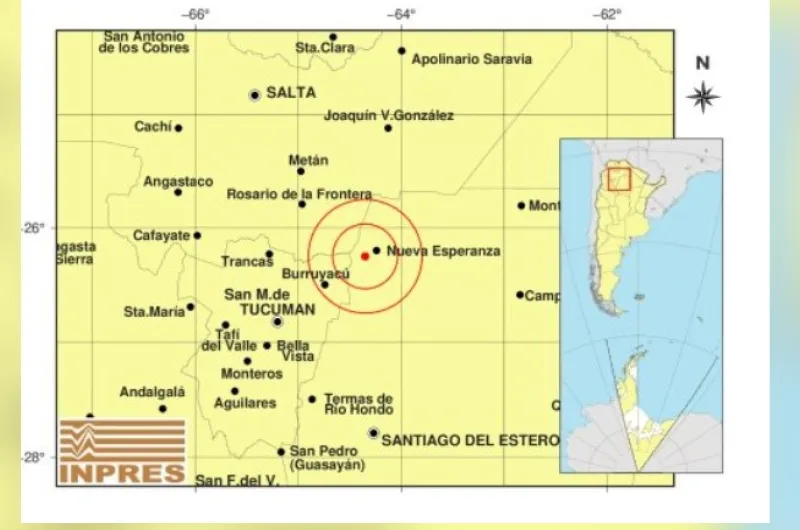
Adding to the recent activity, a magnitude 4.1 earthquake shook northern Santiago del Estero province on Monday, January 5, 2026, at 10:41 a.m. local time. According to reports from El Liberal, the tremor was strongly felt by residents, prompting concerns among locals in the affected areas. "El fenómeno se registró a las 10:41 de este lunes y se percibió de manera muy fuerte por los vecinos," the article noted, highlighting the intensity perceived despite the moderate magnitude. The article, published on January 5 at approximately 3:30 p.m. UTC, did not detail any injuries or significant disruptions.
These events underscore Argentina's position in one of the world's most seismically dynamic zones. The country lies along the boundary of the Nazca and South American tectonic plates, where the former subducts beneath the latter at rates of up to 8 centimeters per year. This subduction generates frequent earthquakes, particularly in the northwest, including provinces like Salta, Catamarca, and Jujuy. Intermediate-depth quakes, like those on December 30 and January 1, often originate in the subducting slab, sometimes hundreds of kilometers below the surface.
Background on Argentina's Seismic Landscape
Argentina's seismic risk is concentrated in the Andean northwest and the Vaca Muerta shale region in the south, but intraplate activity can extend eastward, as seen in Santiago del Estero. Historical data from the United States Geological Survey (USGS) and Argentina's Instituto Nacional de Prevención Sísmica (INPRES) indicate that the country averages several hundred earthquakes annually, most below magnitude 4.0. Larger events, such as the 1944 magnitude 7.0 quake near San Juan or the 1977 magnitude 7.4 tremor in the Andes, have caused significant damage in the past.
INPRES maintains a national network of over 50 seismic stations, providing real-time monitoring and early warnings. Recent upgrades have improved detection of deep-focus events, which, while less destructive, contribute to public awareness and preparedness. The December 2025 and January 2026 quakes occurred amid a backdrop of heightened vigilance following global seismic upticks, though experts attribute such clusters to natural tectonic loading rather than any anomalous surge.
In Salta province, San Antonio de los Cobres—a remote town near the Tren a las Nubes railway—lies in a high-altitude valley prone to both shallow and deep quakes. Londres, in Catamarca, is similarly situated in the Andean foothills, where mining operations occasionally intersect with seismic zones. Santiago del Estero, farther east on the Chaco plains, experiences shaking from distant Andean sources, explaining the strong perceptions reported locally.
Authorities have not issued evacuation orders for these events, emphasizing standard preparedness measures: securing furniture, identifying safe spaces, and following INPRES alerts via apps and social media. The Argentine government, through the Secretaría de Gestión de Riesgo Climático, routinely conducts drills in vulnerable provinces.
Looking Ahead
Seismic monitoring continues across northern Argentina, with INPRES and international partners tracking aftershocks. While these medium-severity events have not resulted in reported harm, they serve as reminders of the region's inherent risks. Residents are advised to stay informed through official channels, as deeper quakes can occasionally trigger shallower aftershocks with greater surface effects.
As of January 6, 2026, no additional significant tremors have been recorded in the immediate aftermath, but the public remains on alert in this tectonically active corridor.
(Word count: 712)