
Magnitude 5.1 Earthquakes Rattle Calabria Region in Southern Italy
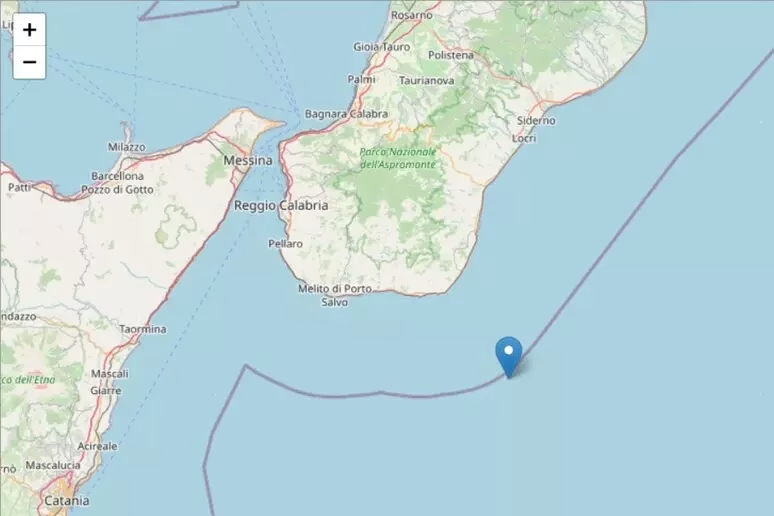
Brancaleone, Italy – Two earthquakes measuring 5.1 on the Richter scale struck off the coast of Calabria in southern Italy early on January 10, 2026, causing tremors felt across Reggio Calabria and as far as Sicily. The events, occurring at shallow to moderate depths, prompted seismic alerts but no immediate reports of significant damage or casualties.
The first quake hit at 04:53 GMT (05:53 local time), centered 17 kilometers east-southeast of Brancaleone at a depth of 52 kilometers. Approximately three hours later, at 07:39 GMT (08:39 local time), a second 5.1 magnitude tremor struck in the same general area, registering a seismic intensity of 6 on the Modified Mercalli scale. Both events were classified as medium severity by monitoring agencies, indicating potential for light damage in populated areas but primarily resulting in widespread shaking.
Italian news outlets reported the quakes as originating al largo della costa ionica (off the Ionian coast), with the shaking strongly felt in Reggio Calabria, a city of around 180,000 residents near the epicenters. Residents described a "brivido sismico all'alba" – a seismic thrill at dawn – as the early morning jolts interrupted sleep and routine activities. The tremors extended to Sicily, evoking historical memories of past disasters in the region.
Italy's National Institute of Geophysics and Volcanology (INGV), which maintains a real-time seismic network, confirmed the parameters of both events through its monitoring stations. The Calabrian Arc, where the quakes occurred, is a tectonically active subduction zone where the African plate dives beneath the Eurasian plate, contributing to frequent seismic activity in southern Italy.
Regional Impact and Response
No major structural damage or injuries have been reported as of the latest updates, though authorities urged caution amid aftershock risks. Local media in Reggio Calabria highlighted the event's visibility, with one report noting it was "avvertita" (felt) across the province. In Sicily, the shaking reignited discussions of the devastating 1693 earthquake that killed thousands in the Val di Noto area, underscoring the region's vulnerability.
Civil protection teams in Calabria activated standard protocols, including public advisories to avoid coastal areas prone to minor tsunamis – though no such warnings were issued for these events. The European-Mediterranean Seismological Centre (EMSC) corroborated the INGV data, listing the epicenters near Brancaleone, a small coastal town in the Province of Reggio Calabria.
Social media and local broadcasts captured resident accounts of furniture swaying and windows rattling, but emergency services reported no widespread calls for assistance. Schools and some businesses in the affected zones remained operational, pending further assessments.
Seismic Context in Southern Italy
Southern Italy, particularly Calabria and Sicily, lies in one of Europe's most seismically hazardous zones. The region experiences thousands of tremors annually, most minor, due to its position at the convergence of tectonic plates. Historical precedents include the 1783 Calabria earthquakes, which caused over 30,000 deaths, and the 1908 Messina quake that killed up to 80,000 across the Strait of Messina.
More recently, the 2016-2017 Central Italy sequence and the 1980 Irpinia event (magnitude 6.9) highlight the potential for escalation. Calabria's rugged terrain and coastal location amplify risks from secondary effects like landslides. Italy's robust early-warning system, operational since 2012, provides seconds to minutes of advance notice for populated areas, credited with saving lives in events like the 2016 Amatrice quake.
The INGV's seismic hazard map designates much of Calabria as high-risk, with expected peak ground accelerations exceeding 0.25g in the Ionian sector. These January 10 events align with typical patterns: moderate magnitudes at intermediate depths, often in swarms rather than isolated shocks.
Ongoing Monitoring and Outlook
As of January 10 afternoon, INGV recorded minor aftershocks, including several below magnitude 3.0, but seismologists anticipate a gradual decline in activity. The Italian Civil Protection Department (DPC) maintains a "yellow" alert level for the region, facilitating rapid response if needed.
Experts emphasize preparedness in this perennial hotspot. Italy's building codes, updated post-2009 L'Aquila quake, mandate seismic-resistant designs, though older structures in historic centers remain vulnerable. Public education campaigns, including annual drills, continue to bolster resilience.
While these quakes caused alarm without catastrophe, they serve as a reminder of Italy's seismic reality. Monitoring networks will track developments, with updates available via INGV's portal. Residents are advised to follow official channels for real-time information.
(Word count: 612)