
Magnitude 5.1 Earthquake Jolts Southern Italy's Calabria Region, Reigniting Seismic Concerns in Historic Hotspot
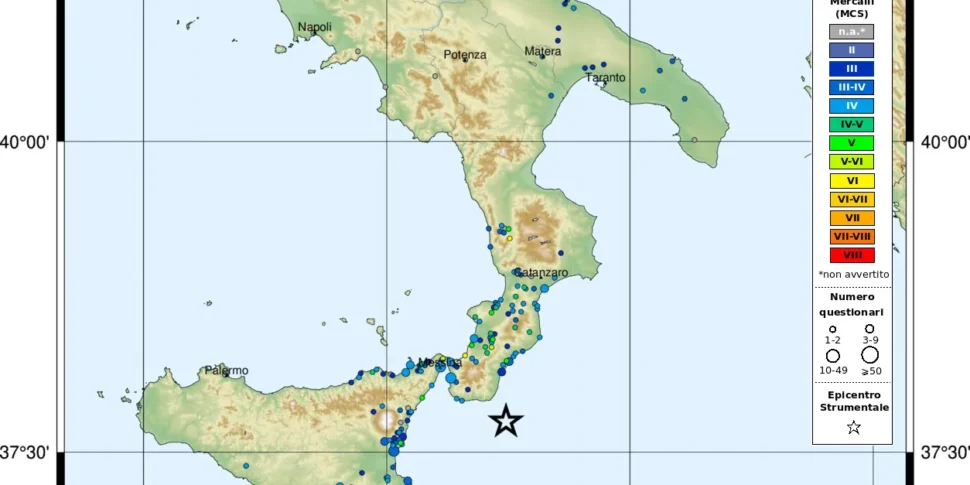
ROME — A magnitude 5.1 earthquake struck off the coast of Calabria in southern Italy early Saturday, registering a seismic intensity of 6 on the Mercalli scale and prompting heightened vigilance in one of Europe's most seismically active zones. The tremor, centered in the Ionian Sea between Calabria and Sicily, occurred at 07:39 UTC on January 10, 2026, with no immediate reports of casualties or significant structural damage.
Italian authorities and seismic monitoring agencies quickly assessed the event as medium severity. The National Institute of Geophysics and Volcanology (INGV) recorded the quake's epicenter approximately 20-30 kilometers offshore, at a shallow depth that amplified ground shaking in nearby coastal areas. Tremors were felt across Calabria, Sicily, and parts of Basilicata, with residents in towns like Reggio Calabria and Messina reporting swaying buildings and rattling windows. Emergency services were placed on alert, but preliminary inspections indicated limited impacts, consistent with the quake's moderate magnitude.
The event has drawn attention to the region's longstanding vulnerability to seismic activity. Calabria and Sicily lie at the convergence of the African and Eurasian tectonic plates, where the Ionian subduction zone generates frequent earthquakes. As noted in recent coverage, this "terra che trema da secoli" — land that has trembled for centuries — has seen numerous destructive quakes, underscoring the area's status as a European seismic hotspot.
Historical Context and Regional Risks
Italy's southern regions have a grim history of seismic devastation. The Ionian Sea has been the epicenter of some of the deadliest events in modern European history, including the 1908 Messina earthquake, which killed over 80,000 people across Calabria and Sicily with a magnitude of 7.1. More recently, a 6.2-magnitude quake off Sicily in 1990 caused widespread damage, and swarms of tremors in the Strait of Messina area have been recurrent.
The latest event echoes this pattern, occurring in the Mar Ionio — the Ionian Sea — which has registered heightened activity in recent monitoring data. Italy's civil protection agency maintains a robust early-warning system, bolstered by EU-funded seismic networks, which allowed for rapid response. Schools and public buildings in affected areas were evacuated as a precaution, and aftershocks — including several below magnitude 3.0 — continue to be monitored.
Experts emphasize that while magnitude 5.1 quakes are not uncommon here (averaging several per decade), the Mercalli intensity of 6 indicates "strong" shaking capable of cracking walls and dislodging objects, particularly in older structures. Calabria's rugged terrain and aging infrastructure amplify risks, though post-1980s building codes have improved resilience in urban centers.
Political Reactions and Infrastructure Debates
The earthquake has intersected with ongoing national debates, particularly surrounding the proposed Ponte sullo Stretto — the Strait of Messina Bridge. Green politician Angelo Bonelli linked the tremor to concerns over the megaproject, which aims to connect Sicily and Calabria with a 3.3-kilometer span. Critics, including Bonelli, argue that seismic risks in the strait make the bridge untenable, accusing proponents of downplaying geological threats for political gain.
Supporters counter that modern engineering, including seismic isolators and deep foundations, renders the project safe, citing successful bridges in similarly active zones like Japan. Coverage has highlighted accusations of "vili speculazioni" — vile speculations — amid Italy's polarized infrastructure discourse under the current government, which has revived bridge plans dormant since the 1960s.
Prime Minister Giorgia Meloni's administration reaffirmed commitment to the project in late 2025, allocating €1.2 billion for initial works, but seismic events like this inevitably fuel opposition. No official statements tied the quake directly to bridge planning, but it has reignited public discourse on balancing development with natural hazards.
Outlook and Preparedness Measures
As of Saturday afternoon, the INGV reported no major aftershocks exceeding magnitude 4.0, and civil protection teams have lifted most alerts. However, residents are advised to prepare for potential follow-on tremors, with hotlines active for reporting damage.
Italy's seismic preparedness has evolved significantly since the deadly 2009 L'Aquila quake (magnitude 6.3, over 300 deaths) and 2016 central Italy sequence. Nationwide drills, retrofitting programs, and apps like "Where's My Earthquake?" provide real-time alerts, credited with minimizing casualties in recent events.
This Calabria tremor serves as a reminder of Italy's position astride multiple fault lines, which produce about 2,000 quakes annually, most minor. While medium severity limits immediate fallout, it underscores the need for sustained investment in monitoring and resilient infrastructure in this perennial hotspot.
(Word count: 612)