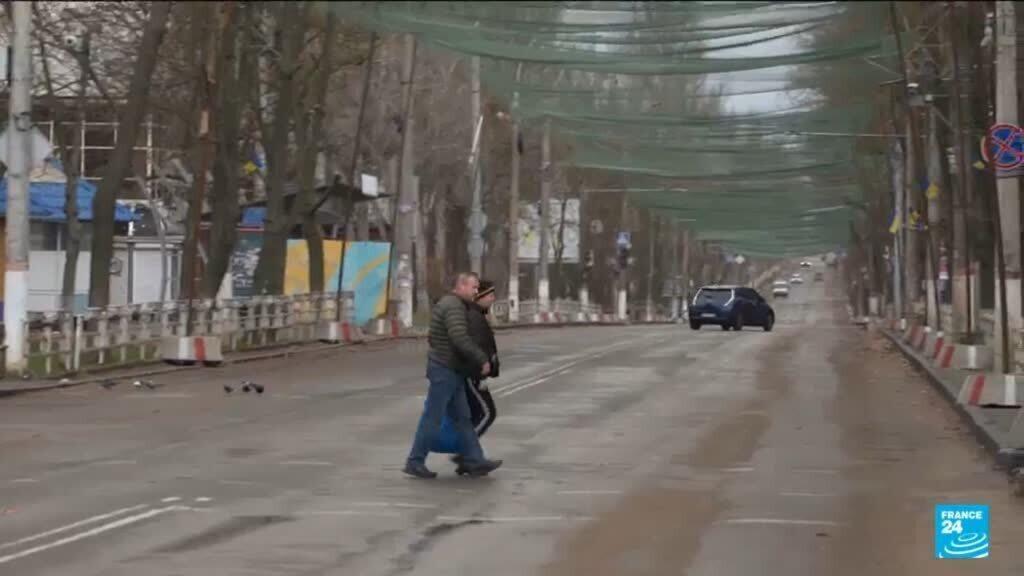

Kherson Residents Live in Constant Fear Under Anti-Drone Nets as Russian Attacks Persist
Kherson, Ukraine – In the southern Ukrainian city of Kherson, residents are resorting to makeshift anti-drone nets strung across streets and tied to trees, offering a fragile shield against relentless Russian drone strikes. The measures, implemented amid ongoing hostilities, underscore the precarious daily life on the front lines of Russia's invasion, even as diplomatic talks on Ukraine's security guarantees unfold in Paris.
The city, located just across the Dnipro River from Russian-occupied territories, has become a focal point for drone incursions. According to reports from France 24 correspondents on the ground, these giant protective nets provide a semblance of security, though they do not always succeed in thwarting attacks. "Although it doesn't always work, it makes life seem a bit safer," the report notes, capturing the grim resilience of locals navigating a landscape scarred by war.
Kherson's vulnerability stems from its strategic position. Since Ukrainian forces liberated the city in November 2022 during a daring counteroffensive, it has faced near-constant bombardment from Russian positions on the east bank of the Dnipro. Drones, including Iranian-designed Shahed models and smaller first-person-view (FPV) variants, have become a hallmark of Moscow's attrition strategy, targeting civilian infrastructure, energy facilities, and even residential areas. The latest wave of threats intensified around January 7, 2026, placing the city at medium severity risk, with residents living in perpetual anticipation of the next strike.
Eyewitness accounts paint a picture of normalized peril. Streets once bustling with daily life are now overshadowed by camouflage netting, transforming urban spaces into improvised fortresses. The France 24 report highlights how these defenses, while rudimentary, reflect broader adaptations across Ukraine's frontline cities. Similar measures have been employed in places like Kupiansk and Avdiivka, where anti-drone systems have evolved from experimental to essential.
Background on Kherson's Ordeal
Kherson's plight is emblematic of the protracted conflict that erupted with Russia's full-scale invasion on February 24, 2022. The city, a key Black Sea port and administrative hub with a pre-war population of around 280,000, fell under Russian occupation within weeks. Moscow installed a puppet administration and subjected residents to forced deportations, Russification efforts, and cultural erasure.
The Ukrainian retaking of Kherson marked a rare battlefield victory for Kyiv, boosting morale and prompting the withdrawal of Russian forces across the river. However, this success came at a cost: the left bank remains a stronghold for Russian troops, enabling cross-river assaults. Since liberation, Kherson Oblast has recorded thousands of civilian casualties from artillery, missiles, and drones. The United Nations has documented over 500 civilian deaths in the region post-liberation, with drones accounting for a growing share due to their precision and low cost.
Russia's drone campaign has escalated in tandem with its broader aerial strategy. Moscow has imported thousands of Shahed-136 drones from Iran and developed domestic analogues like the Geran-2. These loitering munitions, often launched in swarms, overwhelm Ukrainian air defenses. Ukraine has countered with electronic warfare, mobile firing groups, and Western-supplied systems like the U.S. Patriot and German IRIS-T, but resource constraints limit coverage over populated areas like Kherson.
The timing of the intensified drone activity coincides with international diplomacy. As noted in the France 24 coverage, discussions on Ukraine's long-term security were underway in Paris on January 7, 2026. These talks, involving European leaders and possibly U.S. representatives, aim to forge guarantees against future Russian aggression amid uncertainties over Western aid following the 2024 U.S. elections. Ukrainian President Volodymyr Zelenskyy has repeatedly called for enhanced air defenses, emphasizing that cities like Kherson bear the brunt of delays.
Broader Conflict Context
The drone threats in Kherson are part of a wider pattern across Ukraine. In the east, Russian forces continue grinding advances toward Pokrovsk in Donetsk Oblast, while in the north, Kursk incursions by Ukrainian troops have stretched Moscow's lines. Winter conditions have slowed major offensives, shifting emphasis to aerial and drone warfare.
Ukrainian officials report intercepting over 90% of incoming drones in recent barrages, but gaps persist in southern regions. International aid remains pivotal: the European Union approved a €50 billion package in 2024, while the U.S. has provided $175 billion in total support since 2022. Yet, fatigue among donors and Russia's war economy—bolstered by North Korean munitions and Iranian drones—prolong the stalemate.
Local voices in Kherson emphasize endurance. While specific quotes from residents are limited in available reports, the collective sentiment is one of defiance amid exhaustion. Community leaders have organized evacuation drills and reinforced shelters, but many refuse to leave ancestral homes.
Outlook Amid Uncertainty
As Russian drone attacks persist, Kherson's anti-net defenses symbolize Ukraine's adaptive spirit. Diplomatic progress in Paris could yield new commitments for air defense systems, potentially alleviating the pressure. However, with no immediate ceasefire in sight, residents brace for the long haul.
The situation remains fluid, with Ukrainian military updates expected to detail any escalations. For now, Kherson endures—a frontline testament to the war's unyielding toll.
(Word count: 712)






