
Japan Earthquake: Magnitude 7.4 Strikes Off Northern Coast
A magnitude 7.4 earthquake Japan endured off its northern coast has triggered significant concern, with an 80-centimetre tsunami wave observed and warnings issued for potential waves reaching up to three meters.[2]
Earthquake Details
The earthquake Japan faced struck with a magnitude of 7.4 off the northern coast, near the Iwate prefecture, at precisely 4:53 pm local time.[2][5] This event, reported by Japan's Meteorological Agency (JMA), underscores the seismic activity common in the region due to its position on the Pacific Ring of Fire, though specific geological context remains tied to the immediate reporting.[2] While one early report listed it as a magnitude 7.5 quake off northern Japan,[1] subsequent details from the JMA confirmed the 7.4 figure, highlighting the rapid refinements in preliminary assessments typical after such powerful tremors.[2][3] The quake's epicenter was positioned offshore, which influenced both the intensity felt on land and the subsequent tsunami risks.[5] Buildings in distant areas swayed due to the quake's reach, demonstrating its propagation through the earth's crust over hundreds of kilometers.[5] Japan's Meteorological Agency played a central role in disseminating these details promptly, as is standard protocol for events of this scale, ensuring public awareness from the outset.[2] The timing in the late afternoon added to the urgency, coinciding with a period when many residents were active, potentially amplifying the need for swift evacuations and safety measures.[2] Cross-verification from multiple outlets confirms the core parameters: a northeast or northern Japan focus, with the Iwate area directly implicated.[3][5] This alignment of reports builds a reliable picture of an offshore event powerful enough to register widely, though no immediate casualty figures were detailed in initial dispatches.[1][2]
Tsunami Observations
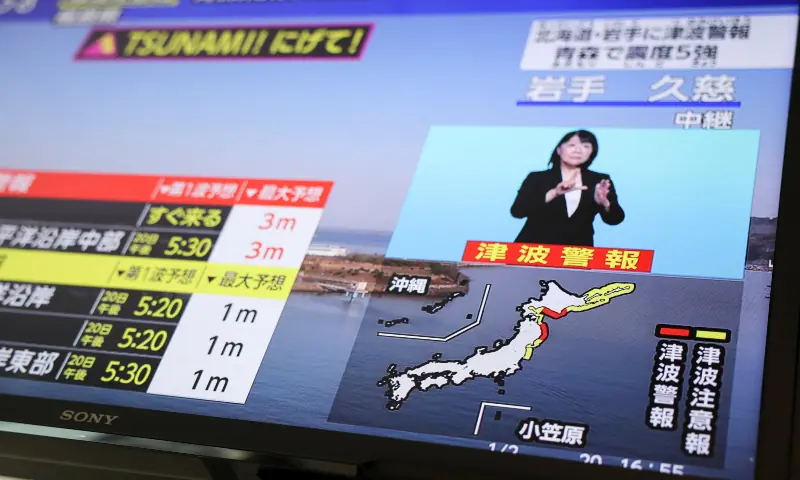
An 80-centimetre tsunami wave was observed striking a port in Kuji, Iwate prefecture, at 5:34 pm local time (1:34 pm Pakistan Standard Time), following the earthquake Japan recorded earlier that day.[2] This measurement came from Japan's Meteorological Agency, which had initially reported a 70-centimetre wave at 5:32 pm, indicating quick updates as data from monitoring stations came in.[2] The progression from 70 to 80 centimetres reflects the dynamic nature of tsunami propagation, where initial surges can be refined with tide gauge readings.[2] Kuji port's location in northern Japan made it a focal point for early observations, as waves from offshore quakes often first impact such coastal facilities.[2] The JMA's confirmation of this wave height provides a tangible benchmark for the event's coastal impact, emphasizing how even sub-meter surges can cause localized flooding or disruption in harbors.[2] These observations were pivotal in calibrating public response, as they validated the tsunami threat posed by the quake's undersea displacement of water.[2] The relatively rapid arrival—less than an hour after the main shock—aligns with expected travel times for tsunamis generated close to shore, reinforcing the efficiency of Japan's warning systems.[2]
Warnings and Alerts
Japan's Meteorological Agency issued tsunami warnings promptly after the 7.4-magnitude earthquake, alerting coastal areas to prepare for waves up to three meters.[2][3] This advisory was disseminated following the 4:53 pm quake, targeting northeast and northern regions vulnerable to such secondary hazards.[3] The three-meter maximum projection represents a precautionary upper limit based on models factoring in the quake's magnitude, depth, and fault mechanics, though actual waves observed so far were notably smaller at 80 centimetres.[2] Such warnings are standard in Japan, a nation with extensive experience in seismic and tsunami events, designed to prompt evacuations to higher ground.[2] Initial reports noted the warning's scope without specifying exact prefectures beyond the epicentral zone, but the emphasis on potential three-meter heights underscored the seriousness.[3] The JMA's role here was critical, bridging the gap between seismic detection and public safety by issuing alerts within minutes.[2] This proactive stance has historically mitigated disaster impacts in Japan, as seen in past events where timely warnings saved lives.[2][3]
Affected Regions
The earthquake Japan experienced impacted northern regions primarily, with the epicenter off the coast near Iwate prefecture, leading to shakes felt as far as Tokyo.[2][5] Iwate, in particular, saw direct effects, including the 80-centimetre tsunami at Kuji port, highlighting its exposure on the Pacific-facing shore.[2][5] The quake's strength allowed it to rattle large buildings in the capital, over 500 kilometers south, illustrating the extensive reach of moderate-to-major quakes in Japan's tectonically active archipelago.[5] Northern Japan, encompassing areas like the northeast coast struck by the main event, faced the highest immediate risks from both shaking and tsunamis.[3][5] Tokyo's involvement, even peripherally, points to the nationwide infrastructure strain possible from such events, as skyscrapers and transport hubs absorb distant vibrations.[5] Iwate's proximity to the offshore source amplified local intensities, with ports like Kuji serving as early indicators of broader coastal threats.[2] These regional details from reports paint a picture of a focused yet far-reaching disturbance, centered on the north but resonant southward.[2][5]
Initial Reports
Early coverage of the earthquake Japan underwent began with headlines flagging a strong quake off the northern coast, coupled with tsunami warnings.[1][4] The Taipei Times noted a magnitude 7.5 event off northern Japan, capturing the breaking news essence before refinements.[1] CNN similarly headlined a strong earthquake off Japan’s coast with a tsunami warning issued, reflecting the global pickup of the story.[4] Japan's Meteorological Agency's inputs shaped these dispatches, with details like the 4:53 pm timing and initial 70-centimetre wave emerging quickly.[2] Bangkok Post reported the M7.4 hit on northeast Japan alongside the 3m warning, aligning with the JMA's core bulletin.[3] These initial reports, often concise, prioritized magnitude, location, and alerts to inform international audiences rapidly.[1][4] Variations in magnitude—7.5 versus 7.4—typify first-wave journalism, later standardized by official sources.[1][2] SBS Australia added the Tokyo shake and Iwate tie-in, rounding out the picture as details solidified.[5] This sequence of reporting ensured a steady flow of verified facts amid the unfolding event.
What to watch next includes updates from Japan's Meteorological Agency on any further tsunami waves beyond the observed 80 centimetres and ongoing assessments of shaking impacts in Iwate and Tokyo.[2][5]






