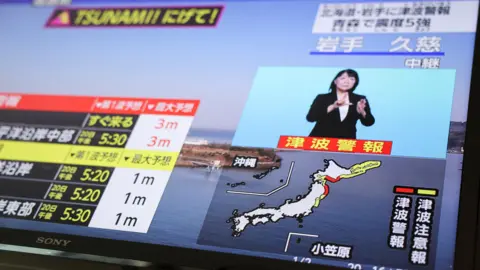

Japan Earthquake: 7.5 Magnitude Quake Triggers Tsunami Warnings Off Northeastern Coast
A 7.5 magnitude earthquake struck off the northeastern coast of Japan, triggering tsunami warnings and evacuations.[3]
The Main Earthquake Event
The primary seismic event, a powerful 7.5-magnitude earthquake, occurred off the northeastern coast of Japan on Monday, sending tremors through the region and prompting immediate concerns for public safety.[3] This major quake was described as hitting with significant force, consistent with its high magnitude reading on the Richter scale, which measures the energy released by such geological disturbances.[3][4] Official reports pinpointed the epicenter offshore, a location that amplified fears of secondary coastal hazards due to Japan's position along the Pacific Ring of Fire, where tectonic plates frequently interact.[3] The Times of India noted it as a "powerful earthquake" that disrupted normal activities, underscoring its intensity even before full assessments were complete.[4] Further details from comprehensive coverage highlighted the event's timing in the evening news cycle, aligning with broader regional updates, though the focus remained on the quake's immediate seismic impact.[4] Japan's vulnerability to such events is well-known, given its history of major quakes, and this 7.5 reading placed it among the stronger recent occurrences, necessitating rapid response protocols from authorities.[3][5] The offshore nature of the rupture likely involved subduction zone activity, common in this part of the world, where the Pacific Plate dives beneath the Eurasian Plate, releasing built-up stress in sudden bursts.[3] While exact depth details for the main quake were not specified in initial reports, the event's magnitude alone warranted widespread monitoring and preparedness measures.[5]
Tsunami Warnings and Responses
In the wake of the 7.5 magnitude earthquake Japan experienced, authorities swiftly issued tsunami warnings, urging residents to evacuate coastal areas to mitigate potential risks.[3][5] Japan's meteorological agency and other officials anticipated waves reaching up to 3 meters (10 feet) in height, a scale that could cause significant inundation in low-lying regions.[3] This prompted clear directives for people to stay away from shorelines, with evacuations underway to higher ground as a precautionary measure.[3][5] An 80 cm tsunami was already recorded following the initial quake, confirming the validity of the alerts and providing early evidence of coastal impacts.[5] Response efforts emphasized rapid movement inland, reflecting standard protocols honed from past disasters like the 2011 Tohoku event.[5] The Daily Maverick reported on the proactive stance, with authorities communicating the expected wave heights to ensure compliance and minimize exposure.[3] Such warnings are critical in Japan, where tsunami-prone coastlines demand efficient alert systems, including sirens, broadcasts, and mobile notifications to reach populations quickly.[1][3] The combination of the quake's offshore location and its power made tsunami generation a primary concern, leading to a coordinated national response.[5]
Risk of Further Quakes
Japan remains on high alert following the 7.5 magnitude event, with the meteorological agency issuing warnings about the potential for a stronger earthquake within the next week.[1][5] Described as a possible "huge" second quake, this advisory underscores the ongoing seismic instability in the region after the initial tremor.[1] Officials have highlighted a heightened risk, keeping communities vigilant amid aftershock sequences that could escalate.[5] The BBC coverage emphasized the agency's proactive stance, noting that such forecasts are based on monitoring data from seismic networks tracking ongoing activity.[1] This period of elevated danger follows the pattern seen in major quakes, where foreshocks or main events can precede larger ruptures along fault lines.[1][5] The special advisory serves as a call for sustained readiness, acknowledging that the northeastern coastal zone could face intensified shaking if tectonic stresses realign.[5] Such predictions draw from historical precedents and real-time geophysical observations, placing the area under a "high alert" status to prepare for worst-case scenarios.[1]
Reported Impacts and Status
No major damage or injuries have been reported so far from the earthquake Japan endured, according to officials monitoring the situation.[5] An 80 cm tsunami was recorded, indicating some coastal effects but not reaching the more destructive heights initially feared.[5] This relatively contained impact allowed for evacuations without widespread disruption to infrastructure, though vigilance continues.[5] Separately, a 5.1 magnitude earthquake struck 129 km east of Yamada, Japan, at a depth of 10.0 km, adding to the regional seismic activity but not linked directly to major consequences.[2] The USGS data on this event provides precise location and depth metrics, situating it in the same broader offshore area affected by the larger quake.[2] Overall status reports reflect a scenario where preparedness measures held firm, preventing casualties despite the dual events.[2][5] The absence of significant structural failures or human harm points to effective building codes and early warnings in Japan, which are designed to withstand such forces.[5]
Official Advisories
Japanese authorities issued a special advisory following the 7.5 tremor, warning of the risk of a "new, huge quake" and stressing the need for continued preparedness.[5][1] Officials urged residents to maintain daily life while staying ready, balancing normalcy with caution in the face of potential aftershocks.[5] The meteorological agency's input was central, forecasting the possibility of a stronger event in the coming week and prompting a high-alert posture nationwide.[1] This guidance included calls for evacuations where necessary and adherence to tsunami protocols, as seen in the immediate post-quake phase.[5] Coverage from the Times of India reinforced the advisory's role in guiding public behavior, ensuring that communities remain informed without panic.[5] Such measures are part of Japan's comprehensive disaster management framework, which prioritizes resilience through education and infrastructure.[1][5]
What to watch next: Monitor updates from Japan's meteorological agency for signs of a stronger earthquake in the next week, as well as ongoing tsunami observations and aftershock reports.[1][5]






