Iran Strikes U.S. Military Targets in Gulf as Khamenei Is Buried
Iran strikes on U.S. military infrastructure in Persian Gulf states accompanied the burial of Iran's slain Supreme Leader Ayatollah Ali Khamenei in Mashhad on Friday as renewed U.S. and Iranian strikes escalated fighting and eroded a three-week-old ceasefire. [3]
Burial of Slain Supreme Leader
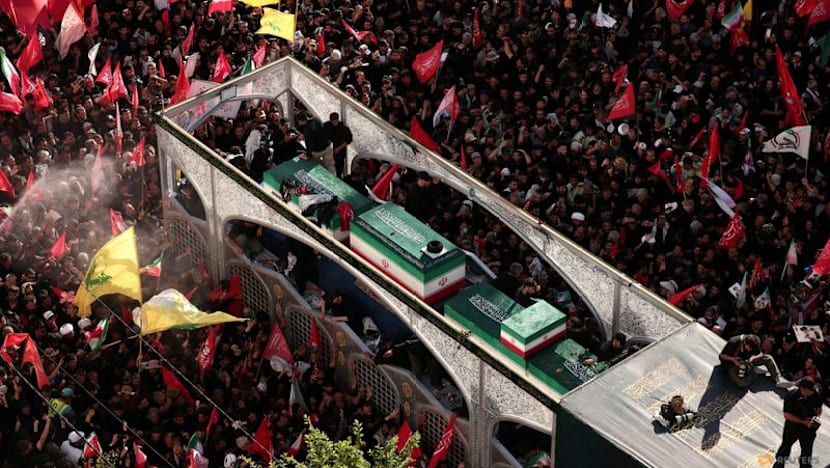
Iran on Friday laid to rest its former supreme leader Ali Khamenei over four months after his killing in an airstrike as two days of U.S. and Iranian attacks raised fears of a return to all-out war. [1] Mourners gathered around a vehicle transporting the coffin of Iran's late Supreme Leader Ayatollah Ali Khamenei on the day of his burial in Mashhad. [3] Iran's slain Supreme Leader Ayatollah Ali Khamenei was buried in his hometown of Mashhad early Friday bringing to a close nearly a week of funeral ceremonies. [4] Khamenei who ruled Iran for almost 37 years was killed in U.S. and Israeli airstrikes that marked the start of the Middle East conflict on February 28. [4] After several days of public mourning he was laid to rest at the Imam Reza Shrine in Mashhad one of the holiest sites in Shia Islam. [4] Khamenei is only the second Iranian ruler to be buried in Mashhad. [4] The first was Nader Shah who was laid to rest in the city after his assassination in 1747 following nearly 11 years in power. [4] Funeral processions began last Saturday with authorities shutting down streets closing airspace and bringing daily life to a standstill in Tehran and other cities. [4] Large crowds gathered to pay their respects to the leader who ruled Iran with an iron grip for decades while maintaining a confrontational stance toward the West. [4] According to Iran International Khamenei's eldest son Mostafa led the funeral prayers. [4] However Mojtaba Khamenei the second eldest of the late Supreme Leader's four sons and his successor as Iran's Supreme Leader was notably absent from the ceremony. [4] The other three sons attended the funeral. [4] Khamenei's body had to be transported by air to the holy shrine as massive crowds packed between the Danesh intersection and the Imam Reza Shrine. [4] State media aired visuals showing vast crowds of mourners lining the funeral route in Mashhad and surrounding the convoy carrying the former Supreme Leader's body to bid their final farewells. [4] The state broadcaster also showed the crowd displaying anti-Trump banners during the procession. [4] The burial came amid renewed hostilities between the United States and Iran. [4]
Renewed U.S. Strikes on Iran
The attacks came as Iran buried its slain Supreme Leader Ayatollah Ali Khamenei at a shrine in Mashhad capping a week of funeral processions and rallies. [3] The burial came amid renewed hostilities between the United States and Iran after Washington carried out two consecutive days of strikes in response to attacks on civilian tankers in the Strait of Hormuz that it blamed on Tehran. [4] ABD savaş uçakları İrana yönelik yeni bir saldırı dalgası başlattı. [5] ABD Merkez Kuvvetler Komutanlığı (CENTCOM) İran’a yönelik 7 ve 8 Temmuz’da düzenlenen hava saldırılarında vurulan hedeflere ilişkin ayrıntıları paylaşmıştı. [5] CENTCOM 7 Temmuz’da düzenlenen ilk saldırı dalgasında ise yaklaşık 80 İran askeri hedefinin vurulduğunu bunlar arasında İran Devrim Muhafızları Ordusu’na ait 60’tan fazla sürat teknesinin de bulunduğunu öne sürmüştü. [5] 140 hedefin vurulduğu öne sürüldü. [5]
Iranian Retaliation and Explosions
Iran strikes on U.S. military infrastructure in Persian Gulf states occurred on Thursday following U.S. strikes on Iran’s southern coastal and eastern provinces further eroding a 3-week-old ceasefire. [3] Iranian armed forces launched attacks on U.S. military infrastructure in Persian Gulf states on Thursday following U.S. strikes on Iran’s southern coastal and eastern provinces including Bushehr Konarak Choghadak and Bandar Abbas. [3] Iranian media later reported multiple explosions across southern Iran including Bushehr where one of the country’s nuclear plants is located along with Konarak Choghadak and Bandar Abbas. [3] A U.S. official said there had been no American strikes in recent hours. [3] İran da boş durmadı. [5] Peş peşe misilleme saldırıları düzenlenirken Körfez ülkelerinde sirenler çaldı. [5] ABD üslerinin hedef alınmasının ardından bölgede alarm seviyesi en üst düzeye çıkarıldı. [5] Birden fazla şehirde patlama sesleri duyuldu. [5] İran haber ajansı Mehr'in aktardığına göre ülkenin güneyinde yer alan Buşehr Çoğadak ve Kunarek kentlerinde patlama sesleri duyuldu. [5] İran'ın Hürmüzgan Eyaleti'nin yönetim merkezi olan şehir Bender Abbas'tan da patlama sesleri geldiği bildirildi. [5]
Ceasefire Collapse
Iran subsequently retaliated further escalating tensions. [4] In June the two countries signed a Memorandum of Understanding to end their conflict last month. [4] The agreement established a 60-day ceasefire and roadmap for ongoing negotiations was initially drafted on June 14 and officially took effect on June 17. [4] Trump savaşın yeniden başladığını duyurmuştu. [5] NATO Zirvesi'nde Rutte ile düzenlenen basın toplantısında konuşan ABD Başkanı Donald Trump "Bence ateşkes sona erdi. Pisliklerle anlaşmak istemiyorum. Bunlar hastalıklı insanlar. Bana kalırsa bu iş bitti. İranlılar yalanca bir anlaşma yaptı" diyerek çatışmaların yeniden başladığını söylemişti. [5] Donald Trump: İran'la ateşkes bence bitti. [5]
Expansion to Northern Front
A remote bridge shows how US-Iran war is expanding. [2] A reported US strike on a railway bridge in northern Iran has drawn attention to a lesser-known front in the widening conflict the battle over the transport corridors linking Iran to Central Asia Russia and China. [2]
What to watch next: Further attention may focus on the transport corridors linking Iran to Central Asia Russia and China following the reported U.S. strike on the remote railway bridge in northern Iran.