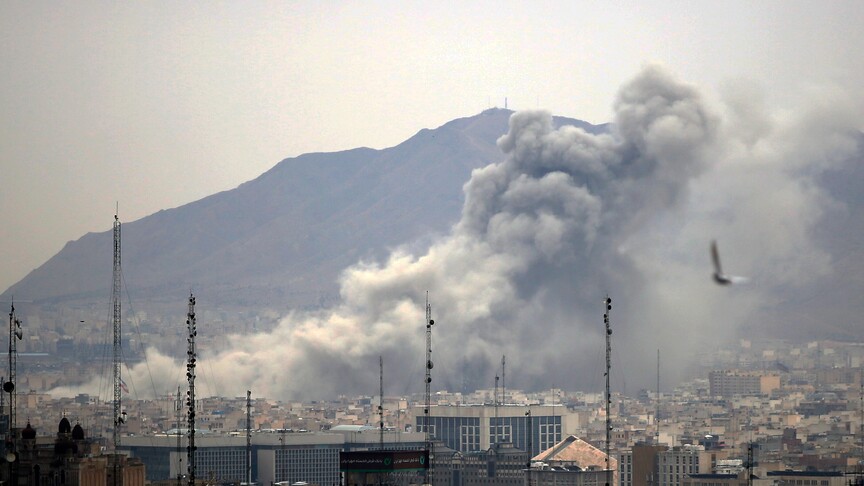
Iran Strikes US Bases in Jordan Bahrain Kuwait and Oman After New US Attacks
The United States conducted a new wave of precision strikes on Iranian military targets near the Strait of Hormuz, prompting Iran to launch retaliatory attacks on US military sites in Jordan, Bahrain, Kuwait and Oman. Iran strikes followed the latest US offensive as the two sides clashed over control of the strategic waterway.
US Launches Second Day of Strikes on Iran
The United States struck Iran on Monday for a second day running. [4] Central Command reported that the latest salvo began at 2100 GMT on Sunday. [4] Centcom said it had completed a new wave of offensive strikes against Iran, hitting dozens of targets at multiple locations with precision munitions to degrade Iran’s ability to continue attacking international shipping flowing through the Strait of Hormuz. [4] Centcom forces struck Iranian military air-defence systems, coastal radar sites, missile and drone capabilities, and small boats using US fighter aircraft, naval vessels, one-way attack aerial drones, and one-way attack sea drones for the first time. [4] The operation marked the first use of one-way unmanned surface vessels in combat by US forces. [5] Centcom stated the strikes were carried out under the direction of President Donald Trump. [5] Iranian state media reported that the latest US strikes targeted large areas across southern and western Iran, including Qeshm Island and Bandar Abbas near the Strait of Hormuz, and in Khuzestan province bordering Iraq. [4]
Iran's Retaliatory Attacks on Gulf Bases
Iran’s Revolutionary Guards Corps said they had struck US military targets and bases in Jordan, Bahrain, Kuwait and Oman. [4] The IRGC claimed missile and drone strikes on Prince Hassan Air Base in Jordan, a US military drone command centre in Bahrain and airbases including Ali Al Salem in Kuwait. [4] The IRGC also said its missile and drone attacks had set fire to fuel storage tanks and ammunition depots on the Jordanian base used by the US military. [4] It said a military base at Bahrain’s Sheikh Isa was hit in the second phase of the retaliatory operation. [4] Revolutionary Guards also claimed attacks on Ali Al Salem and Ahmad Al Jaber military bases in Kuwait. [4] In another statement, the IRGC said its naval forces targeted and destroyed US military facilities in Jafirah, Bahrain, and radar systems in Oman as part of reciprocal actions. [4] Iran’s Revolutionary Guard Corps claimed missile and drone strikes on Prince Hassan Air Base in Jordan, a command center in Bahrain, air bases in Kuwait, radar systems in Oman and other US-linked facilities, setting fires to fuel tanks and ammunition depots. [2] Neither the US military nor the militaries in Jordan, Kuwait or Bahrain have confirmed that the Iranian attacks hit their targets. [2] In Bahrain air raid sirens sounded early Monday morning. [2]

Iran launches retaliatory strikes on US military bases in Jordan, Bahrain, Kuwait and Oman. — Source: gdelt
Dispute Over Strait of Hormuz Control
Iran declared the Strait of Hormuz closed to shipping until US military interference ends. [4] The IRGC statement said that ending US military interventions in the Strait of Hormuz was the only way to restore vessel passage. [4] It warned that continued interference could lead to greater incidents in the global oil and gas sector. [4] The US Centcom countered that the strait was open to all vessels seeking to lawfully transit. [4] The military command added that US forces were positioned and prepared to ensure freedom of navigation, claiming Iran does not control the strait and traffic is flowing. [4] Centcom reiterated its assertion that Iran did not control Hormuz and US forces are postured and prepared to ensure that freedom of navigation remains available to commercial shipping despite Iran’s continued unwarranted aggression, harassment, threats, and arbitrary declarations. [4] Iran’s Revolutionary Guards said after an incident involving a commercial ship that the Strait of Hormuz would be closed until further notice and until the end of American interventions in this region. [4] Ship-tracking data from Kpler showed six vessels passed through the strait on Sunday — the lowest number in five weeks. [4] Iranian officials have argued that navigation through the waterway should be coordinated with Tehran and Oman. [5]
Context of Collapsed Ceasefire
The strikes follow the collapse of a mid-June interim agreement to end the US-Israel war on Iran that began in late February, with President Trump declaring the ceasefire over. [4] The flare-up is the latest to undermine an interim agreement between Washington and Tehran aimed at ending their war, which has caused global economic shockwaves since it began in late February. [4] USA initiated together with Israel on 28 February a war against Iran. [2] Trump justified the war with the claim that he wanted to prevent Iran from developing a nuclear weapon. [2] After several months of negotiations the two countries signed in mid-June a memorandum of understanding that was to pave the way for an end to the conflict. [2] US President Donald Trump stated at a Nato summit on Wednesday that he no longer considers the memorandum of understanding to be valid. [2] Later in the week he wrote on Truth Social that the ceasefire is over. [2] Mediators including Pakistan have been trying to salvage a diplomatic solution to end the war after President Donald Trump this week declared that a ceasefire agreed with Iran after the signing of the interim accord on June 18 was over. [4]
Casualties, Oil Market Reaction and International Calls
An Iranian official says the US strikes hit an agricultural water pumping station in Mahshahr city in southwestern Iran, according to state media. [4] One person was killed and four others injured, the deputy governor of Khuzestan province told the IRNA news agency. [4] Oil prices, which have tumbled since the announcement of the agreement, rose over 3.5 per cent when futures trading opened on Monday in Tokyo, with the US benchmark WTI jumping above $74 a barrel. [4] Deputy Prime Minister and Foreign Minister Ishaq Dar called for de-escalation on Sunday during a phone call with Iranian Foreign Minister Abbas Araghchi. [4] Dialogue and diplomacy remain the only viable path to resolving disputes and achieving lasting peace, Dar said. [4] UN Secretary General Antonio Guterres also called for peace, with his spokesman saying these attacks must stop. [4] Iran’s foreign ministry said the US attacks on Sunday had caused the return of insecurity in the Strait of Hormuz and have rendered futile all efforts at establishing peace in the region. [4]
What to watch next: Mediators including Pakistan continue efforts to salvage a diplomatic solution while Centcom maintains forces positioned to ensure freedom of navigation and the IRGC warns that continued US interference could lead to greater incidents in the global oil and gas sector.