
Iran Conflict Sees Direct Strikes on US Bases Across Gulf and Jordan
Iran and the United States have traded direct attacks on military targets and shipping in the Strait of Hormuz in the Iran conflict, with Iran striking US facilities in Bahrain, Kuwait, Oman and Jordan while the US hit Iranian air defenses, as hardliners in Tehran push for more aggressive confrontation and the future of their interim ceasefire agreement hangs in doubt. [4] [5]
Direct Iran-US Exchanges of Fire
Iran struck several US military sites across the region on Monday as it traded fire with the US. [5] Iran said Monday evening that it targeted US military facilities and equipment in Kuwait with drones, with sirens heard in Bahrain. [5] Iran said it had targeted US military facilities in Bahrain and Kuwait, destroyed radar systems in Oman and hit fuel tanks and ammunition depots at Prince Hassan Air Base in Jordan, in response to US strikes. [4] The US military said it had struck Iranian air defence systems, coastal radar sites, missile and drone capabilities, and small boats on Sunday, using aircraft, naval vessels and drones. [4] Iran’s official news agency, IRNA, reported that the US had attacked military sites in southern Iran. [4] The UAE also said Iranian missiles hit two of its tankers in the Hormuz strait, killing one sailor. [5] US President Donald Trump said Monday he considers the ceasefire to be over, while leaving the door open to further talks. [4]
Strait of Hormuz Disruptions and Blockades
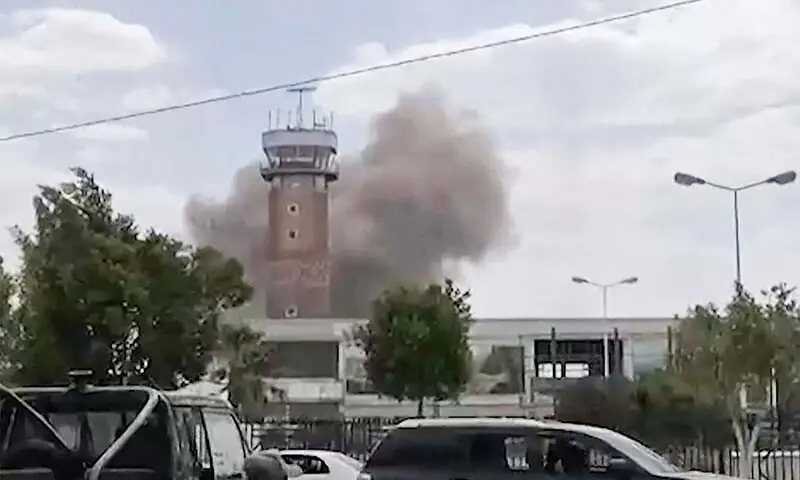
Yemen government claims strike on Sanaa airport as Houthis attack Saudi Arabia. — Source: dawn
Iran’s Revolutionary Guards said afterwards that the Strait, a key global shipping route that has been largely restricted since the start of the Middle East conflict, would be closed “until further notice and until the end of American interventions in this region”. [4] The statement was referring to Iran’s attack Sunday on a commercial vessel in the Strait of Hormuz, which caught fire and its crew were forced to abandon ship. [4] Trump also said the US would take control of Strait of Hormuz, and that it should be “reimbursed for that”. [4] Trump reimposed a US naval blockade on Iranian ports on Monday and vowed hefty fees for ships transiting the Strait of Hormuz. [5] Iran's military responded Monday saying it would not allow the US to "interfere" in the management of the Strait. [4] In a video message, a spokesperson of Khatam Al-Anbiya military command warned Gulf countries that any cooperation with the US would be considered "an act of war". [4] US President Donald Trump on Monday said that the US would take out Pickaxe Mountain in Iran, warning that Washington would continue to hit the country hard this evening and Tuesday. [5]
Hardline Shift in Iranian Policy
As renewed fighting pushes Iran and the United States away from diplomacy and back toward full-scale confrontation, influential hardline voices in Tehran are openly arguing that political assassination and a more aggressive foreign policy are both justified and necessary. [1] Iran's top negotiator, Mohammad Baqer Qalibaf, struck a similar tone. [4] "The era of one-sided deals is OVER,” he posted on social media on Sunday. [4] “We told you: keep your word or pay the price. Reality is knocking." [4]
Yemen Flare-up Involving Houthis and Saudi Arabia

US and Iranian forces exchange direct strikes on military targets in the Strait of Hormuz region. — Source: thenewarab
Yemen’s Houthis targeted Saudi Arabia on Monday, hours after the rebels accused the kingdom of attacking Sanaa airport — the biggest flare-up in years between the two sides that threatens to upend a frozen conflict. [2] The Saudi-backed Yemeni government claimed responsibility for the attack on the Houthi-held airport, saying it wanted to prevent an Iranian plane from landing. [2] It came after they failed to convince a Houthi delegation that went to Tehran for the late Iranian supreme leader Ali Khamenei’s funeral to board a flight on domestic carrier Yemenia instead. [2] Yemen’s defence ministry accused the Houthis of “allowing an Iranian plane to violate Yemeni territory; consequently, the airport runway was targeted” in Sanaa. [2] “Air defences dealt with a ballistic missile threat launched by the terrorist Houthi militia towards the southern region,” coalition spokesman Turki al-Maliki said in a social media post. [2] Earlier, Houthi military spokesman Yahya Saree accused Saudi Arabia of “ending the de-escalation phase” and warned that “this aggression will not go unanswered or unpunished”. [2] The latest escalation threatens to unravel a truce that has been holding since 2022 despite expiring, and comes at a time of heightened tensions as the United States and Iran trade attacks impacting the Gulf and traffic in the Strait of Hormuz. [2] Iran condemned the attack on the airport, with foreign ministry spokesperson Esmaeil Baghaei describing it “as a clear violation of international law,” state news agency IRNA reported. [2] Following the strikes, the head of Yemen’s Presidential Leadership Council, Rashad al-Alimi, said he had “ordered that the scope of the confrontation not be expanded”. [2] Mohammed al-Basha of the US-based risk advisory Basha Report told AFP there was a risk of the 2022 ceasefire failing. [2] “If this cycle of action and retaliation continues, it could effectively mark the collapse of the April 2022 ceasefire framework and signal a return to a much more intense phase of the conflict,” he said. [2]
International Condemnations and Diplomatic Responses
Egypt and Saudi Arabia have condemned repeated Iranian attacks targeting Kuwait, Bahrain, Oman, and Jordan, warning that the strikes constitute a blatant violation of state sovereignty and a direct threat to regional security and stability. [3] In an official statement, the Egyptian Ministry of Foreign Affairs expressed full solidarity with the four targeted nations, rejecting any practices that endanger Arab populations or their regional facilities. [3] The ministry demanded an immediate end to the attacks, urging respect for international law and the principles of good neighbourliness to spare the region further escalation. [3] The condemnation was also a focal point during a phone call between Egyptian Minister of Foreign Affairs Badr Abdelatty and Saudi Foreign Minister Prince Faisal bin Farhan. [3] Reviewing the regional escalation, the two officials stressed the critical need for an immediate halt to all escalatory actions that could widen the circle of conflict. [3] During the talks, Abdelatty and Prince Faisal agreed on the necessity of safeguarding freedom of navigation in the Strait of Hormuz in accordance with international law. [3] They affirmed the need to ensure the unhindered movement of ships and rejected any attempts to impose restrictions on international waterways, warning of the negative repercussions for the global economy and energy security. [3] "We condemn Iran' heinous attacks on merchant shipping in the Strait of Hormuz and on countries in the region, including Qatar, Kuwait, Oman and Jordan," the three countries, known as the E-3, said in a joint statement. [4] The E-3 called “the resumption of the ceasefire” negotiated in early April and negotiations aimed at ending the conflict to resume. [4]
Status of Ceasefire and Future Outlook
The future of the interim agreement between Iran and the US now appears uncertain. [4] US President Donald Trump said Monday he considers the ceasefire to be over, while leaving the door open to further talks. [4] "We had a deal. It was a done deal, and then they broke it. They always break it,” he said in a telephone interview on Fox News' ‘Fox & Friends’ programme. [4] “So we're just going to hit them very hard.” [4] Iran's top negotiator, Mohammad Baqer Qalibaf, struck a similar tone. [4] "The era of one-sided deals is OVER,” he posted on social media on Sunday. [4] “We told you: keep your word or pay the price. Reality is knocking." [4]
What to watch next: The next move of the plane, which the rebels said had landed, will likely determine how things will go in Yemen, while both sides assess whether they are prepared to move back toward sustained military escalation.