
Intense Heatwave Engulfs Southern Australia, Triggering Severe Warnings Across Four States
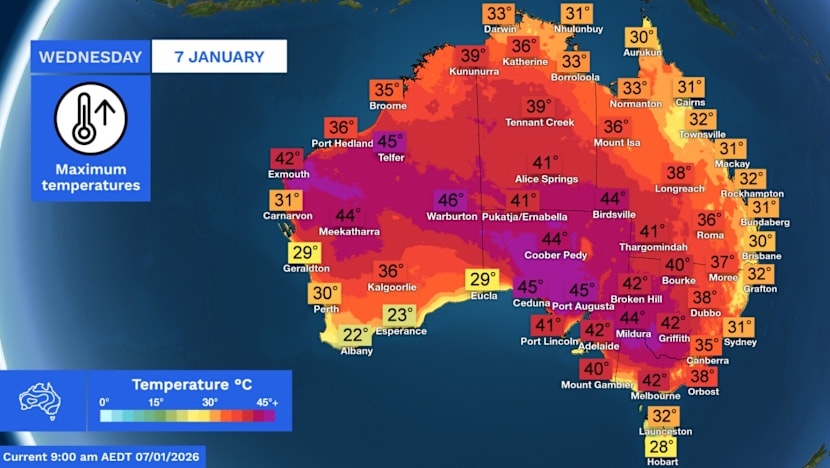
Sydney/Melbourne, January 7, 2026 – An intense heatwave has swept across southern Australia, with temperatures soaring beyond 40°C in major cities like Melbourne and Adelaide, prompting the Bureau of Meteorology (BOM) to issue severe and extreme heat warnings for New South Wales, Victoria, South Australia, and Tasmania.
The heatwave, which began early Wednesday, has gripped the region during the peak of Australia's summer season, exacerbating risks to public health, infrastructure, and the environment. BOM forecasters reported maximum temperatures exceeding 40°C in parts of Victoria and South Australia, with Melbourne and Adelaide among the hardest hit urban centers. The warnings indicate conditions that could lead to heat-related illnesses, power strains, and heightened fire dangers, urging residents to take precautions such as staying hydrated, avoiding strenuous outdoor activities, and checking on vulnerable populations.
In Victoria, Melbourne's forecast highs pushed past 40°C, marking one of the hottest starts to the year in recent memory. Adelaide, in South Australia, similarly baked under extreme heat, with the BOM classifying the event as "severe" in large areas, escalating to "extreme" in isolated pockets. New South Wales, particularly its southern regions, and the island state of Tasmania also fell under the alerts, as a high-pressure system trapped hot air over the continent.
Widespread Impacts and Response Measures
Authorities across the affected states have mobilized responses to mitigate the heatwave's effects. In Victoria, the State Control Centre activated its heat health alert system, advising people to limit time outdoors between 11 a.m. and 3 p.m. South Australia's health department echoed similar guidance, emphasizing cooling centers for the elderly and those without air conditioning. Power grids, already tested by summer demand, are under close monitoring to prevent blackouts, a recurring issue in past heat events.
The BOM's warnings categorize heat severity based on temperature, humidity, and duration, with "severe" thresholds often exceeding 36-38°C combined with high overnight minimums, and "extreme" reserved for outlier conditions above 40°C persisting over multiple days. This event aligns with those criteria, as overnight temperatures are expected to remain in the mid-20s°C, offering little respite.
Fire agencies have raised concerns over elevated bushfire risks, given the dry antecedent conditions following a La Niña-influenced wetter-than-average 2025. While no major fires were reported as of Wednesday afternoon, total fire ban declarations were in place across parts of Victoria and South Australia, prohibiting outdoor activities like barbecues.
Historical Context and Climate Patterns
Australia's southern states have a long history of extreme heat events, often linked to the Indian Ocean Dipole and prolonged blocking high-pressure systems. The infamous 2019-2020 Black Summer bushfires were preceded by similar heatwaves, with Adelaide recording 46.6°C and Melbourne 46.4°C on single days. More recently, the 2023-2024 summer saw record-breaking heat across the southeast, contributing to over 100 heat-related deaths nationwide, according to government data.
Climate records show that heatwaves have intensified in frequency and severity since the 1950s, with the BOM attributing much of this trend to human-induced climate change. Australia's land surface has warmed by about 1.51°C since 1910, roughly 60% faster than the global average, amplifying summer extremes. This current event occurs amid a shift back to El Niño-like patterns in late 2025, which typically bring hotter, drier conditions to the southeast.
The heatwave also coincides with broader severe weather patterns in Australia. Earlier in the week, northern Queensland dealt with tropical cyclone remnants, while Western Australia faced damaging winds. These events underscore the continent's vulnerability to compound weather hazards.
Outlook and Precautions
Forecasters predict the heatwave will peak mid-week before easing slightly over the weekend as a southerly change brings cooler air. However, temperatures are unlikely to drop below average levels, with follow-up warnings possible. BOM Director Robert Vertessy noted in recent updates that such events are becoming "the new normal," calling for enhanced urban planning like green spaces and heat-resilient infrastructure.
Health experts from the Australian Institute of Health and Welfare recommend vulnerable groups— including the elderly, children, and outdoor workers—monitor for symptoms of heat stress such as dizziness and rapid heartbeat. Emergency services report a spike in calls related to heat exhaustion already.
As Australia navigates this heatwave, it serves as a stark reminder of the growing challenges posed by extreme weather. Residents are advised to stay informed via BOM apps and local alerts, ensuring community resilience in the face of intensifying climate pressures.
(Word count: 612)