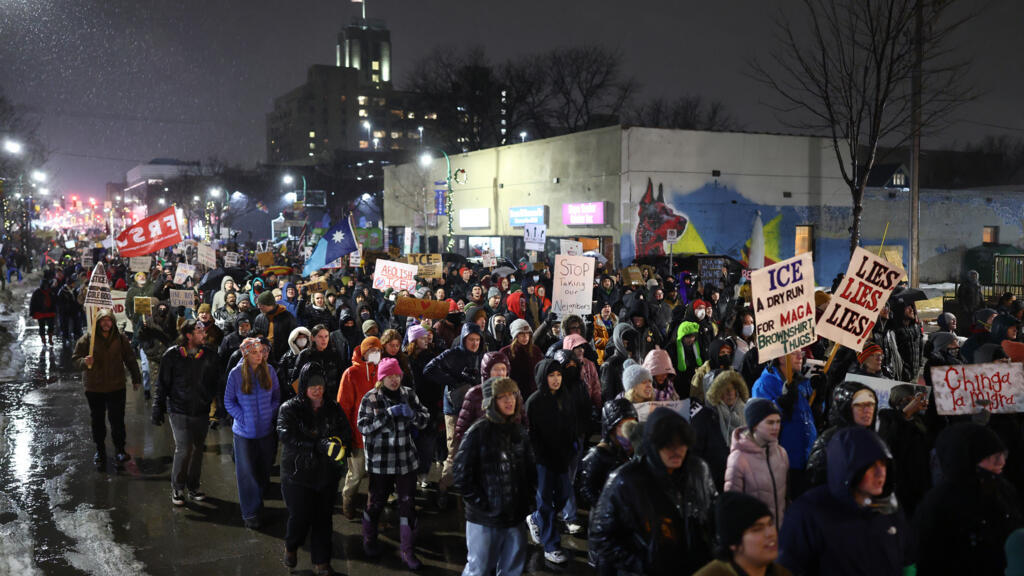

Immigration Agent's Fatal Shooting of Woman Shocks Minneapolis, Echoes City's Tense History with Law Enforcement
Minneapolis, Minnesota – A U.S. immigration agent fatally shot Renee Nicole Good on a snow-lined street in Minneapolis on Wednesday, January 7, 2026, leaving the community reeling and prompting Minnesota Governor Tim Walz to call for calm amid an ongoing investigation. The incident, which unfolded less than a mile from the site of George Floyd's 2020 killing by police, has reignited discussions about law enforcement accountability in the city.
The shooting occurred around 5:14 p.m. GMT (11:14 a.m. local time) in a residential area of Minneapolis, according to initial reports. Good, whose full background details remain under review by authorities, was gunned down by an agent from U.S. Immigration and Customs Enforcement (ICE), a federal agency under the Department of Homeland Security responsible for immigration enforcement and border security. Eyewitness accounts described a chaotic scene on a wintery street blanketed in snow, with emergency responders arriving swiftly to the site.
Governor Walz, a Democrat who has navigated Minnesota through multiple high-profile policing crises, responded promptly to the event. In a statement urging restraint, he emphasized the need for a thorough investigation while acknowledging community anxieties. "We must allow officials to investigate the situation fully," Walz said, as reported in early coverage. His comments reflect a broader effort to prevent escalation, given Minneapolis's history of protests following police-involved deaths.
Details of the confrontation remain limited as federal and local authorities probe the circumstances. ICE has not yet released an official statement on the agent's identity, the rationale for the shooting, or Good's immigration status, adhering to standard protocols in active investigations. The Federal Bureau of Investigation (FBI) is reportedly assisting, given the involvement of a federal officer. Local police have cordoned off the area, and forensic teams are examining evidence from the scene.
Historical Context in Minneapolis
The location of the shooting carries heavy symbolic weight. It lies less than a mile from the street corner where George Floyd, a Black man, was killed on May 25, 2020, by Minneapolis police officer Derek Chauvin. Floyd's death, captured on video showing Chauvin kneeling on his neck for over nine minutes, sparked global Black Lives Matter protests, led to Chauvin's conviction for murder, and prompted sweeping police reforms in Minnesota, including the prohibition of chokeholds and warrior-style training.
Minneapolis has since seen ongoing tensions over policing. The city disbanded its police department's oversight unit in 2023 amid reform efforts, and federal monitoring continues under a 2023 consent decree. ICE operations, often controversial due to their focus on deportations, have occasionally intersected with local dynamics. In 2019, ICE raids in Minnesota drew protests from immigrant advocacy groups, and the agency has faced lawsuits over use-of-force incidents nationwide.
This shooting marks a rare instance of direct ICE involvement in a fatal civilian encounter within U.S. cities, distinct from border-related operations. ICE data from prior years shows agents are trained in deadly force protocols similar to other federal law enforcement, but public incidents like this are infrequent. The last high-profile ICE shooting in a major city occurred in 2018 in Nashville, where an agent killed a suspect during an arrest.
Community Reaction and Broader Implications
Residents expressed shock and grief in initial interviews. "It's too close to home, literally," one local told reporters, referencing the proximity to Floyd's memorial site, now a garden and gathering spot maintained by community activists. Advocacy groups like the Minnesota Immigrant Rights Action Committee called for transparency, demanding body camera footage if available and an independent review.
The incident unfolds against a national backdrop of polarized immigration debates. Under the incoming Trump administration, set to take office in January 2025 following the 2024 election, ICE is expected to ramp up enforcement, with promises of mass deportations. This could heighten scrutiny on agent conduct. President Joe Biden's administration has emphasized "smart" immigration enforcement, prioritizing threats over families, though critics argue it still leads to overreach.
As of Friday, January 9, 2026, no arrests have been made, and the agent involved has been placed on administrative leave, per standard procedure. The Hennepin County Medical Examiner's Office is conducting an autopsy, with preliminary findings expected soon.
Outlook
Investigators anticipate releasing more details within days, potentially including 911 calls, witness statements, and video evidence. Governor Walz's office has coordinated with federal partners to ensure a "fair and swift" process. Community leaders, meanwhile, plan vigils for Good, underscoring Minneapolis's fragile trust in law enforcement.
This event tests the city's progress on reforms while highlighting federal-local tensions in immigration policing. As the probe continues, it serves as a stark reminder of the human cost in America's ongoing debates over security and civil rights.
(Word count: 682)






