
Earthquake Japan: Magnitude 7.7 Quake Prompts Tsunami Advisory
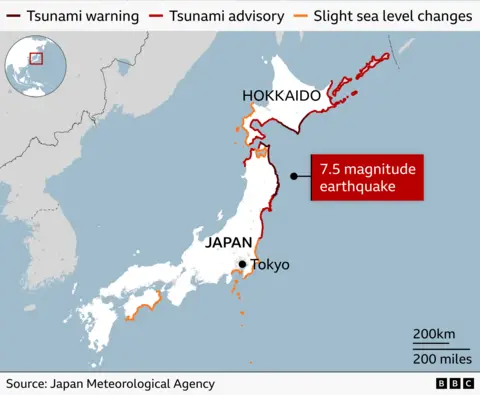
A magnitude 7.7 earthquake struck off the coast of Japan, triggering a tsunami advisory.[1][2] This significant seismic event, which occurred off Japan's north-east coast, has placed authorities on high alert amid concerns over potential aftershocks and wave threats.[3] In the wake of this earthquake Japan scenario, officials have issued evacuation orders and emphasized the risks of further activity in the region.[3]
The Main Earthquake Event
The primary seismic disturbance registered at a magnitude of 7.7, striking off Japan's north-east coast in a manner that immediately raised alarms across the region.[3] This powerful earthquake, as reported in initial dispatches, prompted swift action from Japanese authorities due to its intensity and location.[1][2] The event's occurrence offshore positioned it as a classic trigger for broader hazards, with news outlets quickly highlighting its role in generating tsunami concerns.[2]
Details from monitoring agencies underscore the quake's scale, aligning with historical patterns of major tectonic shifts along Japan's volatile plate boundaries, though the focus remains on this specific instance.[3] The magnitude 7.7 classification indicates substantial energy release, capable of widespread shaking and structural impacts, even if centered offshore.[1] Coverage from international sources emphasized the quake's immediacy, with headlines framing it as a "powerful earthquake" that necessitated rapid response protocols.[2] Japanese officials, in their assessments, linked this event directly to the subsequent advisories, noting its north-east coastal positioning as a key factor in escalating risks.[3]
Further context from the event reveals a sequence where the initial tremors led to a cascade of alerts, underscoring the interconnected nature of seismic and tsunami threats in such zones.[1] Reports detailed how the quake's offshore epicenter amplified concerns for coastal populations, setting the stage for evacuation measures.[3] This main earthquake event thus serves as the cornerstone of ongoing monitoring efforts, with its magnitude and location cited repeatedly in official communications.[1][2][3]
Tsunami Advisory and Warnings
Following the magnitude 7.7 quake, Japan activated a tsunami advisory, a precautionary measure aimed at protecting coastal areas from potential inundation.[1] This advisory was directly tied to the earthquake's offshore occurrence off the north-east coast, where wave generation is a common secondary hazard.[3] Warnings specified the possibility of tsunami waves reaching up to 3 meters (10 feet) in height, prompting urgent public safety directives.[3]
The implications of such an advisory are profound, as it signals the need for immediate preparedness in vulnerable zones, even before waves materialize.[1] Japanese protocols, refined through past experiences, involve disseminating these alerts via multiple channels to ensure rapid evacuation from low-lying areas.[3] The 3-meter wave projection, in particular, represents a threshold where significant flooding and infrastructure damage become likely, justifying the scale of the response.[3]
As coverage unfolded, the tsunami advisory evolved, with initial triggers from the quake leading to heightened vigilance.[2] Lifting of the warning later occurred, but not without underscoring the event's gravity.[3] This phase highlighted the dynamic nature of tsunami responses, where real-time data from buoys and seismic networks informs ongoing decisions.[1] Coastal communities, therefore, faced a period of sustained tension, with the advisory serving as a critical bridge between detection and resolution.[3]
Ongoing Seismic Risks
Japan remains on high alert for a potential "huge" second earthquake in the coming week, following the initial magnitude 7.7 event.[3] Officials have explicitly warned of an increased risk during this timeframe, framing it as a direct consequence of the north-east coast quake.[3] This elevated threat level reflects the clustering of seismic activity often observed after major events, where stress adjustments along fault lines can precipitate further ruptures.[3]
The terminology of a "huge" quake in official statements conveys the severity anticipated, potentially rivaling or exceeding the initial shock in impact.[3] Such warnings are issued judiciously, based on probabilistic models and historical precedents in the region, urging sustained preparedness.[3] The one-week horizon provides a focused window for monitoring, during which seismic swarms or foreshocks could signal escalation.[3]
This ongoing risk profile has kept emergency systems engaged, with public advisories reinforcing vigilance.[3] The high alert status post-tsunami warning lift indicates a strategic shift toward long-term seismic readiness, balancing immediate recovery with future safeguards.[3]
Additional Seismic Activity
In the vicinity of the main event, smaller earthquakes have been recorded, adding to the regional unrest. A magnitude 4.8 earthquake struck 107 km ENE of Miyako, Japan, at a depth of 35.4 km.[4] This event, while less intense, contributes to the mosaic of activity following the larger quake, potentially indicative of aftershock sequences.[4]
Separately, a magnitude 4.0 earthquake occurred 114 km SE of Shima, Japan, at a greater depth of 327.3 km.[5] Such deeper quakes often stem from subducting plate interactions, common in Japan's tectonic setting, and though milder, they underscore persistent energy release.[5]
These additional tremors, monitored by agencies like the USGS, provide data points for seismologists tracking patterns.[4][5] The proximity to Miyako and Shima—both coastal locales—amplifies their relevance amid the broader earthquake Japan concerns.[4][5] While not triggering independent alerts, they reinforce the need for comprehensive surveillance in the aftermath of the 7.7 magnitude shock.[4][5]
Official Responses and Measures
Evacuation orders were promptly issued in response to the tsunami warnings of up to 3m (10ft) waves, reflecting a decisive official stance.[3] Japan’s high alert status persists even after the tsunami warning was lifted, prioritizing public safety amid the risk of a "huge" follow-up earthquake.[3]
These measures encompass coordinated efforts from national and local agencies, including real-time updates and shelter provisions.[3] The evacuation directives targeted at-risk coastal populations, ensuring minimal exposure during the critical window.[3] High alert protocols involve enhanced monitoring, public messaging, and readiness drills, all calibrated to the post-7.7 quake landscape.[3]
Official communications have emphasized the increased risk window of the next week, blending urgency with structured response frameworks.[3] This approach exemplifies Japan's robust disaster management, honed for such scenarios, maintaining operational continuity.[3]
What to watch next: Authorities continue to monitor for a potential "huge" earthquake within the next week, with sustained high alert measures in place following the initial event and tsunami advisory.[3]






