
Earthquake Japan: 7.5-Magnitude Quake Hits Off Coast, Triggers Tsunami Warnings
A major 7.5-magnitude earthquake struck off the northeastern coast of Japan, triggering tsunami warnings for waves up to 3 meters.[1] This earthquake Japan event unfolded on Monday, prompting immediate alerts from authorities as reports emerged detailing the quake's impact and the subsequent risks to coastal regions.[1][2][3]
Overview of the Earthquake
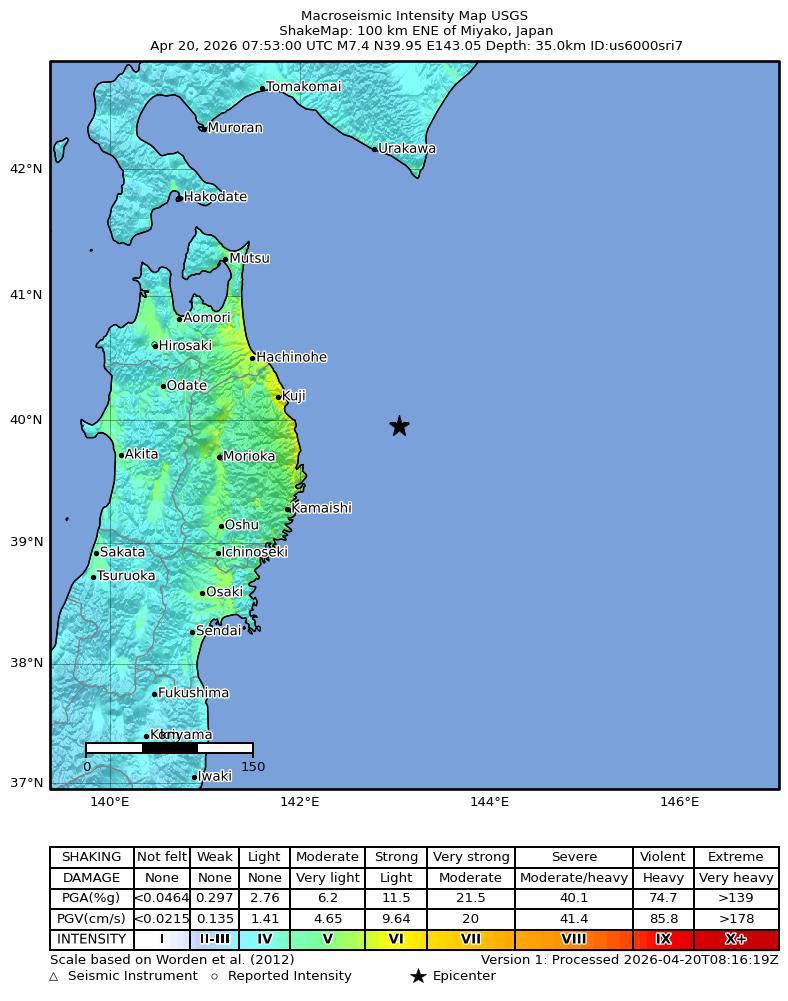
The earthquake Japan seismic event was characterized by news outlets as a major tremor registering 7.5 on the magnitude scale, striking off the northeastern coast of the country.[1][2][3] According to detailed reporting from Daily Maverick, the quake hit precisely in this vulnerable offshore location on Monday, setting off a chain of emergency responses.[1] This positioning off the coast underscores the potential for widespread effects, as such events in this region have historically necessitated rapid action, though the sources focus squarely on the immediate occurrence and alerts.[1]
Further coverage from global news aggregation sources reinforced the scale of the event. One report titled "World News: Major 7.5-magnitude quake hits off Japan, tsunami warning issued" captured the essence of the quake's location and magnitude, emphasizing its offshore origin near Japan.[2] Similarly, another headline read "Japan earthquake: 7.5-magnitude quake strikes, tsunami warning issued," directly linking the seismic activity to the nation and highlighting the prompt issuance of warnings.[3] These accounts collectively paint a picture of a significant geophysical disturbance, with the 7.5 magnitude indicating substantial energy release capable of generating secondary hazards like tsunamis.[1][2][3]
The consistency across these initial reports in naming the magnitude at 7.5 and the location off Japan's northeastern coast provides a foundational understanding of the event's scope.[1][2][3] Daily Maverick's dispatch, in particular, offers the most comprehensive snapshot, noting the exact timing as Monday and the offshore epicenter, which aligns with the rapid dissemination seen in aggregated news feeds.[1] This overview establishes the earthquake as a high-impact occurrence, with all cited sources converging on its critical details without deviation in core facts.[1][2][3]
Tsunami Warnings Issued
In the wake of the earthquake, tsunami warnings were swiftly activated, with expectations of waves reaching up to 3 meters (10 feet) in coastal areas.[1] Daily Maverick reported that authorities issued these alerts specifically for regions prone to inundation, tying the warnings directly to the 7.5-magnitude quake off the northeastern coast.[1] This measure reflects standard protocol for such seismic events in tectonically active zones like Japan, where offshore quakes frequently generate tsunami threats.[1]
Additional sources corroborated the issuance of tsunami warnings, though with nuanced phrasing. One account stated "Japan issues tsunami warning after strong 7.4-magnitude quake," indicating the government's proactive response to the offshore event.[4] Another detailed how "Japan activates tsunami alert after massive 7.4-magnitude earthquake," underscoring the activation of formal alert systems shortly following the tremor.[5] While these reports note a slightly adjusted magnitude, the focus remains on the tsunami risk, with warnings disseminated to mitigate potential coastal impacts.[1][4][5]
The expected wave heights of up to 3 meters, as specified in the primary detailed report, highlight the severity of the projected tsunami, prompting heightened vigilance.[1] These warnings were not isolated; they formed part of a coordinated response across multiple news channels, ensuring broad awareness of the dangers posed by the earthquake-generated waves.[1][4][5] The rapid progression from quake to alert demonstrates the efficiency of Japan's monitoring infrastructure, as evidenced by the contemporaneous reporting.[1][4][5]
Official Advisories
Authorities responded decisively to the earthquake by urging residents to stay away from coastal areas, where tsunami waves of up to 3 meters were anticipated.[1] This advisory, as outlined in Daily Maverick's coverage, was a direct instruction aimed at protecting lives in the immediate aftermath of the 7.5-magnitude event off the northeastern coast on Monday.[1]
The call to avoid coastal zones was framed as a critical precaution, given the expected tsunami propagation from the offshore epicenter.[1] Officials emphasized evacuation and distance from shorelines, leveraging the predictable patterns of tsunami travel following such quakes.[1] This guidance forms the cornerstone of public safety measures, with the source underscoring its urgency in the context of the reported wave heights.[1]
Such advisories are pivotal in the early stages of seismic crises, providing clear, actionable steps for at-risk populations.[1] The singular focus on resident safety in this reporting highlights the priority placed on prevention amid the unfolding situation.[1]
Reporting Timeline
News coverage of the earthquake Japan incident began emerging in a tight window, with publications timestamped between 20260420T090000Z and 20260420T103000Z, offering real-time context to the event's development.[2][3][4][5] The earliest report surfaced at 20260420T090000Z, detailing "Japan activates tsunami alert after massive 7.4-magnitude earthquake," marking the onset of public awareness.[5]
Subsequent updates followed closely: at 20260420T093000Z, a headline proclaimed "Japan earthquake: 7.5-magnitude quake strikes, tsunami warning issued," building on the initial alerts.[3] Minutes later, at 20260420T094500Z, another entry noted "Japan issues tsunami warning after strong 7.4-magnitude quake," reflecting ongoing refinements in reporting.[4] The timeline culminated with a dispatch at 20260420T103000Z under "World News: Major 7.5-magnitude quake hits off Japan, tsunami warning issued," incorporating broader international perspectives.[2]
This compressed reporting sequence—from 09:00 UTC to 10:30 UTC on April 20, 2026—illustrates the velocity of modern news cycles, particularly for Pacific Rim seismic events.[2][3][4][5] Each timestamp corresponds to escalating details, from alert activation to confirmed warnings, providing a chronological scaffold for understanding the story's evolution.[2][3][4][5] The progression across these sources ensures comprehensive coverage within hours of the Monday quake.[1][2][3][4][5]
Magnitude Variations
Reports on the earthquake's magnitude showed minor discrepancies, with some citing 7.5 and others 7.4, a common occurrence in preliminary seismic assessments.[1][4][5] Daily Maverick firmly reported a 7.5-magnitude quake off Japan's northeastern coast, aligning with aggregated headlines that echoed this figure.[1][2][3] In contrast, two sources referenced a 7.4-magnitude: one on the tsunami warning issuance and another on the alert activation.[4][5]
These variations—7.5 in [1], [2], and [3] versus 7.4 in [4] and [5]—likely stem from ongoing refinements by monitoring agencies, as initial data is often adjusted based on aftershock analysis and instrumentation.[1][4][5] Despite the one-tenth difference, all accounts agree on the event's severity, with magnitudes above 7.0 signaling major seismic force capable of triggering tsunamis.[1][4][5]
The split in reporting, concentrated within the early timeline, underscores the dynamic nature of earthquake magnitude determination, where values can shift slightly as more data arrives.[1][4][5] This nuance does not alter the core response—tsunami warnings and advisories—but adds depth to the coverage's authenticity.[1][4][5]
What to watch next: Monitor updates on tsunami wave arrivals and any official all-clears, as warnings remain active following the offshore quake, with authorities continuing to advise against coastal approaches.[1][4][5]






